






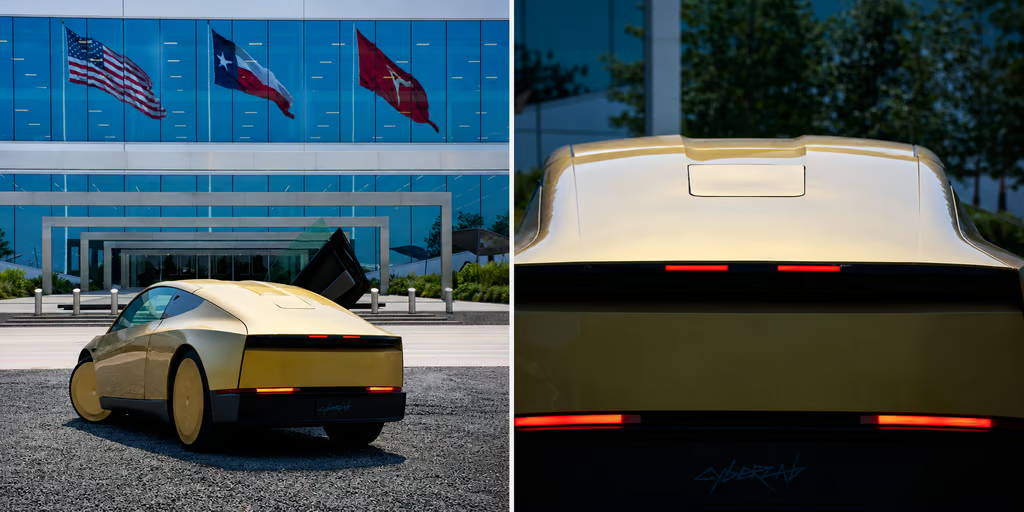


Tesla showed its first Cybercab with integrated Starlink hardware on Aug. 10, placing SpaceX’s satellite-internet terminal directly into the robotaxi’s roof. The installation gives Tesla another communications option when cellular service drops.
Tesla Vice President of AI Software Ashok Elluswamy has said Starlink is not required for safe vehicle operation and is intended mainly for navigation, customer service, and fleet management. CEO Elon Musk has separately said satellite coverage could prevent robotaxis from losing connectivity in cellular dead zones. Tesla has not released real-world performance data for the system.
Tesla had already disclosed the Starlink integration on July 20, showing a V5 terminal alongside GPS and 5G/LTE connectivity in Cybercab.
The terminal has a peak hardware download capability of more than 375 Mbps, according to Starlink’s V5 specifications. Starlink separately limits in-motion service to approved hardware and service plans. Tesla and SpaceX have not publicly detailed how Cybercab’s V5 implementation is configured for operation while the vehicle is moving.
Starlink fills gaps in cellular coverage
During Tesla’s July 22 earnings call, Musk said Starlink could help keep robotaxis connected through cellular dead zones as the service expands. He pointed to poor or nonexistent cellular coverage in some areas and said Tesla cannot have robotaxis become unreachable when their cellular connection disappears.
Tesla began testing a production Cybercab without a steering wheel or pedals on public roads in Austin in July. Starlink supports connectivity rather than the onboard system responsible for autonomous driving.
Tesla’s July hardware disclosure showed 5G/LTE alongside Starlink, but the company has not detailed how the connections switch between networks or how Cybercab handles a complete communications outage. Pairing terrestrial and satellite connectivity gives Tesla two physically separate network paths, reducing dependence on a single coverage layer. Whether Cybercab delivers that redundancy in practice will depend on Tesla’s undisclosed failover design.
Musk has also pitched passenger broadband as a benefit. Following the Aug. 10 Cybercab reveal, he said riders could use Starlink for live sports, movies, gaming, or work while traveling.
Real-world performance remains unknown
Tesla has not published pricing, real-world uptime or latency results, throughput while moving, or details about switching between cellular and satellite connections. Those figures will help determine how useful Starlink is as Cybercab moves from testing into passenger service.
Cybercab is also entering a market where robotaxi regulation remains unsettled, particularly around vehicle design, commercial deployment, and government oversight. Tesla is not alone in building vehicles specifically for autonomous service; Amazon-owned Zoox has developed a purpose-built robotaxi without traditional controls.
Musk has said the Starlink strategy could expand beyond Cybercab. During the July earnings call, he said the satellite service would eventually be integrated into Tesla vehicles in markets where Starlink operates.
The unanswered questions are operational: reliability in motion, network switching, and cost. Until Tesla publishes those metrics, Cybercab shows how satellite internet could fit into its robotaxi infrastructure, but not yet whether the system delivers dependable connectivity at fleet scale.
Read more: Starlink’s arrival in Cybercab is another example of how Musk’s Tesla, SpaceX, and AI businesses are converging across vehicles, communications, and autonomous systems.