






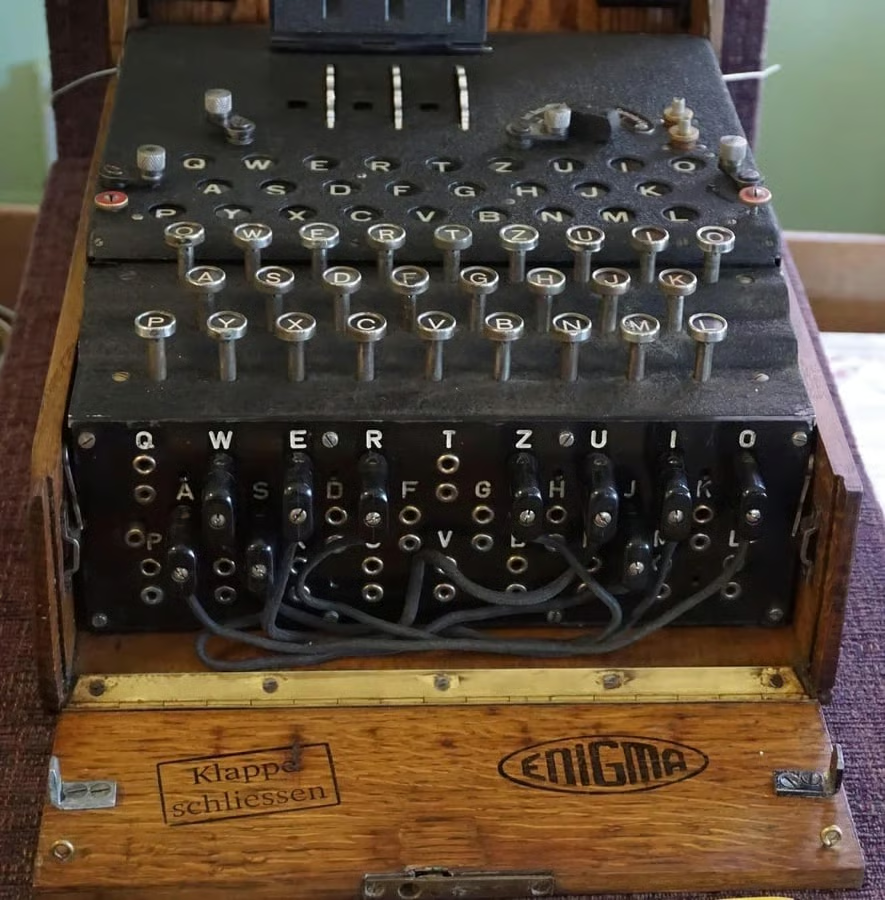


Artificial intelligence models like ChatGPT could crack the infamous Enigma code in minutes, experts say. This feat once demanded a global team of experts during World War II.
What is the Enigma code?
The Enigma code was a cipher that Nazi Germany extensively leveraged before and during World War II to hide military plans and orders from the Allies.
It was made possible by an electromechanical machine that randomly scrambled the alphabetical letters using three rotors. When one letter key of an Enigma machine was pressed, its corresponding code letter would light up. The device would always return a different letter, even if the same key were pressed twice.
In 1932, Polish mathematicians could decipher the Enigma code’s initial version using their electromechanical device called a “bombe.” However, Germany changed the key list daily to increase its security.
Many initially considered the code unbreakable — until a group of mathematicians and engineers, including the famous Alan Turing, figured out how to crack it. This breakthrough led to speedier code cracking, which gave the Allies information about key Nazi military actions, such as submarine movements. Breaking the Enigma Code may have helped the Allies win the war faster.
Some historians claim that the Enigma codebreaking was the single greatest Allied win, shortened the war, and possibly even changed its trajectory entirely.
Enigma code = no match for modern AI
It seems the Enigma code is no match for today’s AI models.
Michael Wooldridge, a computer science professor and an AI expert at the University of Oxford, told The Guardian: “Enigma wouldn’t stand up to modern computing and statistics.”
He said that it would be “straightforward” to use a modern AI model like ChatGPT to recreate the bombe’s logic, and modern computers and data would then complete the decryption in “very short order.”
“Enigma would not remotely be a match for these,” he said.
Mustafa A Mustafa, a senior lecturer in software security at the University of Manchester, said that while cracking the Enigma code today wouldn’t be nearly as impressive, that achievement needs to be considered within historical context.
“To be able to crack it – it took them months, more than a year – but to be able actually to do this within the lifetime of the war, it was a huge thing,” he said.
On our sister site TechRepublic, you can read more about Enigma and the secret story of the women who broke Hitler’s codes.