Shift's starting, Tech Insiders.
Robots are hustling on Siemens' floor while Google flirts with fresh chip partners and Meta tightens its belts to feed its AI habit. Clock in and follow the clang of gears to today's line-up. |
|
|
Here's what you need to know today: |
|
|
Siemens Puts Nvidia-Powered Humanoid on the Line |
Who needs coffee breaks when your new coworker is made of carbon fiber?
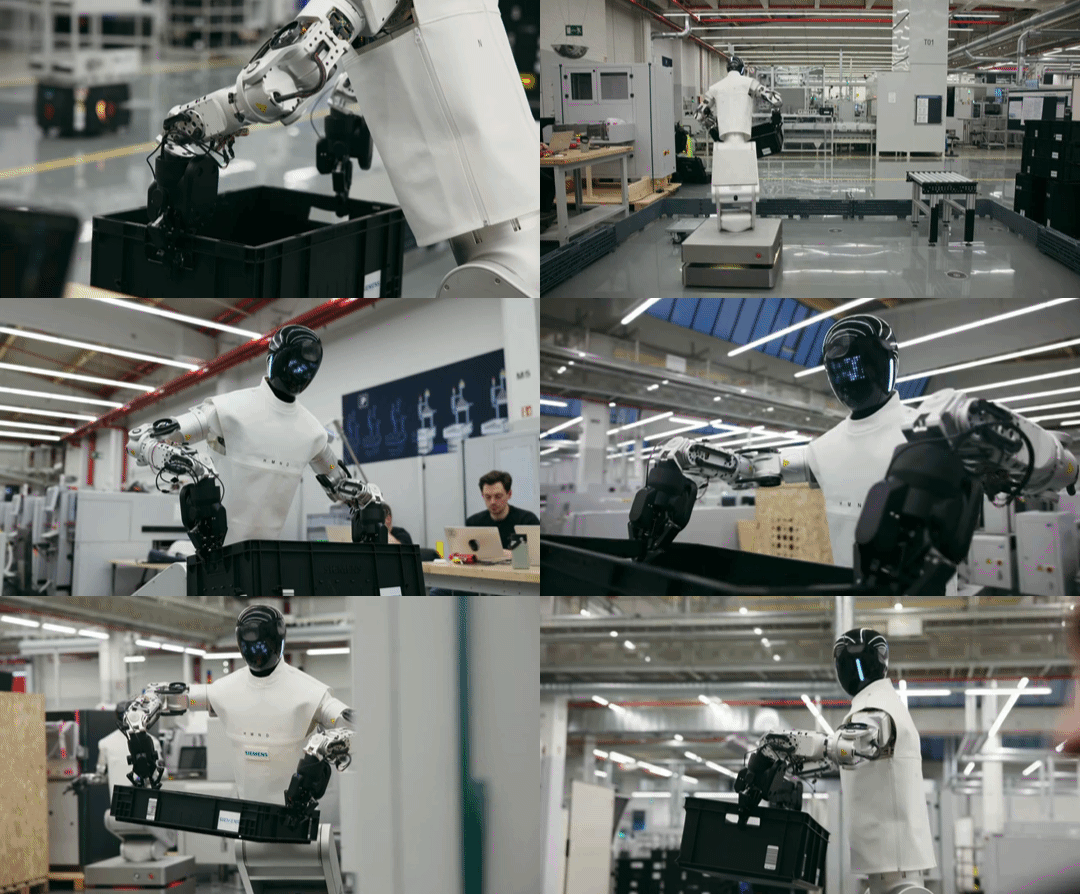
Yesterday at Hannover Messe, the massive industrial tech fair, Siemens revealed the results of a January trial at its Erlangen electronics plant with UK startup Humanoid's HMND 01 Alpha, a wheeled humanoid built on Nvidia's physical AI stack. The robot's mission: tote logistics.
It scooted containers to conveyor belts at a steady 60 moves per hour, stayed online for eight-plus hours, and nailed an autonomous pick-and-place success rate above 90%.
The performance wasn't the only flex. Siemens plugged the bot into its Xcelerator platform, its digital-twin and automation software ecosystem, for real-time coordination with production systems and human operators, turning an isolated robot into a team player in a live factory, not a lab.
|
On the silicon side, Nvidia's tech let Humanoid slash hardware development from the usual 18–24 months to just seven months.
Executives pitched the deployment as proof that factory-grade humanoids can handle the gritty, repetitive chores traditional automation stumbles on. With labor gaps widening, a template for drop-in humanoids could be catnip for manufacturers eyeing productivity boosts without ripping up existing lines.
Why it matters: If humanoids can reliably shoulder the dull, dirty tasks, factories get leaner workflows, and AI goes from powering chatbots to hoisting shipping totes. Sarah Connor can probably keep her day job... for now. |
|
|
Which job would you hand off to a factory bot first? |
|
|
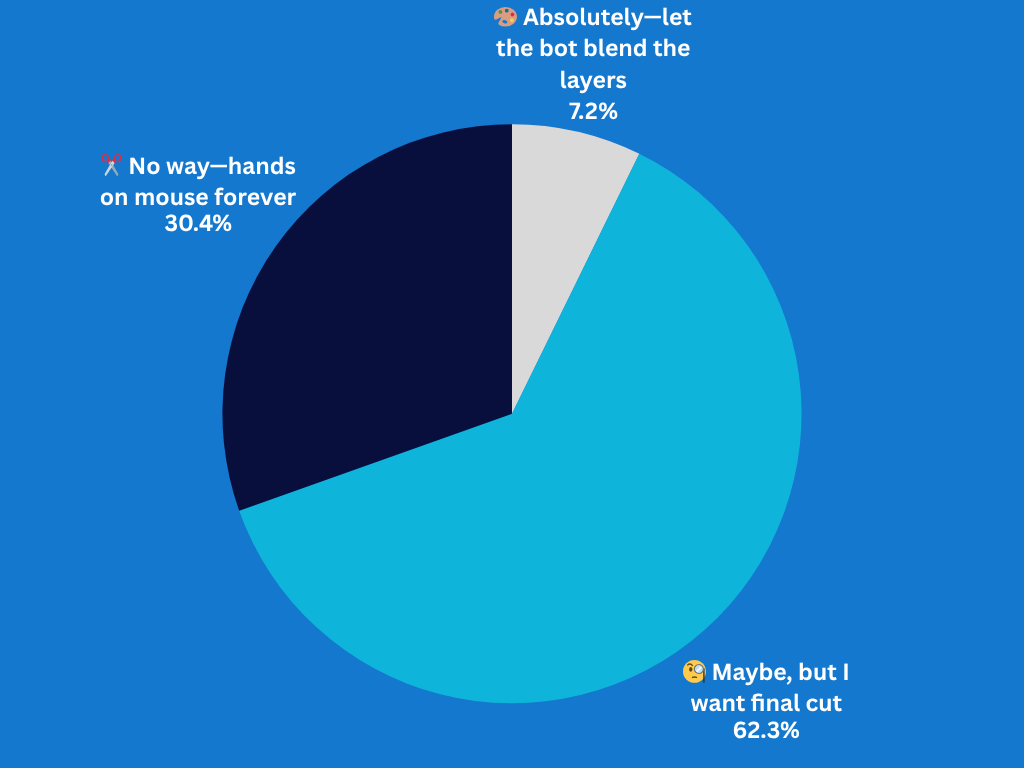
Results from Yesterday's Pulse Check |
Will you trust an AI agent to edit your next project? |
|
|
Google Eyes Marvell for Inference-Ready AI Chips |
Why court just one chipmaker when you can date the whole semiconductor prom?
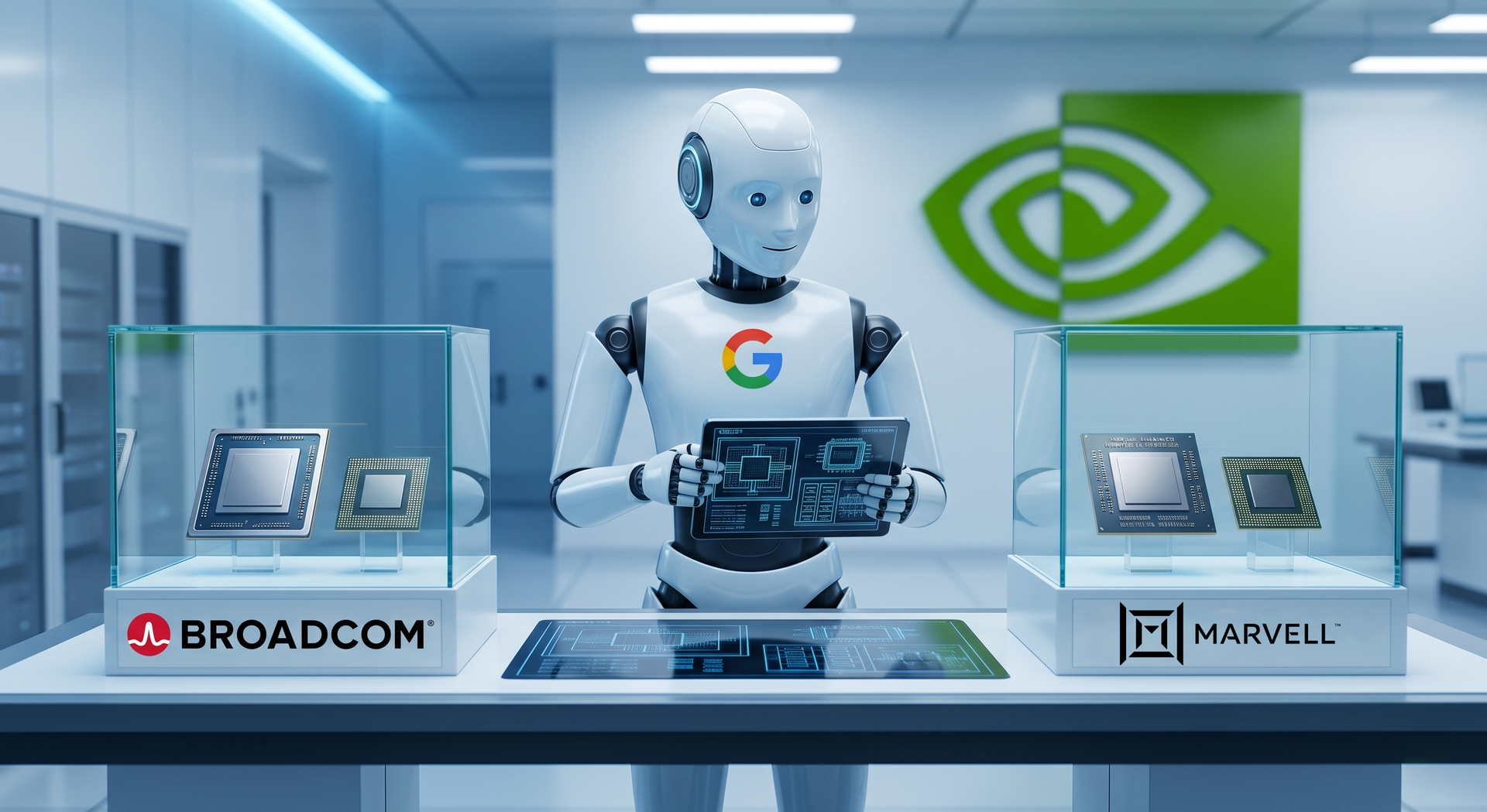
Ahead of its Cloud Next conference this Wednesday, Google is negotiating with Marvell Technology to codesign two fresh pieces of silicon: a memory processing unit that tags along with today's Tensor Processing Units—nearly two million of them—and a brand-new TPU tuned specifically for AI inference, the costly grind of answering every Gemini, Search, and YouTube query in real time.
Talks point to a finished design as early as 2027, with test production to follow.
The move widens Google's dance card beyond long-time partner Broadcom, cost-focused collaborator MediaTek, and new infrastructure partner Intel. By splitting work across a four-partner supply chain, Google lowers supply risk, keeps leverage against Nvidia's pricey training GPUs, and tailors chips to distinct workloads. |
Image created with Gemini |
Wall Street already likes the sound of it. Marvell shares popped almost 6% yesterday on the reports, adding over $7 billion in market value. Broadcom dipped slightly, even though the Google gravy train is plenty safe after recently locking in a TPU supply agreement through 2031.
Analysts say a Google win could vault Marvell to a solid No. 2 position in the booming custom-AI-accelerator market, which is forecast to grow 45% this year.
The ultimate irony? Google is trying to escape Nvidia's grip by tapping Marvell, a company Nvidia just pumped $2 billion into. Because nothing says spring cleaning like swapping in a new silicon roommate who still takes money from your arch-nemesis. |
|
|
Trade promotions should drive growth, but disconnected planning often leads to missed opportunities and inaccurate forecasts. On April 29, 2026, at 1:00 p.m. ET, Revenue Growth Management: It's hard but matters more than ever will explore how to align commercial and supply chain teams to deliver better outcomes.
Hosted by TechnologyAdvice with Anaplan, this session will provide a practical path to turning promotional strategy into measurable results. |
|
|
Defender Exploits Leave Windows Wide Open |
Three leaked Defender exploits—BlueHammer, RedSun, and UnDefend—are being weaponized by attackers so inept that they misspell their own command flags.
BlueHammer received an April patch, but as of press time, RedSun and UnDefend still slice through fully updated Windows hosts. They grant SYSTEM rights by hijacking Defender's file-rewrite routine or quietly blocking updates. |
Image created with ChatGPT |
Attackers are staging binaries in low-profile spots like a user's Pictures folder and dropping a reverse-tunneling agent dubbed "BeigeBurrow."
Since observed attacks began via compromised VPNs, enforce MFA immediately. Until Microsoft ships fixes, roll out the BlueHammer patch, monitor Defender logs, and hunt for odd executables. |
Android Trojans Snatch PINs
|
Four new Android banking-trojan families—RecruitRat, SaferRat, Astrinox, and Massiv—are hijacking Accessibility Services to drop deceptive overlays on 800+ banking, crypto, and social apps.
The malware captures lock-screen PINs, credentials, and 2FA codes, then streams your screen to attackers for real-time fraud. Victims are lured by fake job ads, "premium" streaming offers, or bogus Play Store updates that sideload a dropper. The trojans hide their icons, auto-grant permissions, and fight uninstall attempts.
To protect yourself, install only from Google Play, disable sideloading, audit Accessibility Services permissions, run a reputable mobile AV, and ignore frantic SMS links. If a "system update" screen freezes, it's not improving battery life; it's emptying your wallet. |
Meta Slashes 8,000 Jobs to Feed AI Hunger |
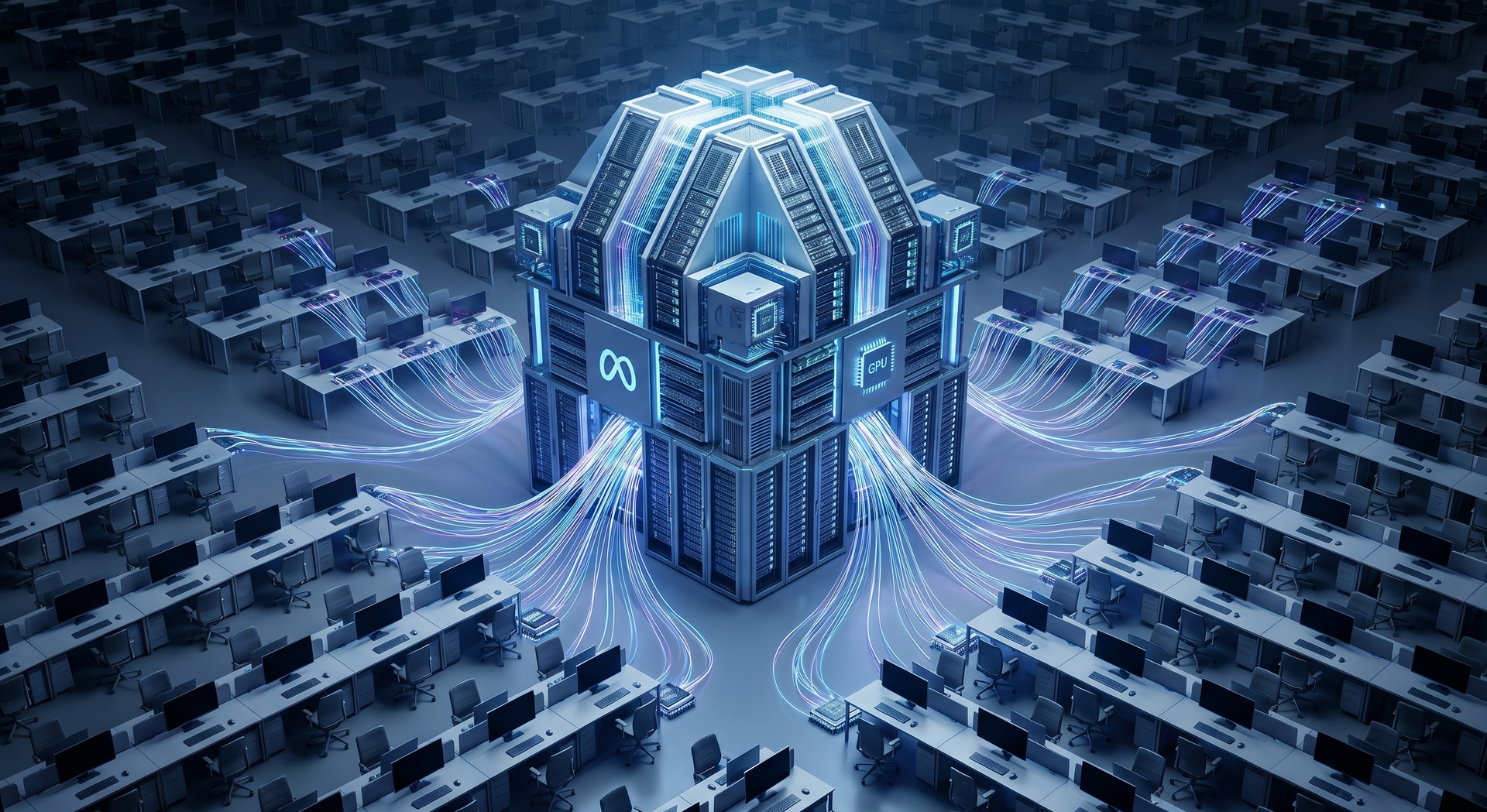
Meta will start pruning roughly 8,000 positions, or about 10% of its head count, on May 20, marking its biggest cull since the 2022–23 "year of efficiency." Additional rounds are penciled in for later this year, and executives say the final tally could grow if AI automation proves it can shoulder even more human work.
Behind the cuts is an eye-watering AI bill: Meta expects to pour $115 billion to $135 billion into data centers, GPUs, and an Applied AI engineering org that's busy training code-writing agents.
A handful of staffers will be shuffled into the new Meta Small Business unit, but most teams—spanning Reality Labs, sales, recruiting, and Facebook's core group—face outright elimination. |
Image created with Gemini |
The company's stock and profits remain healthy (in fact, top executives just unlocked up to $921 million each in new stock options). The layoffs are about funding faster, leaner AI development, not plugging financial holes.
Meta's move echoes a broader pattern: Amazon has already shed 30,000 corporate roles, Snap let go of 1,000, and Oracle, Atlassian, Block, and Disney all cite "AI efficiency" while tightening belts. The broader industry has seen more than 95,000 tech jobs lost in 2026 already, and analysts expect the number to keep climbing as companies swap salaries for silicon.
Even the office coffee machine is starting to look nervously at the server rack. |
|
|
|
Writer at TechnologyAdvice |
Justin Meyers is an investigative writer and editor who draws on over a decade of meticulous hands-on research to deliver the full, trustworthy story behind consumer and enterprise tech, including cybersecurity. |
|
|
Curious about where AI is really headed? |
The Neuron cuts through the noise to bring you smart, hype-free takes on the latest AI trends, tools, and breakthroughs. Join 500,000+ professionals from top companies like Microsoft, Apple, Salesforce and more.
|
|
|
Advertise in Daily Tech Insider! Daily Tech Insider is a TechnologyAdvice business.
© 2026 TechnologyAdvice, LLC. All rights reserved. TechnologyAdvice, 3343 Perimeter Hill Dr., Suite 215, Nashville, TN 37211, USA. |
|
|
|