







The long arm of U.S. justice has once again reached out around the world to identify those responsible for cybercrime.
On Feb. 7, the U.S. Department of Justice unsealed a federal indictment charging 36 individuals with participating in a global cybercrime effort known as the Infraud Organization. Of the 36 individuals who were indicted, 13 defendants have already been arrested.
“Today’s indictment and arrests mark one of the largest cyberfraud enterprise prosecutions ever undertaken by the Department of Justice,” acting Assistant Attorney General John Cronan stated. “As alleged in the indictment, Infraud operated like a business to facilitate cyberfraud on a global scale.”
Those charged by Justice Department include U.S. citizens as well as individuals from Australia, the United Kingdom, Ukraine, Pakistan France, Italy, Kosovo and Serbia. According to the indictment, the Infraud Organization allegedly was already responsible for $530 million in losses. Going a step further, the indictment claims that Infraud was intending further fraud that could have resulted in over $2.2 billion in losses.
In Fraud We Trust
The Infraud Organization was created in October 2010 to be a carding website that sells stolen credit card information. The group’s leader Svyatoslav Bondarenko, aka “Obnon,” launched the site with the slogan “In Fraud We Trust.” The Infraud Organization also led participants to various forms of illegal items, including stolen information and malware. According to the indictment, in March 2017 there were 10,901 member accounts on the Infraud Organization’s discussion forum.
The indictment outlines a complex hierarchy for the Infraud Organization that involved site moderators, vendors and members. An individual could only become a member of the Infraud Organization via an online forum request that had to be approved by an Infraud administrator. Vendors sold various illegal services to the members, while the moderators acted to help make sure everything worked and that vendors were selling quality products and services.
The entire operation aimed to have a high degree of anonymity as well.
“Members and associates strive to achieve shared anonymity to remain as anonymous as possible in order to evade law enforcement and other real-world or offline consequences for their fraudulent and criminal activities,” the indictment stated.
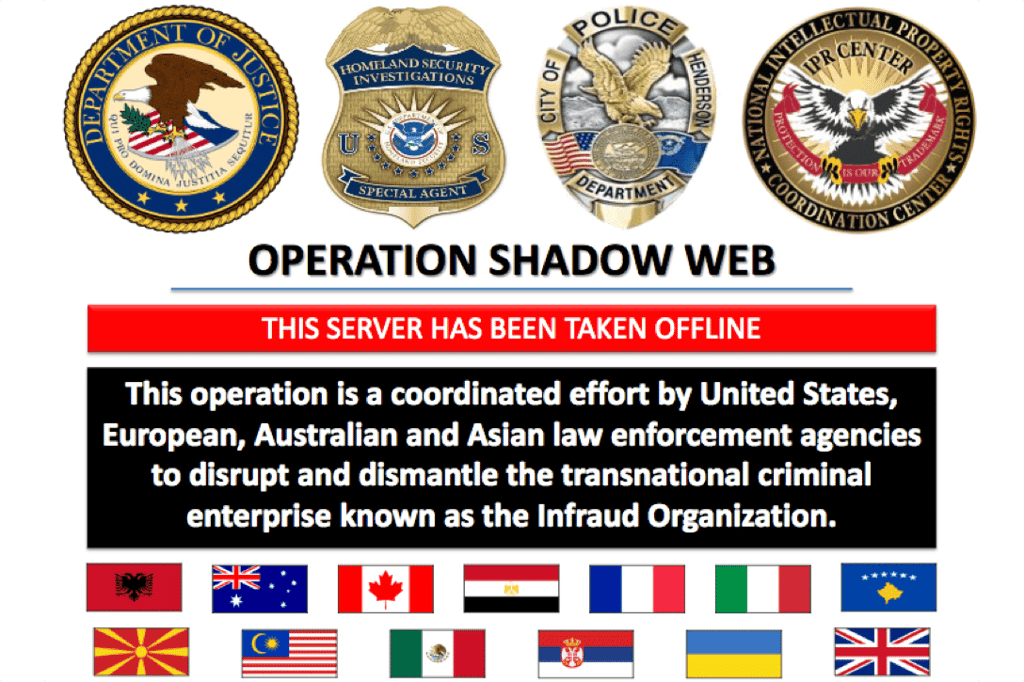
Although the Infraud Organization aimed to be anonymous, that didn’t stop law enforcement from shutting the whole operation down. Law enforcement agencies in the U.S., Europe, Australia and Asia worked together as part of an effort known as Operation Shadow Web to disrupt and ultimately take the Infraud Organization servers offline.
“The Department of Justice refuses to allow these cybercriminals to use the perceived anonymity of the Internet as a shield for their crimes,” Cronan stated. “We are committed to working closely with our international counterparts to identify, investigate, and bring to justice the perpetrators of these crimes, wherever in the world they operate.”
Sean Michael Kerner is a senior editor at eWEEK and InternetNews.com. Follow him on Twitter @TechJournalist.