





Micron, Intel Will Terminate 3D XPoint Joint Development Program

3D XPoint
Published: Jul 17, 2018
Updated: Feb 2, 2021
2 minute read
eWeek content and product recommendations are editorially independent. We may make money when you click on links to our partners. Learn More

Micron and Intel, who have had their differences in their joint 3D XPoint (pronounced crosspoint) development deal, have agreed to end their partnership to design and build the solid-state processors. The project is expected to be finished in the first half of 2019.

Development of the chips beyond the second generation of 3D XPoint chips will be pursued independently by the two companies in order to optimize them for their respective product and business needs, Micron said.

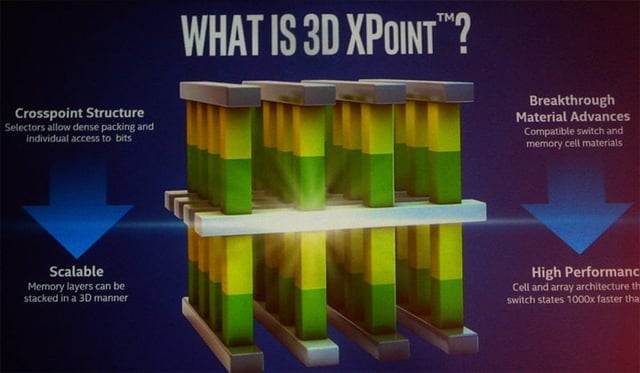
In other words, Intel and Micron could not agree on further development together of the powerful chips, in which silicon layers are stacked vertically instead of remaining flat on the die.


Intel is moving the focus of its 3D NAND flash storage-class memory business to a relatively unknown Chinese company, Tsinghua Unigroup, by providing the company with its chips, according to the Nikkei Asian Review.

Tsinghua’s UNIC storage memory technology division would use the flash chips to create microSD cards and solid-state disks. The supplies could help push UNIC, which became a registered company last summer, to becoming a major market player alongside Samsung, Toshiba and Western Digital’s SanDisk, industry analyst DRAMeXchange said in a media advisory. 

The move could help Intel gain better access to the Chinese market. Intel ranks sixth globally among NAND memory chip manufacturers. 

3D Xpoint is NVMe (Non-Volatile Memory Express), a scalable, high-performance PCIe Gen3 direct connect to NVMe devices, designed for client and enterprise server systems using SSDs.

Three years ago, 3D Xpoint was hailed as potentially the biggest advancement in solid-state processors since the advent of Toshiba’s NAND flash chips in 1989. Since the introduction of 3D XPoint in 2015, the product has been selling in modest numbers, but issues developed involving heat and other factors that stalled advancement of the product.

Nonetheless, the joint project has resulted in the development of an entirely new class of non-volatile memory with lower latency and exponentially greater endurance than NAND memory. A lot of lessons were learned inside this project.

Chris Preimesberger

Chris J. Preimesberger is Editor Emeritus of eWEEK. In his 16 years and more than 5,000 articles at eWEEK, he distinguished himself in reporting and analysis of the business use of new-gen IT in a variety of sectors, including cloud computing, data center systems, storage, edge systems, security and others. In February 2017 and September 2018, Chris was named among the 250 most influential business journalists in the world (https://richtopia.com/inspirational-people/top-250-business-journalists/) by Richtopia, a UK research firm that used analytics to compile the ranking. He has won several national and regional awards for his work, including a 2011 Folio Award for a profile (https://www.eweek.com/cloud/marc-benioff-trend-seer-and-business-socialist/) of Salesforce founder/CEO Marc Benioff--the only time he has entered the competition. Previously, Chris was a founding editor of both IT Manager's Journal and DevX.com and was managing editor of Software Development magazine. He has been a stringer for the Associated Press since 1983 and resides in Silicon Valley.

eWeek Logo

eWeek has the latest technology news and analysis, buying guides, and product reviews for IT professionals and technology buyers. The site's focus is on innovative solutions and covering in-depth technical content. eWeek stays on the cutting edge of technology news and IT trends through interviews and expert analysis. Gain insight from top innovators and thought leaders in the fields of IT, business, enterprise software, startups, and more.

Property of TechnologyAdvice. © 2026 TechnologyAdvice. All Rights Reserved

Advertiser Disclosure: Some of the products that appear on this site are from companies from which TechnologyAdvice receives compensation. This compensation may impact how and where products appear on this site including, for example, the order in which they appear. TechnologyAdvice does not include all companies or all types of products available in the marketplace.