







Imagine starting Monday morning with a report on competitor gains, emerging customer interests, and untapped content opportunities. Instead of spending hours digging through data, your marketing team can get straight to deciding what to do with it.
Agentic marketing makes this approach possible by allowing AI agents to coordinate multiple research, analysis, and execution tasks within defined boundaries.
In a survey of about 60 chief marketing officers (CMOs) by BCG and the Global Marketing and Media Alliance, respondents put agentic AI at 7% of their marketing team mix and expected that share to reach 27% within two to three years.
As agents take on more marketing responsibilities, enterprises must determine which activities to delegate, what technology is needed to support them, and where human judgment remains essential.
- Agentic marketing moves beyond prompts and predefined rules
- Connected data powers agentic marketing workflows
- Four practical agentic marketing use cases
- Human oversight defines the boundaries of agent autonomy
- Enterprise adoption starts with controlled workflows
- Agent performance requires more than productivity metrics
- Bottom line: Delegate tasks, not accountability
Agentic marketing moves beyond prompts and predefined rules
Agentic marketing is the use of AI agents to pursue marketing objectives by planning, gathering information, making decisions, and completing multistep tasks within defined operational boundaries.
While conventional Prompt-based generative AI typically responds to individual instructions, agentic systems can determine intermediate steps, interact with connected tools, evaluate results, and adjust their approach. They may use the same underlying AI models but operate with greater autonomy.
Traditional marketing automation also performs tasks without continuous human intervention. However, it generally follows predefined rules and triggers.
For example, conventional automation might send an alert when a competitor's estimated website traffic increases. An AI agent could investigate the increase, examine acquisition channels, identify relevant keyword trends, and prepare recommendations for further action.
Capability | Traditional automation | Generative AI | Agentic marketing |
| Starting point | Predefined rules | User prompt | Marketing objective |
| Task execution | Follows configured steps | Generates requested outputs | Plans and executes multiple steps |
| Decision-making | Rule-based | Responds to instructions | Selects authorized actions |
| Adaptability | Limited to configured rules | Responds to revised prompts | Adjusts based on intermediate results |
| Human involvement | Setup and monitoring | Prompting and review | Goal setting, supervision, and approval |
These approaches can work together. An enterprise may use generative AI to produce campaign copy, conventional automation to distribute approved content, and AI agents to coordinate multistep activities across business applications.
Connected data powers agentic marketing workflows
An AI agent's effectiveness depends on the information it can access and the actions it is authorized to perform. Even a sophisticated AI model cannot reliably investigate recent competitor activity without relevant, up-to-date market intelligence.
An agentic marketing system typically combines five components:
- Business objectives: Goals, success criteria, and constraints that guide agent activities.
- Reasoning and planning: AI capabilities that determine the steps needed to achieve an objective.
- Connected data: Market intelligence, customer relationship management (CRM) systems, web analytics, and search data.
- Execution tools: Applications through which agents retrieve information or perform authorized actions.
- Governance and feedback: Permissions, approval requirements, activity logs, and performance assessments.
Model Context Protocol (MCP) provides a standardized way for AI applications to connect with external tools and data sources, reducing the need to manually transfer information between platforms.
For example, the Similarweb MCP server gives compatible AI applications access to digital market intelligence. Developers and marketing teams can use these connections to build SEO assistants, competitive intelligence agents, and automated traffic alerts.
Other developments, including Google's WebMCP initiative, explore how websites can expose structured tools that AI agents can interact with directly.
However, data accessibility remains an enterprise challenge.
“AI is only as good as the data that powers it,” said Or Offer, CEO of Similarweb, when introducing the company's AI agents.
A Deloitte survey of 501 US business and technology leaders whose organizations were at least piloting agentic AI found that 72% lacked unified, accessible data, while 67% considered integration too costly and complex.
Marketing and IT teams must therefore establish standards for data freshness, accuracy, access permissions, and how agents handle incomplete or contradictory information.
Four practical agentic marketing use cases
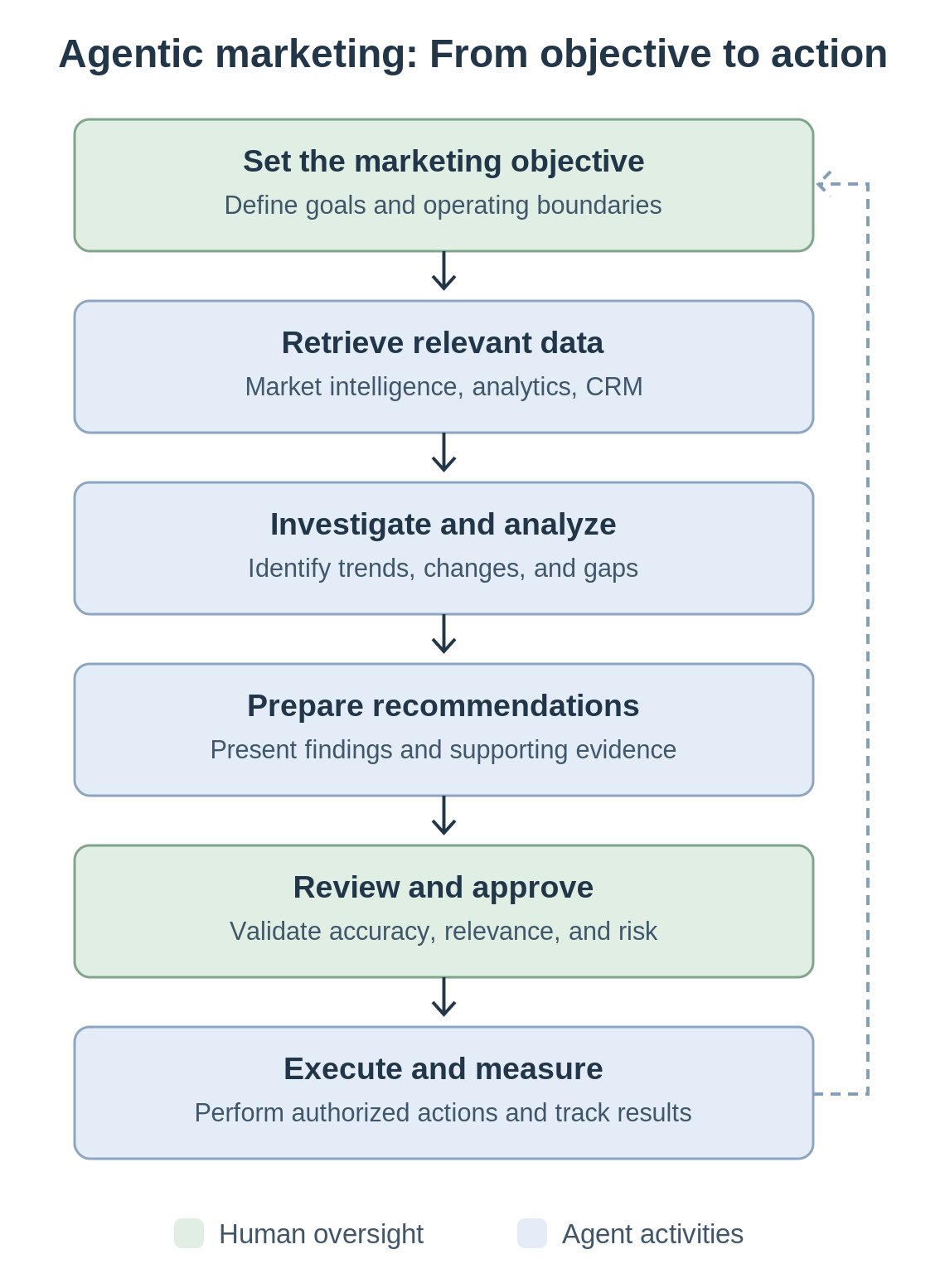
Consider a hypothetical B2B software company experiencing declining organic traffic while competitors gain visibility. The following workflows demonstrate how AI agents could support its marketing team while keeping strategic decisions in human hands.
1. Competitor monitoring: From traffic changes to competitive intelligence
Using website traffic estimates, keyword data, and industry news, an AI agent could:
- Compare competitor traffic across periods and acquisition channels.
- Identify keywords and landing pages associated with traffic growth.
- Investigate relevant product announcements or seasonal patterns.
- Prepare a competitive intelligence report with supporting evidence.
The report might reveal growing competitor visibility around AI-enabled business applications, giving marketers a specific product category to investigate.
Where humans stay involved: Competitive intelligence platforms generally provide estimates rather than direct access to competitors' analytics. Marketers should validate findings and consider alternative explanations. Higher estimated traffic does not necessarily indicate increased sales.
2. Demand research: Identifying emerging customer interests
An AI agent could examine related queries, historical search demand, geographic patterns, and industry developments to identify emerging market opportunities.
With Similarweb's AI Trend Analyzer, available through its Market Intelligence add-on, marketers enter a search term and select a spike in demand for analysis. The agent groups related keywords, checks news and events for possible explanations for the spike, and generates a summary with supporting links for review.
For the software company, the agent could produce a research brief identifying emerging interests in AI-enabled automation, potential audience segments, and regional demand differences.
Where humans stay involved: Rising search demand does not automatically indicate purchase intent. Marketing and product teams must assess whether emerging interests align with customer needs, product capabilities, and business objectives.
3. Content planning: Turning competitive gaps into editorial opportunities
An AI agent with access to competitive search data and an organization's content inventory could evaluate search intent, identify gaps, and prioritize opportunities.
Its deliverables could include:
- Prioritized topics and relevant keywords.
- Recommendations for new articles or content updates.
- Suggested content formats and preliminary briefs.
With Similarweb's AI SEO Strategy Agent, marketers enter a keyword list, website, and target country. The agent analyzes competitors, groups keywords into subtopics, and produces a prioritized content roadmap based on search opportunities and competitive gaps.
As demonstrated in Ahrefs' agentic marketing examples, agents can also identify questions for which AI-generated search responses mention competitors but overlook an organization's brand.
For the software company, this analysis might inform a recommendation for an enterprise AI governance guide.
Where humans stay involved: Editorial teams must assess audience relevance, existing coverage, and subject matter expertise. Search volume should inform editorial decisions rather than dictate them.
4. Performance reporting: Moving from dashboards to recommendations
An AI agent with authorized access to web analytics, campaign performance, CRM data, and external market intelligence could investigate whether declining organic traffic coincides with ranking movements, changing search demand, or shifts in acquisition channels.
Its performance report could include:
- Changes against established marketing targets.
- Pages and channels contributing to performance changes.
- Potential explanations and supporting evidence.
- Recommended actions and data limitations.
Where humans stay involved: Analysts must distinguish correlation from causation, validate attribution, and approve consequential changes before implementation.
Human oversight defines the boundaries of agent autonomy
Greater autonomy changes where human involvement occurs. Rather than reviewing every research step, marketers can focus on defining objectives, evaluating recommendations, and approving decisions with significant business consequences.
Deloitte's research found that 75% of surveyed leaders agree that collaboration between humans and AI agents creates more value than agent-powered automation alone.
“The value in agentic AI depends on more than the agents alone,” said China Widener, Deloitte vice chair and US Technology, Media and Telecommunications industry leader, in the survey announcement.
Organizations can establish different levels of autonomy depending on the reliability of their systems and the consequences of incorrect actions.
Marketing responsibility | AI agent role | Human responsibility |
| Competitive research | Collect and analyze intelligence | Determine strategic implications |
| Demand research | Identify emerging interests | Evaluate commercial relevance |
| Content planning | Recommend topics and prepare briefs | Approve editorial priorities |
| Performance reporting | Investigate changes | Validate attribution and findings |
| Campaign optimization | Recommend or execute permitted adjustments | Establish objectives and spending limits |
| Customer communications | Prepare or personalize messages | Define brand and privacy requirements |
Retrieving keyword data presents different risks from publishing content, modifying customer records, sending messages, or reallocating advertising budgets.
As outlined in Braze's agentic AI marketing guidance, enterprises should evaluate whether platforms provide configurable approval steps, clear audit trails, and the ability to pause or adjust agent behavior.
Security considerations also extend to the information agents retrieve. External websites and documents may contain instructions designed to manipulate agent behavior. Addressing these and other agentic AI security risks requires restricting permissions, validating outputs, and treating retrieved content as untrusted input.
Enterprise adoption starts with controlled workflows
Organizations do not need to redesign their entire marketing operation before introducing AI agents. Starting with a defined business problem allows teams to assess reliability, integration requirements, and operating costs before expanding deployment.
A McKinsey report described how an unnamed consumer brand introduced AI agents in stages, beginning with campaign ideation before expanding into concept testing, compliance checks, and content localization.
Marketers remained responsible for reviewing and refining creative concepts. McKinsey reported that the brand’s end-to-end content creation process was four times as fast as its traditional workflow in some pilots.
A phased approach also aligns with Salesforce's agentic marketing implementation guidance, which emphasizes identifying specific business problems and preparing connected, accessible data.
Enterprise teams can begin with five steps:
- Select a narrow use case: Identify a recurring activity with measurable outputs, such as weekly competitor monitoring.
- Establish data connections: Determine which information sources the agent requires and whether read-only access is sufficient.
- Define operating boundaries: Specify approved actions, prohibited activities, and situations requiring human intervention.
- Test against existing processes: Compare agent-generated findings with reports produced by experienced marketers.
- Expand autonomy gradually: Introduce additional capabilities after the agent demonstrates reliable performance.
This approach gives marketing and IT teams an opportunity to resolve data, security, and integration challenges before deploying agents in more consequential activities.
Agent performance requires more than productivity metrics
Completing marketing tasks faster does not necessarily translate into better business outcomes. Time spent correcting inaccurate reports or reviewing irrelevant recommendations can offset apparent productivity gains.
McKinsey found that nearly 90% of CMOs are experimenting with AI across marketing activities, but fewer than 10% have captured value across end-to-end workflows.
Enterprise teams should evaluate agent performance using metrics that address efficiency, reliability, and business impact:
- Time to insight: Time required to identify and investigate meaningful changes.
- Finding accuracy: The share of checked findings that reliable sources confirm.
- Human intervention rate: How frequently employees need to correct, redirect, or stop agents.
- Net time saved: Reduced manual effort after accounting for review and corrections.
- Operating costs: Expenses associated with models, data subscriptions, integrations, and oversight.
- Business outcomes: Changes in qualified traffic, conversions, customer acquisition costs, or pipeline contribution where attribution is credible.
Establishing performance baselines before introducing agents gives organizations a point of comparison. Where feasible, controlled experiments can help isolate the effects of agent-assisted activities from broader market changes.
Bottom line: Delegate tasks, not accountability
Competitive monitoring, demand research, content planning, and performance reporting offer practical starting points for enterprise marketing teams exploring agentic AI.
The decision to expand agent autonomy should depend on demonstrated reliability, measurable business value, and the organization's ability to maintain oversight. Giving an agent more responsibilities is useful only when it improves the quality or efficiency of marketing decisions.
Humans remain accountable for determining which opportunities to pursue, which risks to accept, and how success should be measured.
Frequently asked questions
What is an example of agentic marketing?
An AI agent that monitors competitors, investigates traffic changes, identifies keyword opportunities, and produces a prioritized marketing report is an example of agentic marketing.
Can small marketing teams use agentic marketing?
Yes. Smaller teams can begin with narrowly defined activities such as competitor monitoring or performance reporting, provided they have reliable data, appropriate tools, and sufficient oversight.
What technologies support agentic marketing?
Agentic marketing can involve large language models, AI orchestration systems, marketing analytics platforms, CRM systems, application programming interfaces (APIs), and integration standards such as MCP.
Will agentic AI replace marketers?
Agentic AI can automate portions of marketing research, analysis, and execution. Strategic planning, creative direction, brand stewardship, and consequential business decisions still require human judgment and accountability.
Thinking about putting AI agents to work on your team? Explore courses from The Neuron Academy to build the skills to evaluate where agents can help and where you still need a human in the loop.