







Google’s Chrome team has rolled out an early preview of WebMCP, a proposed web standard that enables websites to communicate directly with AI agents via structured tools rather than relying on messy screen scraping.
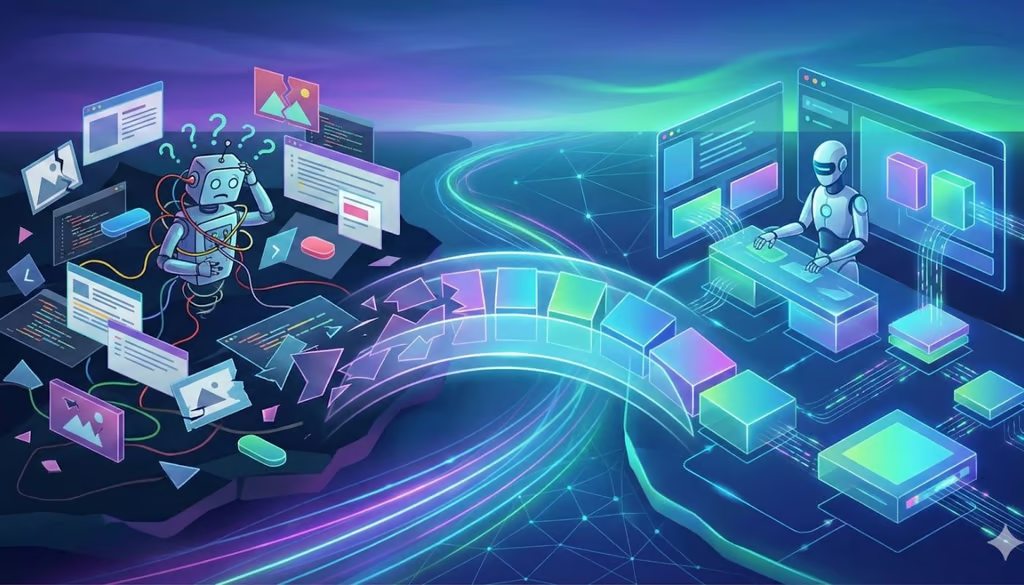
Today, when AI agents access websites, they often rely on screenshots or raw HTML to determine what to do. That means parsing code, scanning layouts, and making repeated guesses, a process that can be slow, expensive, and prone to breaking when page designs change.
WebMCP, short for Web Model Context Protocol, is meant to change that.
Announcing the preview, Google developer André Cipriani Bandarra wrote that WebMCP “aims to provide a standard way for exposing structured tools, ensuring AI agents can perform actions on your side with increased speed, reliability, and precision.”
Instead of forcing an agent to interpret pixels or dig through the DOM, websites can now explicitly publish “Tool Contract.” Through a new browser API, navigator.modelContext, a site can define clear functions, such as booking a ticket or submitting a form, that an agent can call directly.
“By defining these tools, you tell agents how and where to interact with your site, whether it’s booking a flight, filing a support ticket, or navigating complex data. This direct communication channel eliminates ambiguity and allows for faster, more robust agent workflows,” Bandarra wrote.
Why it matters for developers and enterprises
For companies experimenting with browser-based AI agents, the cost of automation can add up quickly. Screenshot-based approaches send images to multimodal models, consuming large amounts of tokens. DOM parsing forces agents to sift through irrelevant markup before finding the right element.
WebMCP offers a different path: one structured tool call could replace dozens of fragile UI interactions. Development teams can reuse existing front-end JavaScript rather than build and maintain separate backend integrations for agents.
Wait, isn’t this just MCP?
Not exactly, and the distinction matters for anyone building infrastructure.
Despite the similar name, WebMCP is not the same as Anthropic’s Model Context Protocol (MCP). Anthropic’s MCP runs on servers, connecting AI platforms to service providers through back-end integrations. WebMCP runs entirely client-side, inside the browser tab.
Think of it this way: MCP is for when no human is watching. WebMCP is for when the user is right there, ready to step in when things get weird. Nonetheless, the two approaches can coexist and serve different use cases.
Early days, but a clear direction
WebMCP is currently behind a “WebMCP for testing” flag in Chrome Canary, and developers must join Google’s early preview program to access documentation and demos. The specification is being developed with Microsoft and incubated through the W3C Web Machine Learning community group, signaling an effort to turn it into a broader web standard.
Industry observers expect formal browser announcements by mid-to-late 2026, with Google Cloud Next and Google I/O as probable venues for broader rollout.
Before you trust your next AI deployment, read how researchers pulled off model extraction attacks against Google Gemini and what it means for enterprise security.