







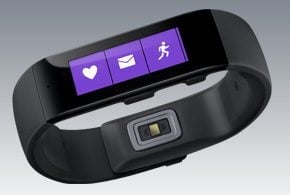
Bad news for fitness buffs and fans of the quantified self. Microsoft’s wearable health monitor is in short supply this holiday season.
The Band fitness tracker, the company’s latest stab at wearable devices, is currently sold out and won’t be back in stock until after the new year. Shoppers that visit Microsoft’s online store in search for the product are greeted with a notice that the company will restock the Band in early 2015 with the option to sign up for an email when it becomes available.
Launched in late October, Microsoft Band is a health and fitness tracker with built-in GPS and a 1.4-inch touch-screen display that is meant to be worn on the inside of the wrist. The Band’s array of sensors include an optical heart rate sensor, an accelerometer, galvanic skin response and a skin temperature sensor, among others. The wearable is compatible with iOS, Android and, of course, Windows Phone. Linking Band to the latter via Bluetooth provides access to Cortana, Microsoft’s digital assistant on Windows 8.1.
Microsoft has not released sales figures for the device. Since its launch, availability has been a hit or miss affair, suggesting a limited supply.
Priced at $199, Microsoft Band is available in small, medium and large to accommodate different wrist sizes. The water-resistant device provides 24/7 heart-rate monitoring, guided workouts, sleep tracking and UV monitoring for outdoor activities. Battery life is rated at 48 hours under “normal use,” and a full charge takes approximately 1.5 hours.
Users can chart their progress and review their stats with the cloud-enabled Microsoft Health app. “Microsoft Health will unite data from different health and fitness devices and services in a single, secure location,” said Microsoft Corporate Vice President Todd Holmdahl in an Oct. 29 statement.
“Once stored in Microsoft Health, you can combine the data you generate from different devices and services—steps, calories, heart rate and more—to receive powerful insights from our Intelligence Engine,” Holmdahl continued.
Although the company has a fitness tracker of its own, Microsoft has opened the platform up to competing devices. Microsoft Health also works with UP by Jawbone, MapMyFitness, MyFitnessPal and RunKeeper.
“Plugging into [Microsoft’s] cloud platform will allow us to match up fitness and nutrition data from our 65 million users around the world with deeper and broader data, ultimately helping people build even healthier habits in their everyday lives,” said Mike Lee, CEO of MyFitnessPal, in a statement. Jawbone’s Travis Bogard, vice president of Product and Strategy, stated that the move will “allow us to provide even more personalized insights through the Jawbone UP system in the future.”
In November, Jawbone launched two new wearables of its own, the UP3 heart rate monitor ($179.99) and the UP Move activity and sleep tracker ($49.99). The UP3 employs bioimpedance technology instead of optical sensors to deliver all-day heart monitoring while conserving battery life.