







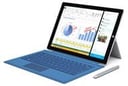
Revisiting themes from the company’s Surface Pro 3 reveal in May, Microsoft is again making Apple’s MacBook Air the target of unflattering comparisons.
Since its release in 2008, the ultrathin MacBook Air has become a common sight in workplaces and schools, particularly in tech-savvy areas like San Francisco and Manhattan. It also helped spark the Intel-led Ultrabook trend of thin and light notebooks among the Windows laptop makers.
Now, as the back-to-school tech buying season goes into full swing, Microsoft is taking aim at its historic rival with new television ads.
Titled “Surface Pro 3 – Power,” the 30-second commercial opens with the off-screen voice of a MacBook Air user marveling at how Microsoft’s tablet can run Photoshop, challenging assumptions about computing slates. The discussion turns to the Surface Pro 3’s touch-screen capabilities—a feature the Apple’s laptop lacks but compensates with a track pad that supports touch gestures—and how the device at least matches the MacBook Air performance-wise.
At one point, the Surface Pro 3 user says, “But it’s not just a tablet, it’s really a laptop.” Microsoft’s newest tablet is meant to bridge the gap between the two.
On May 20, during a press event in New York City, Panos Panay, corporate vice president of Microsoft Surface, observed that despite the explosive popularity of tablets, those in attendance were typing away at laptops, many of them Apple-flavored, instead of tablets.
“Ninety-six percent of you who have iPads in your bag right now are also carrying laptops,” he said. Microsoft’s latest tablet hardware, a larger screen successor to the 10.6-inch Surface Pro 2, was billed as the one device that plays both roles.
“So many people carry both a laptop and a tablet but really want just one device that serves all purposes,” said Panay in a statement, at the time. “Surface Pro 3 is the tablet that can replace your laptop—packing all the performance of a fully powered laptop into a thin, light and beautifully designed device.”
During the event, to demonstrate how the Surface Pro 3 was 30 percent lighter than an 11-inch MacBook Air, Panay placed both on a scale. Apple’s laptop predictably sank.
Yet it wasn’t until just this month that Microsoft could compete with Apple in terms of pricing.
A basic 11-inch MacBook Air costs $899. The Intel Core i3 version of the Surface Pro, which went on sale in August, starts at $799. Prior to the i3 model, only Core i5 versions were available, starting at $999.
Shoppers who pit the Surface Pro 2 and MacBook Air against one another will find that there is more to the buying decision than price.
Obvious differences in operating systems aside, processor options vary widely across both devices. The MacBook Air ships with either a 1.4GHz Intel Core i5 processor or a 1.7GHz Core i7 chip. Microsoft’s options include a 1.5GHz Intel Core i3, a 2.9GHz Intel Core i5 and a 3.3GHz Intel Core i7.
Battery life is also a consideration. The 13-inch MacBook Air will last up to 12 hours on a single charge (Web browsing or watching video). The Surface Pro 3 can squeeze nine hours out of its battery (Web browsing), on par with the 11-inch MacBook Ai