







An AI agent’s workload does not end with a model response. Retrieving business records, executing code, and coordinating tasks also place demands on CPUs.
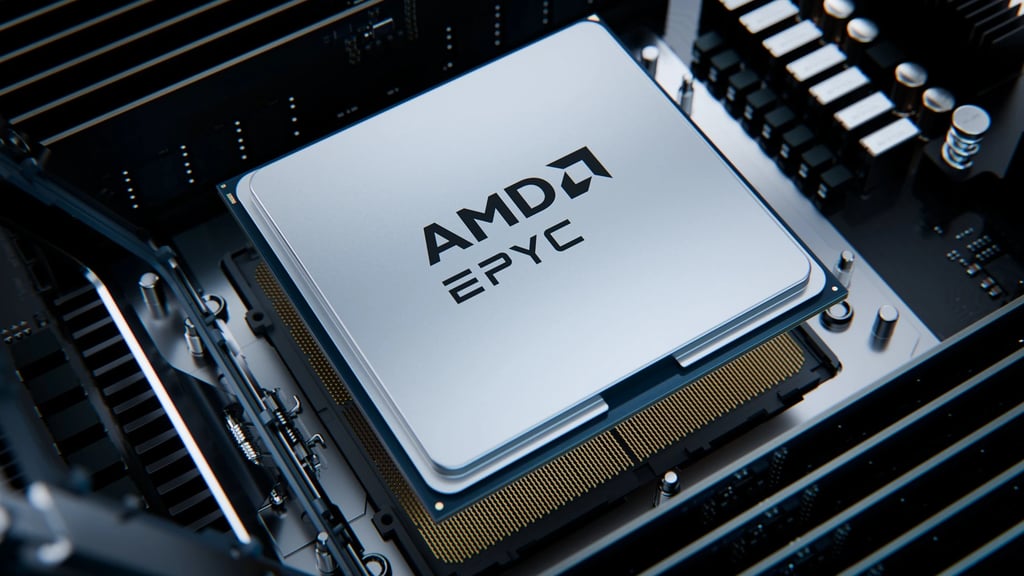
On Nov. 10, AMD announced general availability of its 6th Gen EPYC SP7 server processors, positioning them for agentic AI infrastructure and enterprise applications.
For enterprises expanding AI deployments, the question is whether more CPU capacity will improve performance enough to justify the investment.
What AMD is changing with 6th Gen EPYC
AMD positions its 6th Gen EPYC portfolio around three CPU roles in agentic AI infrastructure:
- General-purpose services: For running enterprise applications and supporting AI workloads
- GPU host nodes: Keeping AI accelerators supplied with data
- Agent sandboxes: For running multiple AI agents concurrently
AMD also outlined three deployment options for its Helion agentic AI rack blueprint, introduced in October:
- AMD Helion Liquid: High-density CPU capacity for large-scale agent execution in liquid-cooled data centers.
- AMD Helion Air: Additional agent capacity for existing air-cooled data centers.
- AMD Helion Air Inference: CPU execution and local GPU inference combined in one rack.
Together, the workload-focused processors and Helion rack designs give enterprises different options for building AI infrastructure. They can select CPUs based on the workloads they need to support and rack configurations based on their existing data center capabilities, cooling requirements, and deployment scale.
What eWeek found: The upgrade case depends on the workload
The launch highlights the CPU work surrounding AI models, including data retrieval, code execution, and task coordination. Enterprises evaluating agentic AI infrastructure should assess those demands alongside GPU capacity.
AMD projects up to 3.3 times the rack-level performance of Nvidia Vera-based systems for EPYC 9996-based systems within a 100 kW power budget. That comparison combines six general-purpose workloads, including web serving, databases, and Java applications. It uses preliminary projections or measurements and does not establish equivalent gains across enterprise agentic AI workflows.
The announcement also does not establish that businesses need sixth-generation EPYC to deploy AI agents. The investment decision should start with evidence of where existing AI infrastructure is limiting performance.
Before upgrading, enterprises should evaluate:
- Where workflows slow down: Measure CPU utilization, memory pressure, data-access delays, and GPU idle time during representative tasks.
- What additional capacity delivers: Compare completed tasks, response times, and failures at the concurrency the business expects.
- What deployment costs: Include servers, memory, networking, cooling, software licensing, and migration in the total cost.
- Whether the software stack is supported: Confirm operating-system, hypervisor, and application compatibility. AMD’s x86 architecture should not be treated as a blanket guarantee that every Intel-based workload will migrate without changes.
Agentic AI could change how enterprises allocate infrastructure spending, as capacity planning must account for the systems that turn model responses into completed work. AMD’s new processors offer another option, but the strongest upgrade case will come from measurable improvements in production workflows.
Read more: Put AMD’s latest performance claims in context with a closer look at its earlier EPYC Venice comparison with Nvidia Vera, including why headline gains can narrow when measured per core.