






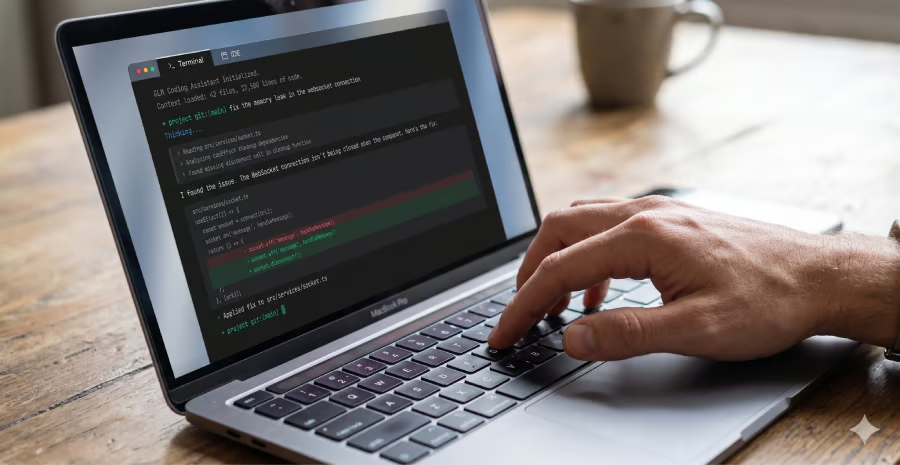


Anthropic’s Fable 5 shutdown has put one of China’s most closely watched AI companies in the spotlight.
Beijing-based Zhipu AI launched GLM-5.2 one day after Anthropic disabled global access to Fable 5, a move tied to US government restrictions on foreign access to the model. GLM-5.2’s benchmark showing, open-weight release, and lower-cost pitch are giving Chinese AI developers a timely chance to argue that enterprise AI buyers should weigh availability and control alongside raw model performance.
Zhipu moved as Anthropic went dark
The South China Morning Post (SCMP) noted that Anthropic disabled Fable 5 globally on June 12 after Washington ordered restrictions on foreign access, citing concerns that the model could be vulnerable to jailbreaking. Anthropic said it disagreed with the government’s approach and was working to restore access.
Zhipu AI Founder Tang Jie called the US restrictions “deeply regrettable” in a post on X while highlighting the model’s open nature, according to SCMP.
“I think the Zhipu rally tells you the market immediately understood the opening that Anthropic just created,” Lizzi Lee, a fellow at the Asia Society Policy Institute’s Centre for China Analysis, said, per SCMP.
Zhipu’s shares have surged as investors reacted to the timing and benchmark results. SCMP reported that the company’s Hong Kong-listed shares rose nearly 60% over the past month, pushing its market value above HK$1 trillion on Monday.
GLM-5.2 is selling openness and cost
Yellow reported that GLM-5.2 ranked second on Code Arena’s front-end coding leaderboard, behind only Anthropic’s Claude Fable 5. The report said Zhipu’s model is a 744-billion-parameter mixture-of-experts model released under a permissive MIT license, with a 1-million-token context window and open weights that developers can download, tune, and run.
The model is also being positioned as a cheaper alternative to leading Western systems. Yellow said that subscriptions start at $10 per month, while per-token API rates undercut Claude's comparable pricing.
MindStudio described GLM-5.2 as an open-weight model from Z.AI, the company formerly known as Zhipu AI. The publication framed the model around coding, design benchmarks, and the control open-weight systems can offer teams that do not want to depend only on closed API access.
The pitch matters beyond China because many AI buyers are now evaluating more than leaderboard placement. Cost, deployment flexibility, licensing, and regional availability are becoming part of the same model-selection conversation.
Reliability is now part of the AI race
The Fable 5 suspension has added a new layer to the competition between US and Chinese AI companies. Performance still matters, but availability, licensing, deployment control, and price are increasingly inseparable from model quality.
According to SCMP, some analysts remain cautious about how much Zhipu can gain. Jefferies said a ban on Fable 5 is unlikely to translate into major revenue gains for Chinese AI firms, and most users are unlikely to switch directly from Claude models to GLM-5.2.
Security and governance questions remain, too.
Yellow also highlighted that US lawmakers have raised concerns about PRC-origin models near critical infrastructure, while companies using China-based cloud services may face data access and compliance questions.
Zhipu does not need to overtake Anthropic overnight for this moment to matter. The shutdown gave China’s AI sector a timely example of why open-weight models, local deployment options, and diversified AI stacks are becoming harder for enterprises to ignore.
Read more: Fable 5 shutdown sparks clash between Anthropic, Washington, and cybersecurity experts.