







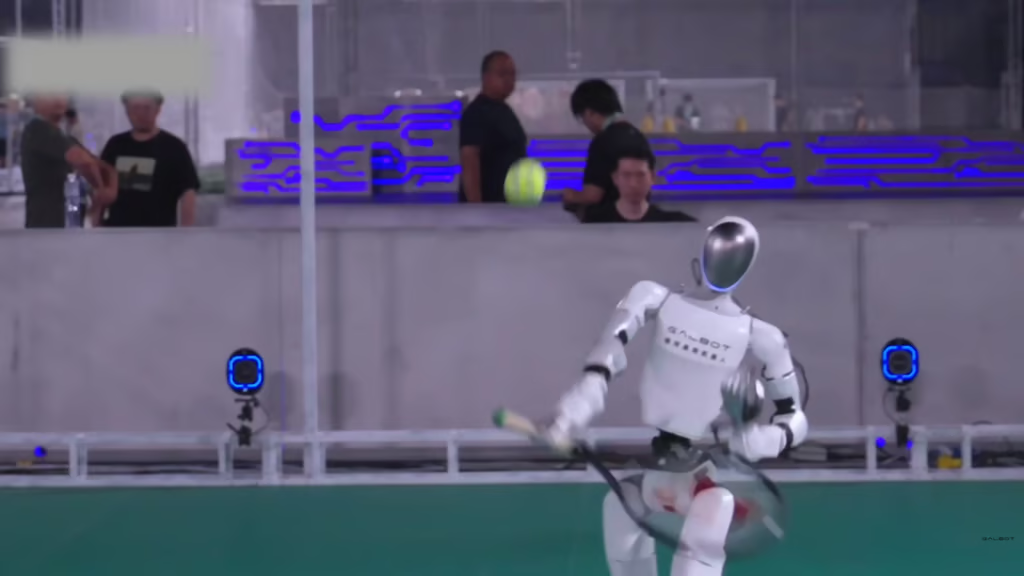
A humanoid robot chasing a tennis ball in Beijing lost its balance, toppled backward, rolled over, pushed itself upright, and went straight back to playing.
That recovery was one of the more revealing moments from the 2026 World Humanoid Robot Games.
Galbot’s robot was rallying with human players during singles and mixed-doubles demonstrations, putting perception, balance, movement, and split-second decision-making into the same live test.
Tennis turns robot control into a live stress test
During the demonstration, the Galbot robot crouched, shuffled across the court, repositioned itself, and returned forehands and backhands before recovering from its fall, according to the South China Morning Post.
The robot faced former tennis champion Zheng Jie and actor Li Yunrui. Galbot has described its system as fully autonomous and developed the underlying tennis technology with researchers from Tsinghua University.
Tennis has become a useful proving ground for humanoid control because almost nothing stays still. A robot has to detect an incoming ball, predict its trajectory, move into position, stabilize its body, and time a swing before the next shot arrives.
Researchers behind the LATENT system previously demonstrated a related approach on a Unitree G1. Their research paper describes a policy trained from imperfect fragments of human motion that can return balls across varying conditions and sustain multi-shot rallies with people.
Sports make failures unusually visible, too. A late perception decision becomes a missed shot. Weak balance becomes a fall. Poor recovery can end the demonstration entirely.
Galbot getting back up did not prove the robot can handle every unexpected situation, but it demonstrated something a perfectly choreographed routine cannot: recovery after the planned motion breaks down.
Robot athletes are getting faster, but benchmarks need context
Galbot was only one of 2,056 robots registered from 666 teams for the five-day Games. Beijing organizers list 51 events and 1,301 competition sessions, ranging from athletics and football to martial arts and real-world scenario challenges.
Some of the biggest headlines came from the track. The Associated Press reported that a Chinese humanoid completed the 100 meters in 9.39 seconds, faster than Usain Bolt’s 9.58-second human world record. Another robot recorded a 2.88-meter standing jump.
Those numbers are striking, but robot and human records are not always direct comparisons. A standing robotic jump is fundamentally different from an Olympic-style high jump, while sprint results depend on race rules, timing methods, starting procedures, and how well the robot can stop after crossing the line.
Other recent demonstrations make the same distinction important. Unitree’s Superman robot reached a reported peak speed of 45.6 km/h, while Sony AI’s Ace has challenged elite table-tennis players using a highly specialized robotic system rather than a humanoid body.
The more interesting direction for robot sports is therefore not whether machines can collect unofficial human records. Courts, tracks, and playing fields give engineers repeatable environments where perception, locomotion, coordination, recovery, and decision-making can all be pushed at once.
Galbot’s fall may ultimately be as informative as one of the Games’ record-breaking sprints. Fast robots are impressive. Robots that can react when things stop going according to plan are harder to build.
Also read: Unitree CEO Wang Xingxing says humanoid robots may be approaching a “ChatGPT moment”, although software still limits their performance in unfamiliar environments.