







Usain Bolt has been the benchmark for human speed for nearly two decades. Unitree says its newest robot just went faster.
Chinese robotics company Unitree’s new “Superman” robot reached a top speed of 12.66 meters per second, or about 45.6 km/h, edging past the roughly 12.42 m/s peak Bolt reached during his world-record 100-meter run in 2009.
Crossing that threshold sets a headline-grabbing benchmark for humanoid mobility and raises a bigger question about how much speed robots may eventually bring into places designed around human movement.
More than a straight-line sprint
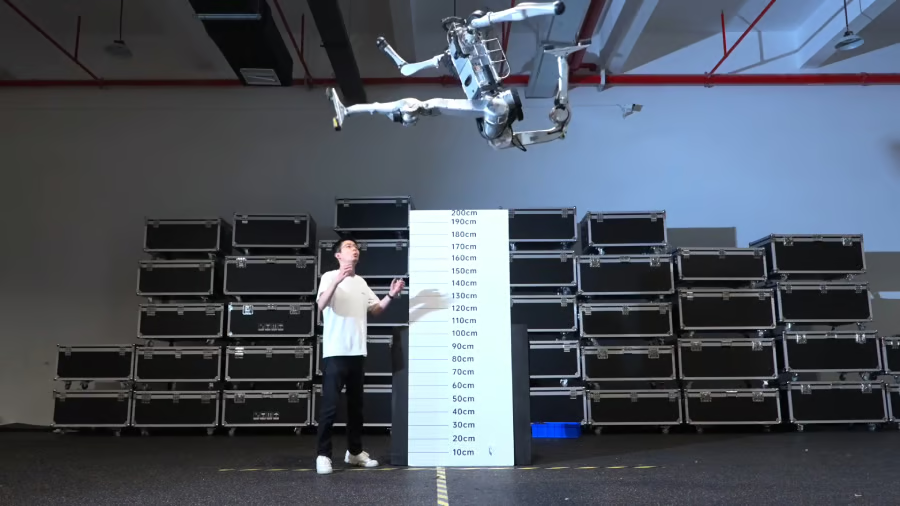
Running fast is only part of what the new machine can do. In its preview, Unitree shows the robot making a two-meter standing jump despite legs measuring just 0.85 meters. Development began a little over three months ago, leaving plenty of room for the young machine to improve.
Athletic demos are familiar territory for the Chinese robotics company. G1 has skated, balanced on one leg, and performed flips, showing how far its robots had already come in balance and body control.
Now the new model is raising the bar with raw speed and jump height. Unitree says Superman is an entirely new robot, separate from H1, so the more interesting question is how far its performance can go as development continues.
A speed milestone before the market debut
Superman entered public view just two days before Unitree's shares are scheduled to begin trading on Shanghai’s STAR Market. Its IPO has already brought attention to the company’s humanoid business as the robotics firm heads into public markets.
Chinese humanoid competition is moving quickly too. Earlier plans called for as many as 20,000 humanoid shipments in 2026, and rivals across China are chasing their own production and deployment targets. Running speed offers manufacturers one more measurable way to separate their machines as the field gets more crowded.
Faster humanoids could change the math at work
Superman’s speed makes for an impressive demonstration. Warehouse operators and industrial teams should be asking how much of it can translate into time saved during an ordinary workday.
Travel time can eat into productivity across large warehouses, factories, and logistics centers. Teams evaluating humanoids moving into logistics and other work environments should ask vendors how quickly a machine can repeat trips under load, then compare stopping distance and battery drain. Higher-speed movement also needs to remain stable around workers.
Emergency crews and industrial safety teams have a different use for speed. A fast robot could reach a fire or other dangerous area sooner while people stay farther away. Robots are already taking on jobs considered too dangerous for humans, so teams considering faster machines should pay close attention to control on uneven surfaces and around nearby personnel.
Peak speed alone will not decide whether a humanoid belongs on the job. Buyers should look for movement a robot can repeat safely while still doing the work it was sent to do.
Crossing Bolt’s peak is an eye-catching achievement, but turning that speed into working time saved will decide how useful it becomes.
Also read: Singapore is turning Punggol Digital District into a real-world testbed for robots handling delivery, cleaning, security, and other daily tasks.