







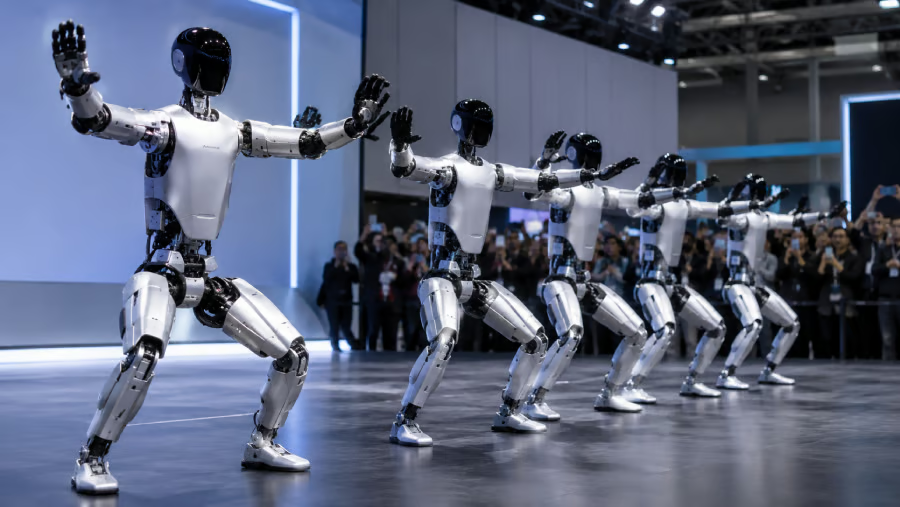
Humanoid robots can already dance, kickbox, and pull in a crowd.
Unitree CEO Wang Xingxing says the industry is nearing its “ChatGPT moment,” when robots can walk into an unfamiliar home, take a simple voice or text command, and successfully handle most tasks.
At the World Robot Conference in Beijing, Wang put a number on that milestone: roughly 80% task success in unfamiliar environments. Reaching that level could push humanoid robots beyond research labs and carefully planned demonstrations toward broader household and industrial use, although Wang cautioned that the software needed to get there may still be years away.
For now, the hardware is ahead of the software, and that gap is what’s holding humanoid robots back.
What Wang means by a ‘ChatGPT moment’
“We are marching towards a ‘ChatGPT moment’ in embodied intelligence,” Wang said at the conference, according to Reuters. He said the industry is moving toward a point where robots can enter unfamiliar environments and complete most tasks from simple voice or text instructions.
Wang said Unitree hopes a robot could eventually enter a household it has never seen before. The Next Web reported that he had previously described the goal as completing 80% of tasks across 80% of unfamiliar settings without scene-specific training.
Wang He, founder of Chinese robotics startup Galbot, offered a similar benchmark. He said he expects the sector to reach its “ChatGPT moment” around 2028, when robots can perform about 70% to 80% of everyday tasks without specialized training.
Software is still the bottleneck
Wang was more cautious about when that breakthrough might happen. He said a major leap in robot software could arrive within two to three years in an optimistic scenario, or take five to 10 years at the latest.
Unitree is putting its biggest investment of capital and staff into world models, systems designed to help robots understand and navigate physical environments. Wang also acknowledged that the company is “lagging” in real-world applications of physical AI models.
Current humanoids are not capable enough for mass deployment, he said, pointing to the AI models responsible for robot decision-making and interaction as the industry's biggest bottleneck.
The Next Web highlighted the same gap between fast-moving hardware development and practical autonomy. Universities and research institutions still make up much of Unitree's customer base, while the household robots Wang described remain a target rather than a widely available product.
China's scale raises the stakes
China shipped more than 40,000 humanoid robots in the first half of 2026 and accounted for 97% of global shipments, according to the Chinese industry body cited by CNA.
Humanoids are gradually appearing on factory floors and in logistics warehouses, although they remain less efficient than human workers in most applications.
Unitree's stock-market debut also showed how much investor attention is already attached to the sector. Its shares rose nearly sixfold in Shanghai before falling 11% the following day.
The more important test will come outside conference stages and controlled demonstrations. If robots can reliably take what they have learned into unfamiliar homes and workplaces, Wang's “ChatGPT moment” comparison may start to hold up. For now, his own timeline makes clear that the breakthrough is still a target, not an arrival.
Also read: Unitree recently soared more than 600% in its Shanghai debut, putting even more attention on the humanoid robotics market.