








Apple’s newest Watches can listen without creating an audio recording, according to the company. The privacy claim rests on a new hardware boundary inside the S11 chip.
Apple Watch Series 12 and Ultra 4 use a hardware-isolated Secure Exclave to process ambient audio while keeping raw microphone data inaccessible to watchOS, apps, the user, and Apple. The design powers four Audio Intelligence features, including Live Rewind and Siri Recap, but the resulting text and summaries can still create governance, confidentiality, and accuracy risks for enterprises.
Apple announced the watches Sept. 9, while Live Rewind and Siri Recap are due in beta in late 2026. The rollout builds on Apple’s broader push to bring Siri AI and more on-device intelligence to the wrist, following earlier watchOS 27 beta testing.
How Secure Exclave handles audio
Apple’s Audio Intelligence documentation says audio enters a protected buffer inside Secure Exclave, where it is processed separately from the operating system and apps. The buffer is continuously overwritten, so new audio replaces older data instead of accumulating as a stored recording.
For Siri Recap, the Watch encrypts detected audio and sends it to the paired iPhone’s Secure Exclave. There, the audio is decrypted, transcribed, and condensed before an encrypted shortened transcript goes to Private Cloud Compute for the final summary. Apple says the condensed text is designed to be less than half the length of the original transcript, while raw audio is deleted after processing.
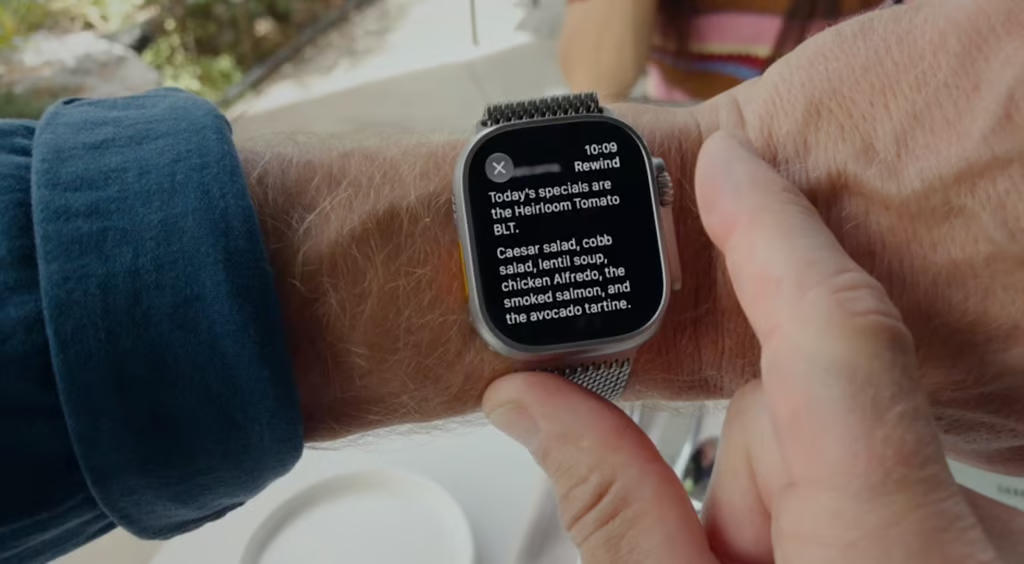
The four features handle data differently. Sound Recognition detects alerts such as sirens and doorbells on-device, while Shazam sends an acoustic signature rather than raw audio. Live Rewind displays the previous 15 seconds of speech after a double-press of the Digital Crown and signals activation with an audible chime and full-screen indicator.
Siri Recap runs only when the user chooses, either manually or through time- and location-based schedules. Unsaved summaries are deleted after seven days.
What the architecture means for enterprise IT
Apple has not documented Audio Intelligence-specific device-management controls. Its current deployment guidance lets organizations manage some Siri behavior on supervised devices, including Siri user-generated content processing on watchOS, but does not list controls for Siri Recap or Live Rewind.
Apple also warns that Siri Recap and Live Rewind may be incomplete or inaccurate and that automated filtering may fail to remove all sensitive information. Apple’s parallel push toward richer AI-ready health data on its new watches raises a similar governance problem: hardware protections can reduce exposure of source data without eliminating the need to control what AI systems derive from it.
What eWeek Found: Apple provides more external verification for PCC than its Watch audio path
Apple keeps raw audio inside Secure Exclave-controlled processing while Private Cloud Compute receives condensed text rather than the original microphone stream. For PCC, Apple publishes every production software image for independent binary inspection and uses cryptographic attestation so devices send requests only to approved builds.
Apple’s Audio Intelligence materials do not describe a comparable external verification program for the Watch-to-iPhone Secure Exclave pipeline. Some organizations are already keeping selected AI workloads on infrastructure they control rather than sending every task to outside cloud services. Apple’s Watch architecture shows how far hardware isolation can reduce raw-data exposure, but enterprises still have to govern what AI systems derive from that data.
Want to learn more AI tips, tricks, and prompting techniques? eWeek readers get free 7-day access to The Neuron Academy, our practical learning platform designed to help professionals use AI more confidently at work. Browse all lessons →