







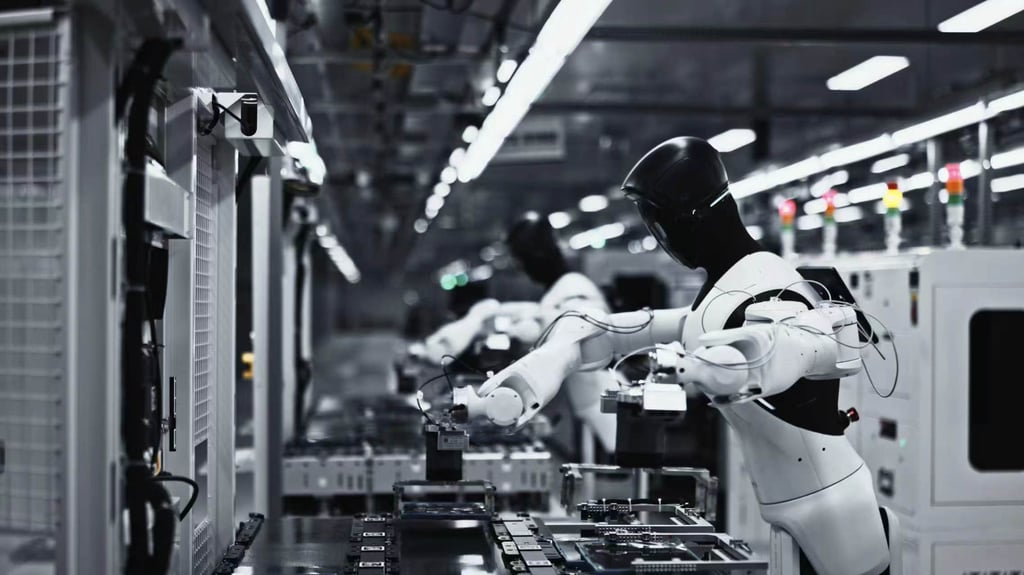
American factories could soon be producing humanoid robots by the hundreds of thousands.
JPMorgan expects US humanoid robot production to reach 300,000 to 400,000 units by 2030 and approximately 1.5 million by 2035. Manufacturers are preparing for growing commercial demand as businesses explore machines capable of performing physical work.
Turning those ambitions into everyday reality will take more than impressive robot demonstrations.
Humanoid robots could save businesses $100,000 annually
Working longer hours is part of the financial attraction. Humanoid robot costs are approaching those of human labor, with machines operating across multiple shifts potentially saving customers about $100,000 annually, JPMorgan estimated in a Reuters report.
Labor shortages are prompting manufacturers and warehouse operators to explore automation to handle repetitive physical work. Agility Robotics, for example, wants its Digit v5 to operate for more than 20 hours a day through improved batteries and rapid charging, although the figure remains a target.
Longer operating hours could make each robot more economical, provided there is enough work to keep it occupied. Early industrial humanoid deployments still concentrate on defined tasks in controlled environments, so the projected savings are not guaranteed returns for every business.
Robot makers still face major production obstacles
Getting humanoids ready for industrial work remains technically demanding. JPMorgan identifies several obstacles that could limit how quickly manufacturers expand output:
- Hands and movement. Robots need dexterous hands to grip different objects and actuators to control their movements accurately.
- AI training. Teaching machines to perform physical tasks requires enormous amounts of data and computing power. Boston Dynamics, for instance, put its Atlas robot through millions of simulated practice hours before demonstrating how it could lift and carry a mini-fridge.
- Manufacturing capacity. Developers must secure enough components and factory space to produce machines in much larger quantities.
Most US humanoid developers outside Tesla are targeting annual production of 10,000 to 30,000 robots. Major contenders include Tesla's Optimus, Boston Dynamics' Atlas, Agility Robotics' Digit, Figure AI's humanoids, and Apptronik's Apollo.
Component suppliers could benefit substantially from the anticipated expansion. Analysts expect the market for key robot parts, including motors and vision systems, to approach $30 billion by 2035.
What eWeek found: Human resistance could challenge the humanoid boom
JPMorgan's ambitious production forecast contrasts with how few businesses have deployed humanoids at scale. An independent eWeek review of Capgemini Research Institute's 2026 study found that only 3% of surveyed organizations across 16 countries were expanding deployments across multiple operations or sites. Another 9% reported limited use.
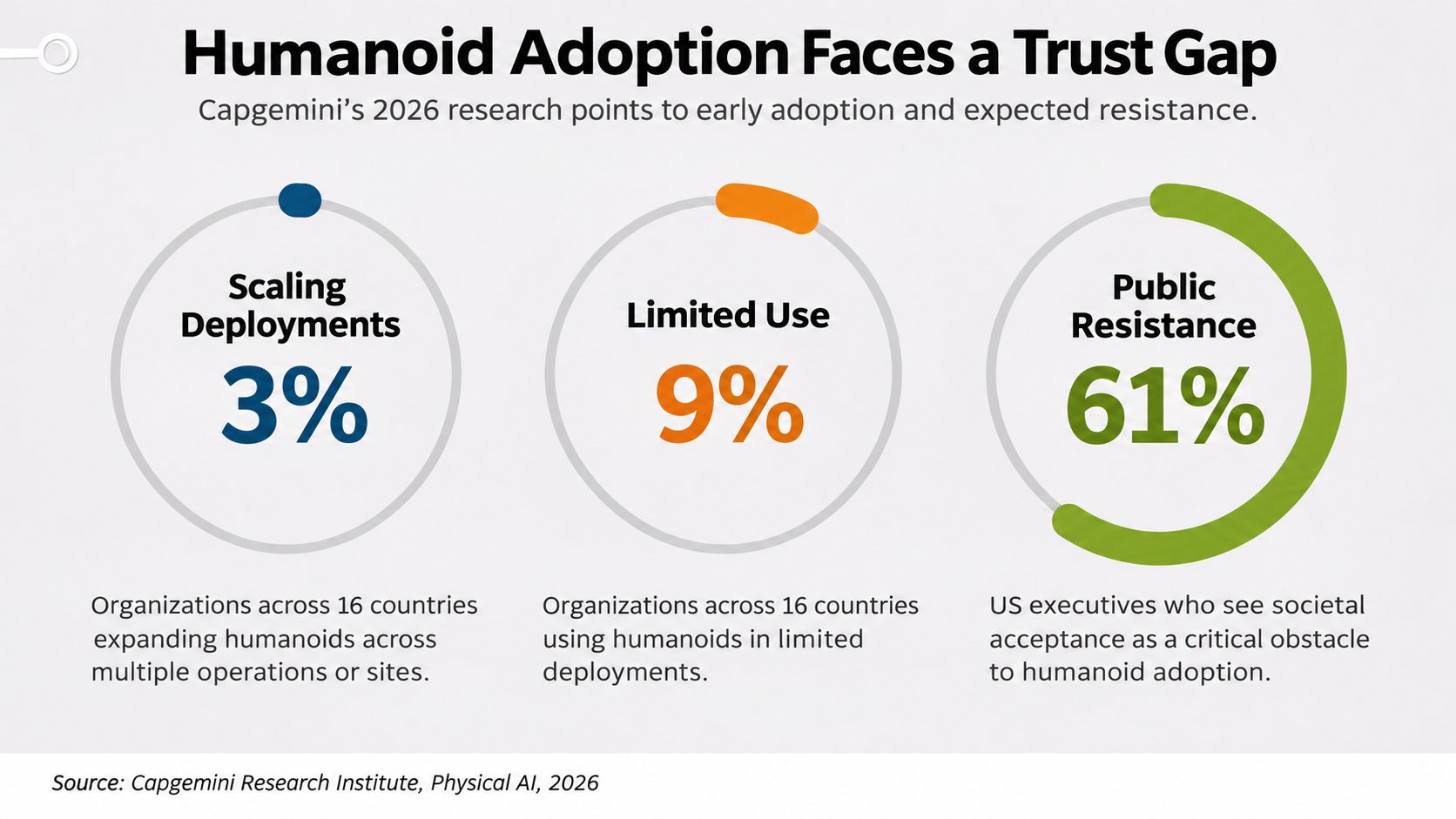
Public acceptance could complicate future expansion. Among surveyed US executives, 61% expected a lack of societal acceptance to be a critical obstacle to humanoid adoption. Researchers also identified concerns about job losses as one potential source of resistance.
Workers are familiar with the fear that technology will replace their jobs. Some US employers have cited AI in announcing job cuts, and humanoids could raise similar concerns on factory floors. During a 2025 trial at BMW's South Carolina factory, Figure 02 handled more than 90,000 automotive components, positioning metal parts with millimeter-level precision.
Imagine spending years learning a job, only to watch a robot perform some of the same tasks. Humanoids cannot yet entirely replace experienced workers, but their growing capabilities help explain why employees might worry about their future.
Employers introducing these machines should involve workers early, explain how their responsibilities may change, and offer retraining opportunities where needed. Producing hundreds of thousands of robots would be an enormous achievement, but earning the trust of the people expected to work alongside them could prove just as challenging.
More on humanoid robots: From Tesla Optimus to Agility's Digit, our analysis examines which humanoid robots are already working and which remain in testing.