






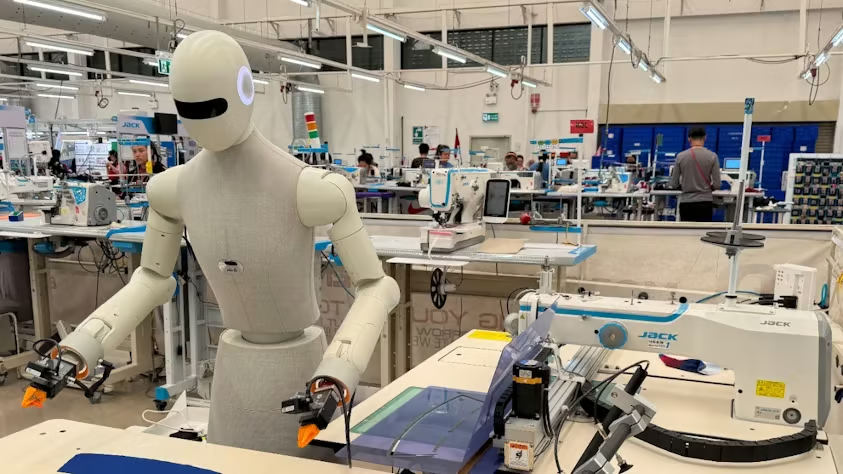


Garments go high-tech.
China-based industrial sewing machine maker Jack Technology has ordered 2,000 humanoid robots designed specifically for apparel manufacturing as part of a partnership with Siemens.
The deployment aims to increase manufacturing efficiency by at least 30% while helping factories respond to shorter production timelines, customized consumer demand, and rising cost pressures.
According to Siemens, the order represents the first large-scale deployment of humanoid robots tailored for apparel production. The robots are intended to work in factory environments already built for people, using existing tools and workstations without requiring major changes to facilities.
Siemens pointed to a recent trial at its electronics plant in Erlangen, Germany, as an example of what these systems can already do.
During a two-week test, a wheeled humanoid robot called HMND 01 autonomously handled warehouse crates, placing them on a conveyor belt and moving them to a handoff point for human workers.
The robot moved 60 crates per hour, handled two different crate sizes, operated for more than eight hours a day, and achieved a success rate of more than 90% in autonomous grasping and placement tasks, Siemens said.
The trial suggests that humanoid robots could take over repetitive material-handling work while fitting into existing industrial workflows.
Robots are expanding beyond the sewing floor
Siemens also highlighted the growing use of four-legged robotic systems in industrial maintenance and inspection.
ANYbotics’ robot dog, ANYmal, is being deployed in chemical and energy facilities to perform inspection tasks that can be dangerous or difficult for human workers. The robot can navigate dark areas, staircases, and multistory buildings while collecting data from hundreds of inspection points. Its infrared cameras measure the temperature of equipment such as pumps and motors, and its acoustic sensors can detect frequencies that help identify gas leaks.
The data is transmitted to operators in real time, allowing facilities to move from reactive repairs toward predictive maintenance.
What this could change for manufacturers
The significance of the 2,000-robot order extends beyond a single company. Apparel manufacturing has historically been one of the world’s most labor-intensive industries, and large-scale deployment of humanoid robots suggests that automation is beginning to move from pilot projects into real factory operations.
For manufacturers, the potential payoff is higher productivity and better handling of labor shortages. For workers, the more immediate impact is likely to be a shift in the kinds of tasks performed, with robots taking on repetitive or physically demanding work while humans supervise, coordinate, and manage production systems.
The bigger challenge may not be the robots themselves. Siemens argues that the real value comes from integrating humanoid robots with digital twins, AI-enabled sensing, production software, autonomous guided vehicles, and factory communication networks.
Without that deeper integration, even advanced humanoid robots remain isolated machines rather than productive factory coworkers.
Also read: A New York school district paused its $58,000 humanoid robot pilot while it strengthens student privacy agreements and continues discussions with the community.