







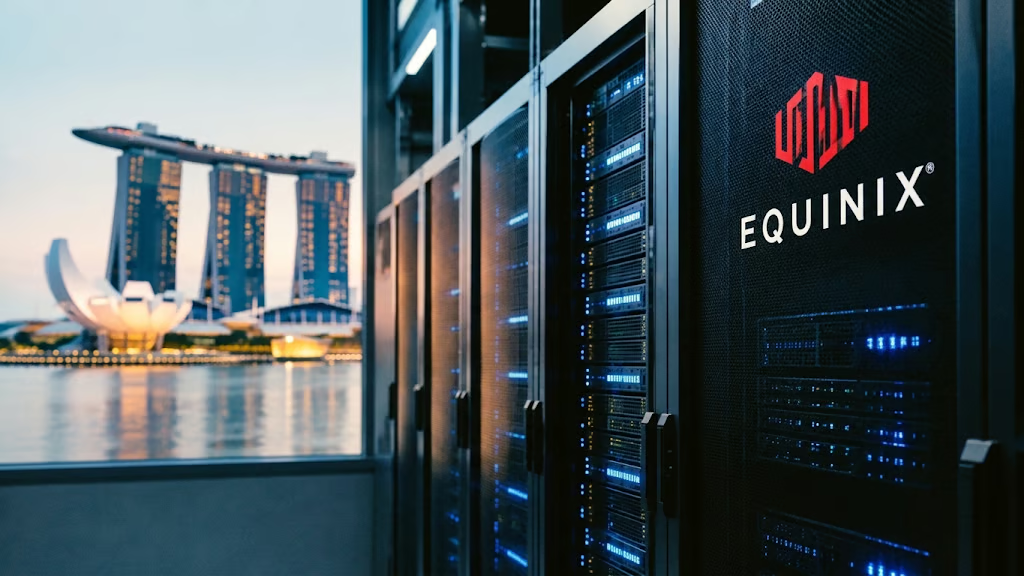
Singapore wants to become a global AI powerhouse. But first, it needs somewhere to put all that computing power.
Equinix announced on Nov. 6 that it has opened SG6, a new Singapore data center backed by an initial US$290 million investment. The facility opens with 8 megawatts (MW) of first-phase capacity and is designed for AI, high-performance computing, and cloud workloads. At full build-out, it is expected to provide up to 20MW of IT capacity.
For businesses expanding AI operations across Asia-Pacific, SG6 adds another potential infrastructure option, although available customer capacity has not been disclosed. It also highlights a growing challenge: Access to electricity, advanced cooling, and connectivity increasingly determine where AI computing can expand.
- Inside Equinix's new US$290 million data center
- What eWeek found: Singapore's AI ambitions face a power test
- Singapore's AI expansion faces an electricity challenge
- Why liquid cooling matters for AI
- What businesses should evaluate before choosing SG6
- Equinix plans a research facility for 2027
- The next AI infrastructure race may be decided by electricity
Inside Equinix's new US$290 million data center
SG6 is Equinix's sixth International Business Exchange data center in Singapore. According to the company's Nov. 6 announcement, the facility combines high-density cooling technology, private interconnection services, and sustainability features.
Feature | SG6 specifications |
|---|---|
| Initial investment | Approximately US$290 million |
| First-phase capacity | 8MW and approximately 1,550 cabinets |
| Planned full capacity | Up to 20MW of IT capacity |
| Cooling | Proprietary cooling array technology and liquid-cooling capabilities |
| Target PUE | 1.20 (design target) |
| Sustainability | Solar panels, NEWater, rainwater harvesting, and water reuse |
| Planned research facility | 2027 |
Power usage effectiveness (PUE) compares a data center's total electricity consumption with the electricity used by its IT equipment. SG6's 1.20 figure is a design target, not a verified operating result.
Equinix reports that its Singapore data centers have maintained 100% renewable-energy coverage since 2020. According to the company's renewable-energy announcement, its four power purchase agreements in Singapore are expected to support a cumulative renewable-energy portfolio of 215 megawatts-peak (MWp) by 2028.
The 215MWp figure represents the expected cumulative renewable-generation capacity associated with those agreements by 2028, rather than SG6's IT capacity. Renewable-energy coverage also does not guarantee that renewable electricity is supplied every hour.
SG6 is a colocation facility, meaning businesses deploy their own computing equipment while Equinix provides power, cooling, and connectivity. Its AI-ready designation does not guarantee the inclusion of GPUs or managed AI services.
Equinix has not disclosed SG6-specific customer pricing, GPU configurations, or AI performance benchmarks. Businesses must confirm whether the facility can support their equipment and workloads.
What eWeek found: Singapore's AI ambitions face a power test
Equinix's investment illustrates how AI infrastructure growth increasingly depends on energy availability, cooling efficiency, and operating costs.
Key finding | Why it matters |
|---|---|
| Electricity is a competitive advantage | Reliable power and efficient cooling influence where businesses can expand AI operations. |
| AI-ready doesn't mean GPUs are included | Customers must verify hardware compatibility, computing resources, and service arrangements. |
| Efficiency requirements are tightening | Customer IT server equipment deployed at SG6 must meet recognized energy-efficiency requirements. |
| Location shapes AI costs | Connectivity, latency, data governance, and electricity expenses affect deployment decisions. |
| Research could improve efficiency | A planned partnership will explore cooling, digital twins, and energy storage. |
Singapore's AI expansion faces an electricity challenge
Singapore is expanding data center capacity while managing limited land, electricity, and water resources.
In August, the government provisionally allocated 200MW of additional capacity across Equinix, Digital Realty, Keppel Data Centres, and ST Telemedia Global Data Centres. Each operator received 50MW under the second Data Centre – Call for Application program.
Those allocations represent planned future capacity. SG6 was developed under an earlier allocation process. Equinix's separate 50MW provisional award in August is intended for another data center development on Jurong Island, according to The Straits Times. Building AI infrastructure takes more than purchasing GPUs. Operators need adequate power, cooling, and network connectivity before the hardware can support production workloads.
Singapore is also tying infrastructure expansion to energy efficiency. Equinix says customer IT server equipment deployed at SG6 must carry a recognized energy-efficiency certification or demonstrate equivalent efficiency under the SS 715:2025 standard.
For businesses, that means checking equipment compliance before committing to a deployment. Singapore's approach could also influence infrastructure development in other markets facing energy and land constraints.
Why liquid cooling matters for AI
AI accelerators can generate substantial heat, making conventional air cooling less practical for some high-density deployments.
SG6's liquid-cooling capabilities could help businesses accommodate demanding hardware while managing temperatures more effectively. Potential benefits include:
- Higher computing density: Supporting more powerful equipment within available space.
- Improved thermal management: Maintaining suitable temperatures for demanding GPU systems.
- Potential efficiency gains: Reducing cooling overhead, depending on workload and system design.
However, liquid cooling introduces compatibility, maintenance, and infrastructure considerations. Businesses should confirm supported configurations, available power per rack, and cooling requirements before selecting a provider.
What businesses should evaluate before choosing SG6
A new AI-ready facility does not automatically guarantee available GPUs, affordable computing, or immediate deployment capacity.
Organizations considering SG6 should evaluate four factors:
1. Available capacity. SG6 opens with 8MW of first-phase capacity, while its planned 20MW represents future expansion. Businesses should verify available space, power density, and deployment timelines directly with Equinix.
2. Hardware compatibility. Training and inference workloads have different requirements. Organizations should confirm GPU compatibility, cooling support, equipment certification, and network performance.
3. Operating costs. Electricity, networking, cooling, and service charges influence total costs. Equinix has not publicly disclosed SG6-specific pricing.
4. Location and connectivity. Singapore's network ecosystem could benefit businesses serving Southeast Asia, but latency, resilience, and data governance requirements should guide deployment decisions.
Equinix is also developing a broader AI infrastructure strategy. In September, eWeek reported on its planned Inference Exchange service, expected to become available starting in the first quarter of 2027.
However, Equinix has not confirmed SG6 as an Inference Exchange location. The initiatives should therefore be considered separately.
Equinix plans a research facility for 2027
Equinix also plans to establish a Co-Innovation Facility at SG6 with the National University of Singapore's Energy Solutions Hub.
Targeted for 2027, the facility will investigate liquid cooling, cognitive digital twins, and battery energy storage to improve data center efficiency and sustainability.
The partnership is part of Singapore's broader effort to develop its AI ecosystem. Earlier this year, OpenAI committed more than S$300 million to establish an Applied AI Lab in Singapore, supporting AI adoption among businesses and government organizations.
Together, these investments highlight Singapore's ambitions to expand AI applications, research, and supporting infrastructure.
The next AI infrastructure race may be decided by electricity
Equinix's US$290 million investment adds to Singapore's AI infrastructure ecosystem, but it also underscores a challenge facing the industry.
Advanced chips alone cannot sustain AI growth. Businesses also need reliable electricity, effective cooling, strong connectivity, and manageable operating costs.
SG6 has opened its first phase, with further expansion planned. Businesses will need to confirm available capacity directly with Equinix.
The bigger question is whether Singapore can keep building AI infrastructure without allowing energy constraints and costs to undermine its ambitions. How it answers that question could influence AI infrastructure development across Asia-Pacific.
Also read: Singapore isn't alone in expanding its AI infrastructure. OpenAI's planned data centers in Malaysia will deploy Nvidia Vera Rubin systems, highlighting how Southeast Asia is becoming a major destination for advanced AI computing investments.