






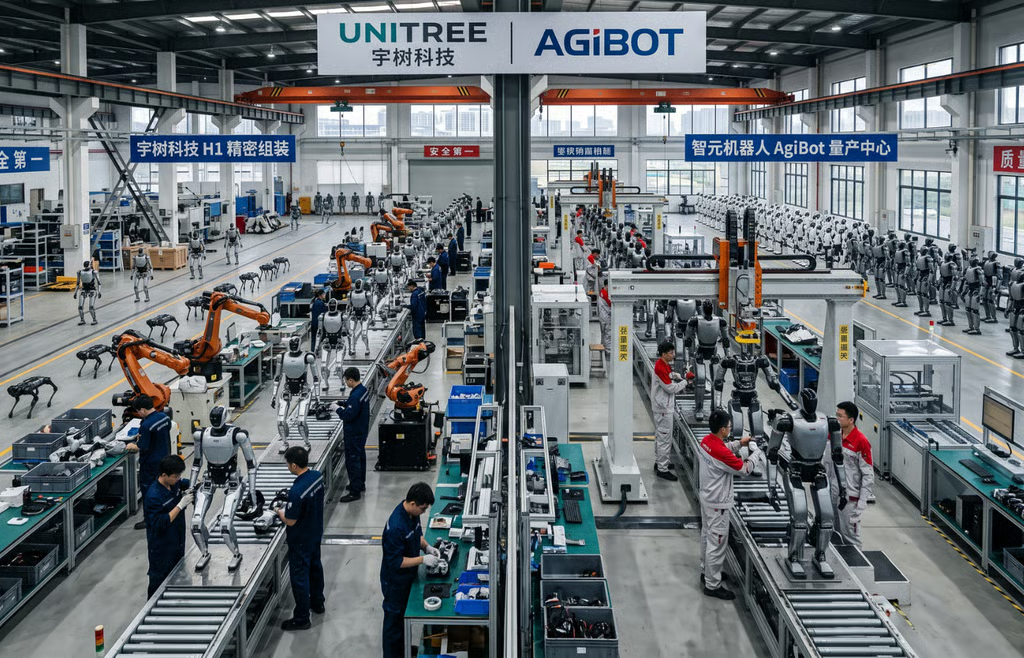


Almost every humanoid robot shipped worldwide in the first half of 2026 came from a Chinese vendor.
Chinese companies supplied more than 97% of global shipments, according to Smart Analytics Global (SAG). Worldwide volume jumped 272% year over year to about 19,100 units, while AgiBot overtook Unitree for the top spot.
China’s lead is already enormous for such a young market. Harder to judge is how much of it survives once customers expect humanoids to work reliably and justify what they cost.
China’s home market fuels its lead
China is making most of the world’s humanoids and buying most of them too. SAG estimates the country generated more than 85% of global demand. Home demand gives local robot makers somewhere to sell machines while production is still ramping up.
A dense manufacturing base gives them another advantage. Robot makers can work close to suppliers and nearby factories, shortening the distance between building a machine and putting it to work. Government-backed programs are also moving thousands of humanoids into factories and logistics operations.
Industrial and commercial uses accounted for more than 70% of shipments during the period, up from roughly half a year earlier. Factories and warehouses offer repeatable jobs where humanoids can be tested at scale, giving Chinese developers more chances to learn what customers will actually pay to automate.
AgiBot pulls ahead in a crowded Chinese field
AgiBot has gained the most ground so far. SAG says the Shanghai robot maker shipped about 8,400 units, helped by a lineup geared toward industrial and commercial work. A six-day factory livestream earlier this year showed its machines operating on an active production line, part of the company’s effort to prove they belong outside exhibitions.
Unitree remained the closest rival at roughly 5,900 shipments, with research and education making up a larger part of its customer base. Its aggressive production plans show the race is far from settled.
Behind both leaders, Galbot, UBTECH, and Leju are pursuing their own industrial markets, giving the country several vendors trying to turn early deployments into repeat business.
Buyers have a different scoreboard
Manufacturers and technology buyers should not read China’s shipment share as proof that one country has already won humanoid robotics.
Shipment tables show who can get machines out the door. However, a factory manager still needs to know how often a robot fails, how much support comes with it, and whether the machine can perform the same task thousands of times without constant intervention.
China’s scale could work in buyers’ favor if higher production brings prices down and gives vendors more opportunities to improve their machines. Reliability remains a tougher test, including basic manipulation work. Regional customers will also need service and integration support once robots move beyond pilot deployments.
Repeat orders will be worth watching more closely than the next leaderboard. Longer factory deployments and sales outside China would show whether today’s shipment advantage can travel across the wider humanoid hardware race.
China has proved it can produce humanoids in volume. Whether customers keep buying them after the first deployments will tell us far more about who is actually pulling ahead.
Related News: China’s 2035 lunar station plans may rely on autonomous robots to take on construction and support work in harsh moon conditions.