







Robots may soon get a second chance to remember things correctly, thanks to an MIT system that helps machines identify faulty memories and rewrite them using fresh visual evidence.
Researchers at the Massachusetts Institute of Technology (MIT) have developed an artificial intelligence system called UQ-DAAAM that allows robots to detect unreliable descriptions of objects in their surroundings and replace them with more accurate information.
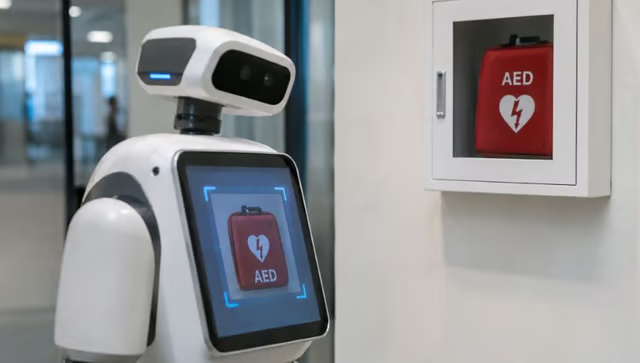
MIT illustrated the problem with a medical emergency: A robot asked to retrieve a wall-mounted defibrillator could fail if it previously mistook the device for a fire extinguisher. By allowing robots to question and update stored information, the researchers hope to make autonomous systems more reliable as they take on increasingly complex tasks.
Why robots need a way to correct faulty memories
The system addresses a problem that could become increasingly important as robots take on more complicated jobs in homes, hospitals and industrial facilities: a machine can make a mistake when identifying an object and continue relying on that incorrect information long after its first observation.
MIT illustrated the risk with a medical emergency. A robot asked to retrieve a wall-mounted defibrillator might fail if it previously misidentified the device as a fire extinguisher. UQ-DAAAM, short for Uncertainty Quantification for Describe Anything, Anywhere, at Any Moment, aims to prevent such mistakes from becoming permanent.
The research builds on MIT's earlier DAAAM framework, which uses vision-language models (VLMs) to generate descriptions of objects captured by a robot's cameras. These descriptions are stored in a three-dimensional map of the environment for future reference.
However, distant objects, poor lighting and partially obstructed camera views can cause the system to generate inaccurate descriptions. Without a correction mechanism, those errors can affect subsequent decisions.
How the system rewrites faulty memories
UQ-DAAAM combines uncertainty measurement with observations captured from different viewpoints.
As a robot moves, its cameras collect images of its surroundings. The system evaluates the confidence of the VLM's descriptions and compares them with captions generated from other images of the same object. It combines these measurements into an uncertainty score.
When the score exceeds a predetermined threshold, the system selects additional images that could help establish what the object actually is.
Instead of repeatedly running the vision-language model on every image, the researchers developed a mathematical method to identify which camera views are most useful for resolving uncertainty. This reduces the amount of processing required as the robot moves through its environment.
A large language model (LLM) then combines the selected descriptions into a revised memory entry, giving greater weight to newer and less ambiguous observations.
Luca Carlone, an MIT associate professor and senior author of the research, said: “Allowing a robot to know what it doesn’t know is going to be essential for this technology to be deployed safely and have a positive impact on society.”
Early tests show measurable improvements
In MIT's reported experiments, the system resolved ambiguities for approximately 92% of objects in the robot's environment while requiring just two additional captions per object.
It also improved object-description accuracy by 5% compared with existing state-of-the-art methods. The researchers found that robots using the system gave more accurate answers about objects they had encountered, where they had seen them and when they last observed them.
The findings will be presented at the Conference on Neural Information Processing Systems (NeurIPS). The research team includes Carlone and MIT graduate students Harry Zhang and Nicolas Gorlo. The work received partial support from the US Army Research Laboratory and the US Office of Naval Research.
What eWEEK found: Better memories do not automatically mean safer robots
The more important development here is not simply that robots can correct incorrect object labels. It is that MIT is addressing a weakness in how physical AI systems use information over time.
eWEEK found that the ability to recognize and correct mistakes could become a critical requirement for enterprise robots, particularly as businesses deploy autonomous machines that must navigate changing environments and work alongside people.
A robot that misidentifies an object once can carry that mistake into several subsequent tasks. In an industrial setting, for example, confusing two similar-looking components could affect equipment handling, inspection or assembly. In a hospital, an incorrect object description could create problems when a robot is expected to retrieve medical equipment.
UQ-DAAAM introduces a way to challenge an earlier observation rather than treating stored information as permanently reliable. That could become an important capability as businesses deploy autonomous machines that must navigate changing environments and work alongside people.
However, the reported 92% ambiguity-resolution rate does not mean the system eliminates 92% of all robot errors. It measures how often the refinement process resolved ambiguities under the researchers' evaluation conditions. It also does not establish that every corrected memory will lead to a safe physical action.
Businesses considering physical AI deployments should therefore look beyond object-recognition accuracy. They will need evidence that these systems can avoid incorrect corrections, recognize when uncertainty remains and make safe decisions when their observations conflict.
Independent testing in unfamiliar environments will be particularly important before applying these capabilities to safety-sensitive tasks.
MIT researchers plan to extend UQ-DAAAM to other robotic platforms, including mobile manipulators, and investigate whether robots can actively revisit uncertain areas to gather better evidence.
The broader implication is that reliable robots may need more than accurate perception. They may also need the ability to recognize when their existing understanding of the world can no longer be trusted.
Boston Dynamics has unveiled Stretch Gen 2, an upgraded warehouse robot capable of unloading up to 1,000 cases per hour, with 81% less internal cabling and redesigned components aimed at reducing maintenance downtime.