







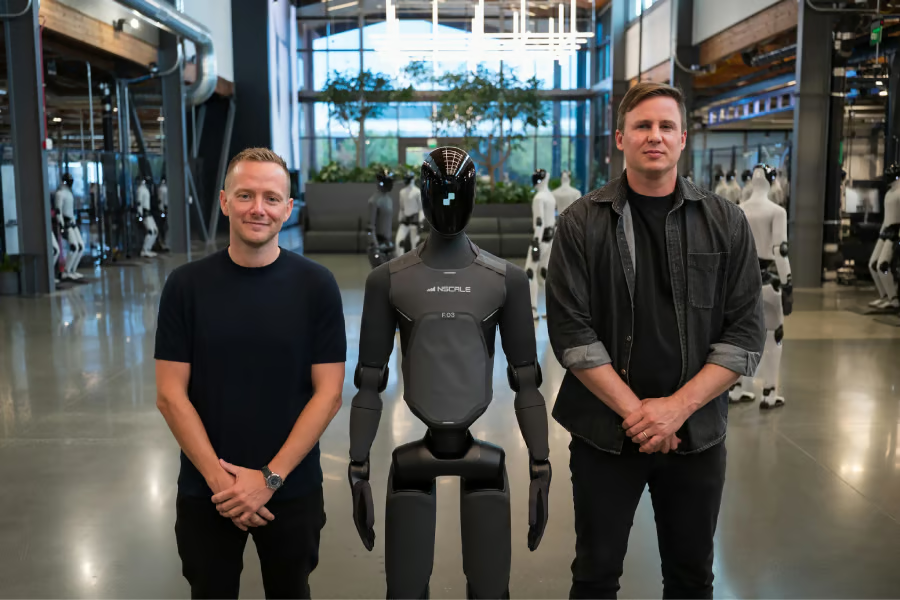
Figure AI has made a multiyear compute commitment worth nearly twice as much as everything it has raised in its entire history.
The humanoid robotics company signed an agreement with AI cloud provider Nscale covering an initial $3.5 billion in compute capacity, with plans to expand the partnership beyond $6 billion. The infrastructure could eventually give Figure access to as many as 100,000 Nvidia GPUs running on the Vera Rubin platform.
That commitment stands out because Figure has raised nearly $2 billion in funding to date. It does not mean the company has paid $3.5 billion upfront, but the disparity reveals just how much computing infrastructure Figure believes it will need to build increasingly capable humanoid robots.
Figure wants up to 100,000 Nvidia GPUs
Under the agreement, announced on Sept. 3, Nscale will become Figure’s preferred compute provider and make a strategic investment in the robotics company.
The first GPU deployments are targeted for the second half of 2027 in Barstow, Texas. Figure said the infrastructure could eventually include up to 100,000 GPUs based on Nvidia’s Vera Rubin platform.
The computing capacity will support future development of Helix, Figure’s AI system for controlling its humanoid robots. Figure said in its announcement of the Nscale partnership that the company has reached a point where its progress is increasingly constrained by the data and compute required to train Helix.
Figure has spent much of 2026 showing what Helix can already do. Its Figure 03 robot recently climbed a ladder autonomously, while earlier demonstrations showed Helix-powered robots performing long-duration logistics work.
The company has also been scaling the hardware side of the equation. In April, Figure said its BotQ manufacturing operation had produced more than 350 Figure 03 robots while demonstrating a production cycle of one robot per hour.
Now the bottleneck may increasingly be the intelligence inside those machines.
What eWeek found: Figure is building an AI flywheel for robots
The $3.5 billion deal makes more sense when viewed alongside another massive undertaking inside Figure: collecting enough real-world data to teach robots how humans move and work.
Figure launched its Index initiative in August to collect video of people performing physical tasks. By Aug. 25, Figure said Index had accumulated more than 16 million videos and was processing about 30 minutes of uploaded video every second. In its announcement, Figure said that rate had increased to 35 minutes of data every second.
Just over a week separated the Index announcement and the Nscale deal.
Taken together, the two initiatives reveal the flywheel Figure is trying to build:
- Humans generate huge volumes of real-world training data.
- Figure uses increasingly large amounts of compute to train Helix on that data.
- Improved Helix models are deployed into more robots.
- Those robots can generate additional data that can help inform future models.
That cycle starts to make Figure look less like a conventional robotics manufacturer and more like a frontier AI company with arms and legs.
The implication is important for the broader humanoid industry. Building better motors, hands and batteries may no longer be enough. Companies could increasingly compete on access to GPUs, data centers, power, and vast datasets that show how people interact with the physical world.
The $3.5 billion figure needs some context
Figure’s commitment should not be confused with an immediate $3.5 billion purchase.
The commitment spans multiple years, and the first GPU deployment is not targeted to begin until the second half of 2027. Figure and Nscale also intend to expand the relationship beyond $6 billion, but that represents potential future scale rather than money already spent.
Still, comparing the commitment with Figure’s fundraising illustrates the size of the bet.
Figure raised $675 million in 2024 before announcing more than $1 billion in committed Series C capital in September 2025 at a $39 billion post-money valuation. Figure said in its Series C announcement that the money would help fund Helix, manufacturing, data collection and next-generation GPU infrastructure.
A Forbes analysis published Friday highlighted the disparity between Figure’s roughly $1.9 billion in fundraising and its $3.5 billion compute commitment.
The publicly disclosed details do not indicate that Figure made an immediate $3.5 billion payment. However, Figure and Nscale have not disclosed the full financial terms or payment schedule behind the multiyear commitment.
That leaves an important question around how Figure will finance such a large infrastructure commitment as it scales its robot fleet.
Humanoid robots are becoming an infrastructure story
Figure already has robots working beyond controlled laboratory demonstrations.
BMW has deployed Figure robots at its Spartanburg plant, where the automaker is testing Figure 03 on increasingly complex factory and logistics tasks. eWeek previously examined how those deployments are putting pressure on the IT infrastructure behind industrial robots.
The Nscale agreement suggests that infrastructure challenge is about to grow much larger.
Humanoid robotics is often presented as a hardware race involving motors, batteries, hands, sensors and manufacturing scale. Figure’s latest commitment suggests that some of the most important competition may happen somewhere far less visible: inside enormous data centers that train the AI models that tell those robots what to do.
If Figure’s strategy works, the winners of the humanoid race may need more than better robots. They may need an AI infrastructure operation capable of competing with the companies building frontier AI models.
Related reading: For a closer look at what all that compute is meant to power, see how Figure AI’s robots worked a 17-hour shift and sorted more than 22,000 packages.