







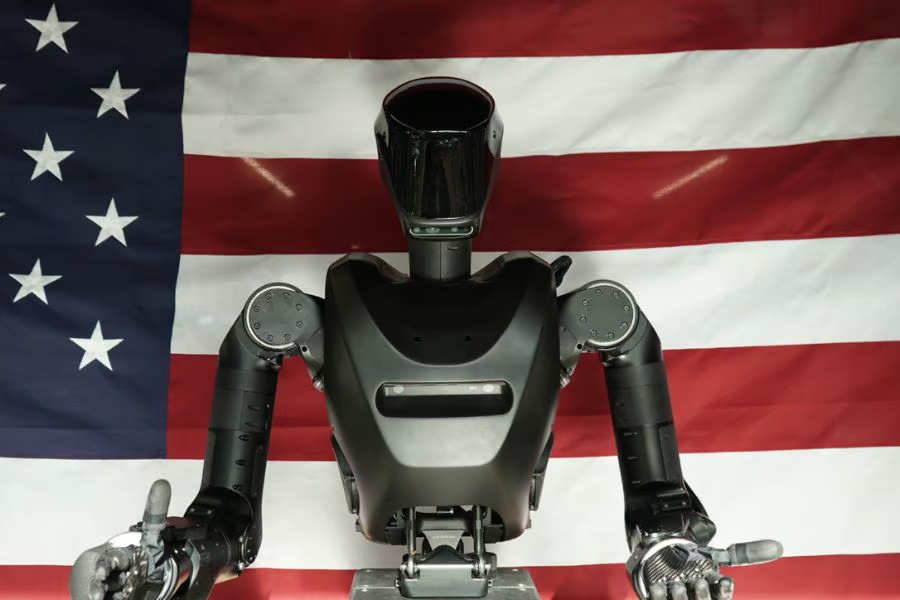
Foundation, a San Francisco robotics company, is proposing its Phantom humanoid robot as a potential surveillance and reconnaissance tool for the US southern border.
CEO Sankaet Pathak told Fox News that the company has demonstrated its technology to Department of Homeland Security officials and is discussing potential applications with multiple national security agencies.
"We're in conversations with almost all national security government bodies, so Air Force, Navy, Army, DHS," Pathak said. "We continue to have dialogues. We're starting to negotiate contracts and some applications for them."
But the proposal has not yet become a government program. A DHS spokesperson told Fox News: "The Department of Homeland Security currently does not have any non-contractual agreements, pilots, or active prime contracts with Foundation."
Foundation says Phantom could move across uneven terrain, distinguish people from other objects and create maps of its surroundings. The company envisions the robot operating autonomously, identifying suspicious activity and alerting human officers rather than making enforcement decisions itself.
From military testing to the border
The border proposal builds on Foundation's broader effort to position Phantom for dangerous environments.
The company previously sent two Phantom MK-1 robots to Ukraine for pilot demonstrations focused on logistics missions in dangerous areas. Foundation has secured $24 million in US government research contracts to evaluate potential uses such as logistics, inspection and weapons handling.
That history makes the border pitch notable: Foundation is moving the same basic idea, sending humanoid machines into places considered risky for people, from military environments toward domestic security. Pathak said tunnels and other difficult-to-reach areas could also become targets for robotic surveillance.
"Our biggest thing is if we can keep our officers in a safe place, and these robots can continue to surveil 24/7," Pathak told Fox News.
The technology still has limits
Foundation's current Phantom is not yet designed for every outdoor condition. Weather resistance remains a major limitation, according to Pathak.
Pathak said the company plans to introduce a second-generation model later this year that will be waterproof, dustproof and more rugged for outdoor deployment. Foundation also says Phantom is built around its Cortex AI system, which combines visual, language and multimodal capabilities to help robots understand and act in physical environments.
The biggest hurdle may not be whether Phantom can walk across rough ground, but whether it can operate reliably in the unpredictable conditions along the roughly 1,950-mile US–Mexico border.
A robot that loses power, struggles with extreme weather, misidentifies a person or suffers a communications failure could create new problems instead of solving old ones. Human oversight also means the system would supplement agents rather than eliminate the need for them.
For Foundation, that could make surveillance the more realistic first step. Pathak said a pilot could begin quickly, but DHS has not announced such a program. If that changes, the border could become another real-world proving ground for humanoid robots, this time outside the battlefield and much closer to home.
Read more: As Foundation explores domestic surveillance applications for Phantom, Taiwan is testing robot dogs for reconnaissance, surveillance and patrol duties, showing how governments are evaluating robotic systems for security roles while formal procurement remains unsettled.