







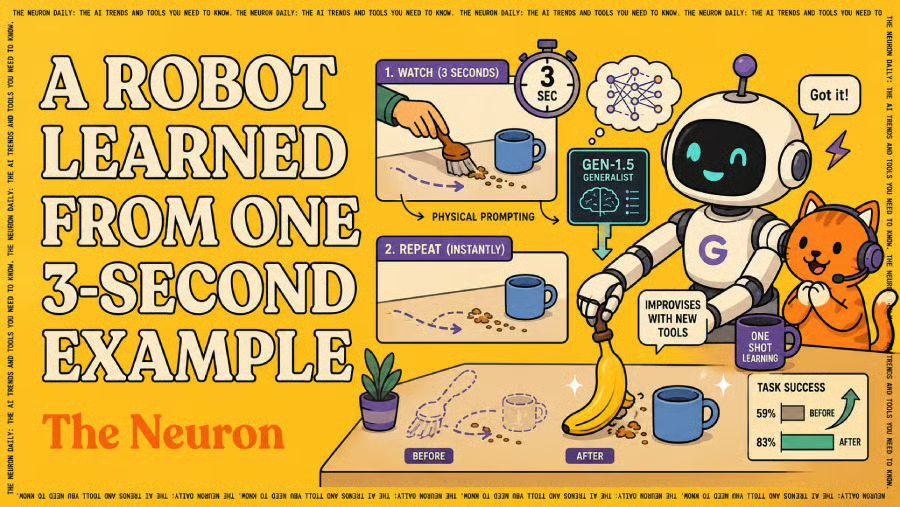
So y’know how you and I can pretty much watch somebody do something once, and at least attempt it, even if we kinda suck at it? Well, now robots can do that too!
Yesterday, Rich Sutton argued that AI’s next leap won’t come from stuffing models with more human-made data. It’ll come from agents that keep learning from the world they’re actually operating in. Less than 24 hours later, Generalist dropped GEN-1.5, a robot model that makes that idea feel a lot less theoretical.
Here's what happened
GEN-1.5 can watch a single 3–12-second physical demonstration and immediately attempt the new task. Generalist calls it “physical prompting”: the demo sits in the robot’s 30-second context window, with zero gradient updates.
- Across 10 simple tasks, one demo achieved an average success of 59%; 10 weight updates on five minutes of data raised that to 83%.
- It can copy some human-hand demonstrations, use simulated demonstrations on a real robot, combine two physical prompts, and improvise with unseen tools.
- Previous robot adaptation can take tens of thousands of gradient steps. Generalist says 10 steps changed GEN-1.5’s weights by less than 0.15%.
Our take
This matters for two reasons. First, the interface changes from programming a robot to showing it. Second, it starts to make Sutton’s “Big World” thesis concrete: the world is far bigger than any static training set, so useful intelligence has to keep learning from whatever it encounters now.
There’s an important distinction Sutton would care about: GEN-1.5’s one-shot trick is in-context learning, not persistent learning. Its weights do not change. The few-shot mode, where GEN-1.5 updates its weights in 1–10 steps, is actually closer to Sutton’s continual-learning vision.
The important number may not be 59%. It may be the amount of new experience required to get there.
After eight months of broad physical pretraining, Generalist says GEN-1.5 can turn just a few seconds of demonstration into useful behavior. The company describes that adaptation as less like teaching a robot something entirely new and more like reminding it of something it nearly knows.
The bigger test comes next. If systems like GEN-1.5 can make those newly acquired skills persistent, build on them over time, and avoid forgetting what they already know, Sutton’s vision of machines that continually learn from the world around them starts looking considerably less theoretical.
Editor's note: This article originally appeared on our sister publication, The Neuron.