






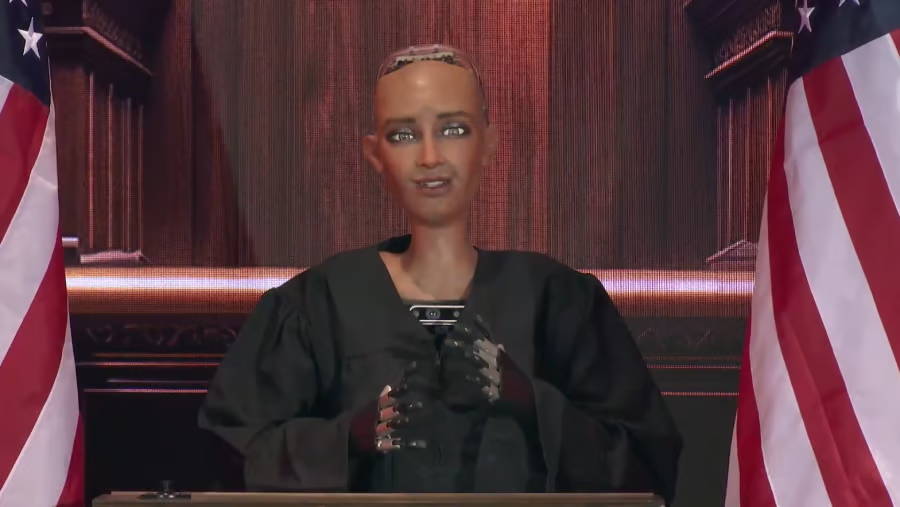


Lawyers usually enter a courtroom hoping to persuade a judge. At the Burton Awards, they had to make their case to Sophia, a humanoid robot.
During a simulated appellate hearing at the Library of Congress, a humanoid judge heard a contract dispute involving former NFL linebacker Ken Harvey and Game Day Jerseys. Its introduction was scripted, while organizers presented the courtroom exchanges and final decision that followed as extemporaneous AI responses.
Seeing a robot on the bench is unusual enough. Asking one to weigh legal arguments and make the call turns the demonstration into a test of how convincing AI can be when authority is part of the performance.
A contract dispute puts the robot to work
At issue was Harvey’s five-year exclusive agreement with Game Day Jerseys. He wanted a commemorative jersey carrying his former teammates’ names, but the manufacturer produced one bearing only his, according to the Burton Awards
His lawyer soon put Sophia to the test. When she called Harvey “hoodwinked,” the opposing lawyer objected, and the robot agreed the wording went too far. Attorneys later asked the humanoid to consider earlier court decisions before making its ruling.
After closing arguments, Sophia found the exclusivity provision “unconscionably broad and vague” and partially rescinded the contract, allowing Harvey to seek another manufacturer for the commemorative jerseys.
Ruling that does not fully add up
One moment in the hearing is difficult to follow. During a dispute over information that was not written into the contract, Sophia said such evidence could still be considered in some cases. A few moments later, it refused to let the evidence in.
If the transcript accurately captures the exchange, the two decisions do not fully line up. The inconsistency raises questions about AI hallucinations when a system is expected to weigh competing arguments and apply the law consistently. Fluent legal language can still make weak reasoning sound convincing.
Real courts have already paid a price when bad AI output survives review. For example, a California appeals court fined an attorney $10,000 after a brief included ChatGPT-generated citations to cases that did not exist. Judicial use would demand an even higher standard because an unchecked error could affect the ruling itself.
With real authority comes real accountability
Anyone whose job or contract could be affected by AI has a more personal concern than whether a robot can perform convincingly onstage. Real use would require a way to understand how an answer was reached and challenge it when the reasoning fails.
Human judges are already encountering AI-generated material inside proceedings. An Arizona sentencing hearing included an AI-generated victim impact statement, and a Chinese court ruled that AI replacement was not enough to justify firing an employee. Human judges remained responsible for both outcomes.
Lawyers would need records showing which facts and legal authorities shaped an AI-assisted ruling. Court administrators would also have to define who can override the system and who bears responsibility when it fails.
Burton’s case had no legal force, but the simulation gave us a small look at what could happen once a robot’s judgment carries real consequences.
If humanoid robots like Sophia ever move from demonstrations into real courtrooms, a contract dispute like Harvey’s may be only the beginning. Future cases could decide a company’s fate, a person’s freedom, or, in the most serious proceedings, a human life.
More News: Robot.com is developing R-Dog to handle package delivery and mobile advertising with one dog-inspired robotic platform.