







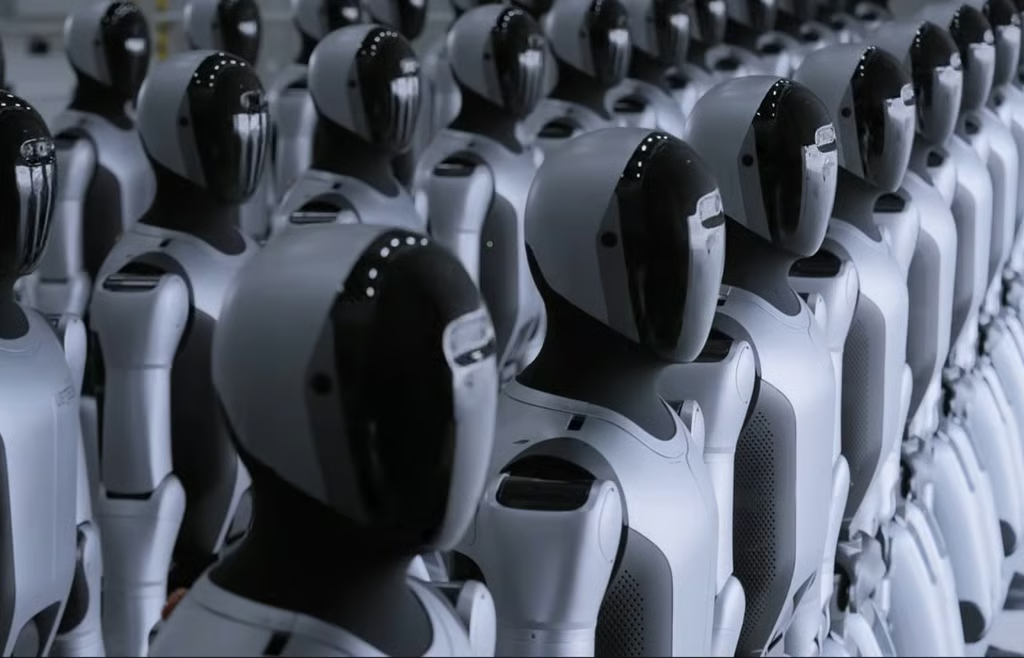
China is putting humanoid robots to work at a scale no one else has matched.
UBTECH has begun delivering hundreds of its Walker S2 units across the country, the first large-scale industrial deployment of full-size humanoids anywhere in the world.
The Shenzhen-based company is filling a surge of domestic orders as automakers and logistics giants adopt the robots for frontline work. With thousands more units in the pipeline, China is moving faster than any rival to turn humanoid robotics into an everyday part of industrial operations.
Mass deliveries kick off
UBTECH’s rollout is being propelled by a surge of high-value contracts across China.
In its latest announcement, the company said it has already shipped hundreds of Walker S2 units into active industrial sites, part of more than 800 million yuan (about $112 million) in confirmed orders. According to PR Newswire, that includes a 159-million-yuan deployment in Zigong and the year’s largest deal: a 250-million-yuan contract signed in September.
Additional purchases across Sichuan, Guangxi, and Hubei are further accelerating the pace, Interesting Engineering reports, putting UBTECH on track to produce 500 humanoid robots before year-end.
No breaks, no breathers
China’s biggest manufacturers are already putting robots to work in roles built for nonstop motion. Automakers including BYD, Geely Auto, FAW-Volkswagen, Dongfeng Liuzhou Motor, Audi FAW, and BAIC have begun integrating UBTECH’s Walker S2 into their production lines, assigning the robots to repetitive, mobility-heavy tasks that typically demand long hours and constant attention.
Logistics leaders Foxconn and SF Express are deploying the units as well, using them in warehouse and smart-factory operations that run around the clock.
UBTECH’s early trials show the robots performing reliably in high-traffic, real-world environments rather than controlled lab setups. As factories aim for 24-hour output with little oversight, full-size humanoids bring the endurance that nonstop industrial work requires.
Hardware built for hard labor
Walker S2 is engineered for the kind of work that rarely slows down. Its self-swapping battery system lets the robot replace its own power pack and jump back into service within minutes, keeping production lines moving with little to no downtime.
Its humanlike mobility gives it range that fixed robots can’t match. The unit can deep-squat, stoop, and lift up to 15 kilograms, allowing it to handle ground-level tasks, tight spaces, and repetitive movements common on factory floors.
UBTECH also equipped it with dexterous, sensor-packed hands, giving it the fine control needed to grip tools, move parts, and complete manual tasks that demand precision rather than brute force.
A binocular stereo-vision system helps Walker S2 read its surroundings in real time, improving navigation and safety as it works around people, pallets, and moving machinery. Paired with UBTECH’s BrainNet reasoning system, the robot can understand instructions, plan tasks, and flag anomalies. These traits help it operate reliably in messy, unpredictable industrial settings.
The frame is made from aerospace-grade materials and reinforced composites, giving the robot the durability to withstand constant movement and long shifts in warehouses and production halls.
Scaling from hundreds to thousands
The robotics company is preparing for an aggressive production leap, targeting 5,000 humanoid robots a year by 2026 and 10,000 by 2027. Output is moving from limited batches to true factory-scale manufacturing as demand for industrial humanoids accelerates.
It’s also transitioning from selling standalone units to delivering turnkey operational systems, complete packages that cover deployment, training, and scenario setup for factory floors. Humanoids now make up more than 30% of total sales, up from last year, supported by stronger financials and growing investor confidence.
China’s ability to manufacture humanoids at scale gives it a head start competitors are still chasing. As rival countries test small pilot fleets, the country is laying the groundwork for an ecosystem where humanoids roll off production lines like any other industrial machine.
A new hybrid grocery model is being tested by Amazon, using a compact robotic backend to stock both specialty produce and familiar pantry brands.