







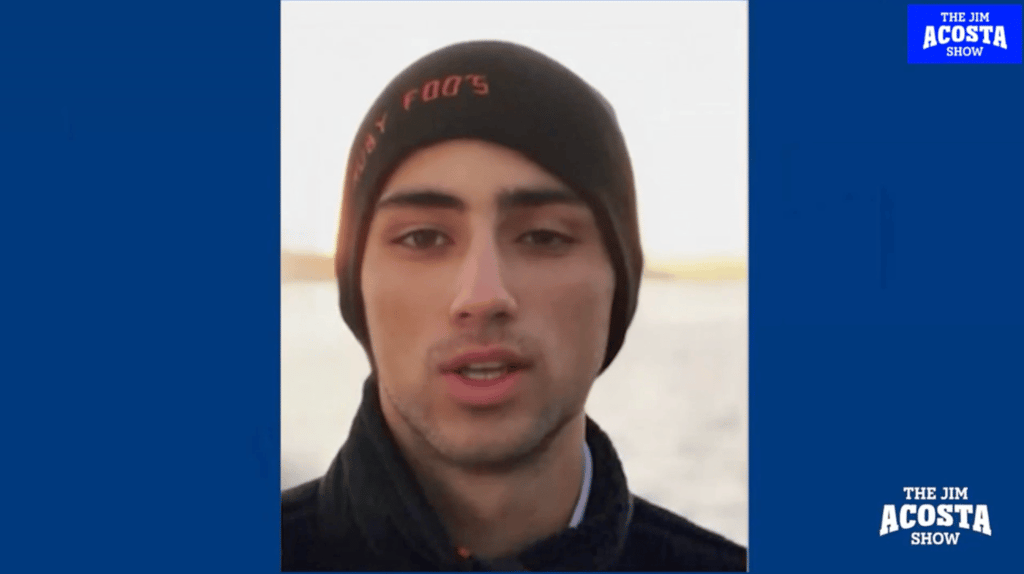
Jim Acosta, CNN’s former White House correspondent, has released an interview featuring an artificially generated avatar of a school shooting victim. Joaquin Oliver was just 17 years old when he was killed by a gunman who opened fire at Marjory Stoneman Douglas High School in Parkland, Florida, in 2018.
Joaquin’s AI avatar was created by his parents using a photograph of him and can answer questions in his voice in real-time. It has been trained on things that the teenager wrote, said, and posted online, as well as broader AI training data.
Acosta began his interview, published on what would have been Joaquin’s 25th birthday, by asking what happened to him, to which the avatar responded that he “was taken from this world too soon due to gun violence while at school.”
The interviewer, who works as an independent journalist posting on Substack since leaving CNN in January, then asked what AI Joaquin’s solution would be for gun violence. He responded in the video, “I believe in a mix of stronger gun control laws, mental health support, and community engagement. We need to create safe spaces for conversations and connections, making sure everyone feels seen and heard.”
The rest of the interview discusses Joaquin’s interests, basketball and the movies “Star Wars” and “Remember The Titans.” The main message, though, was that AI Joaquin “want(s) to keep inspiring others to connect and advocate for change.”
Joaquin’s parents likes to hear their son’s voice through the AI avatar
Acosta then speaks to Joaquin’s father, Manuel Oliver, who offered the journalist the opportunity to be the first person to interview the avatar. Manuel clarified that he did not create the AI avatar as a way of trying to bring his son back, but that he and his wife, Patricia, enjoy hearing his voice again.
“Patricia will spend hours asking questions,” Manuel said. “Like any other mother, she loves to hear Joaquin saying, ‘I love you, mommy.’”
Joaquin’s father wants the AI avatar to be a force for change
Manuel also wants the AI avatar of his son to contribute to the conversation about gun control. He added that the projects they undertake will “always be trying to find that solution, or trying to get closer to the solution that will finally save lives, prioritize life over guns.”
In addition, Manuel said, “Joaquin is going to start having followers. He’s going to start uploading videos. This is just the beginning.”
Acosta clarified that an AI company had not reached out to Manuel or his wife to pressure them into doing this, but that the experiment was “an expression of love from the Oliver family for their son.”
Social media criticises Acosta for not platforming living survivors
The interview drew many negative reactions from social media users, who described it as “grotesque” and “ghoulish” and argued that Acosta should have spoken to living survivors of school shootings rather than amplifying sentiments generated by AI. “You’re interviewing ChatGPT, not Joaquin Oliver,” one Bluesky user commented.
Manuel filmed a separate video where he reiterates that he asked Acosta to conduct the interview. “We feel Joaquin has a lot of things to say and, as long as we have the option, we will use it,” he said. “If the problem you have is with the AI, then you have the wrong problem. The real problem is my son was shot.”
Last year, the Oliver family consented to their son’s voice being used as part of The Shotline campaign, which saw AI versions of several of the Parkland victims’ voices being used to call members of Congress and urge them to pass stronger gun control legislation.
AI recreations of the dead are still controversial
AI replicas of the dead, also known as “deathbots” or “griefbots,” remain an ethical grey area. Over the last few years, companies have formed that will use the digital footprints of people who have passed away, such as their social media posts and voice recordings, to create AI versions of them for their loved ones. Celebrities like William Shatner have been openly supportive of such technology, which even allows the deceased to speak at their own funerals.
But others are less supportive, concerned about the deceased person’s likeness being used for projects they don’t agree with or financially benefit from; one of the reasons for the actors and screenwriters’ strikes in 2023. There are also concerns that such replicas can do mourners more harm than good, and open the door for misinformation, scams, and unethical advertising practices.
AI-generated songs have been appearing on Spotify under dead artists’ names, raising alarms about digital impersonation and platform safeguards.