






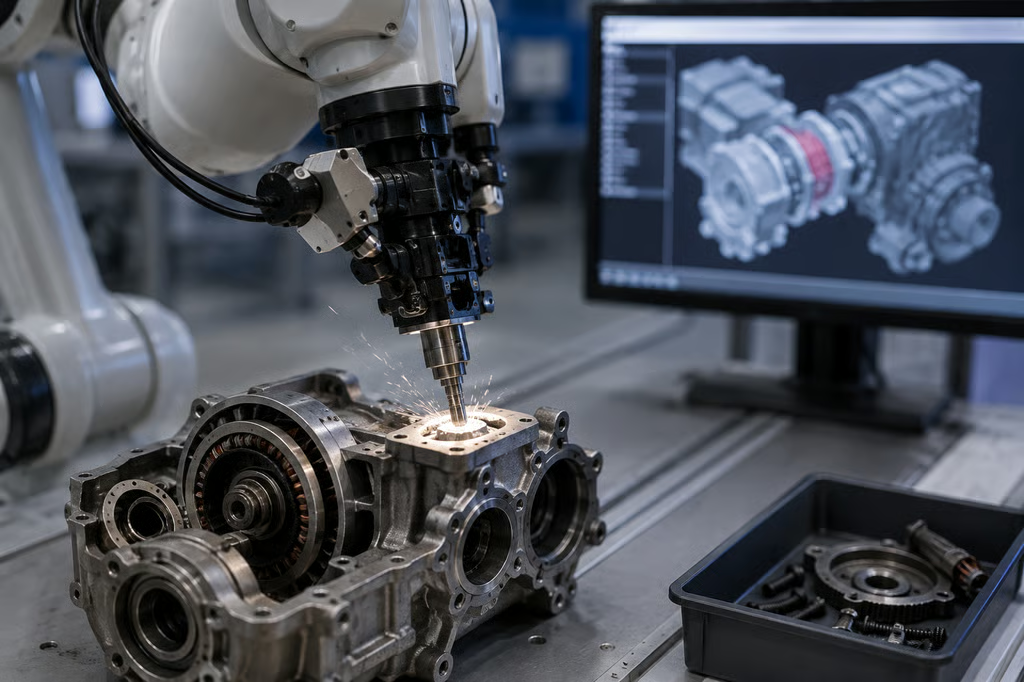


A robotic disassembly system developed at the Karlsruhe Institute of Technology can detect when a damaged machine no longer behaves like its original design and change tactics mid-task, including switching from unscrewing to milling when a fastener is stuck.
The system is still a research prototype, not a commercial product. But its ability to work around missing and damaged parts addresses one of the harder problems in automated repair and component recovery: end-of-life machines rarely arrive in the predictable condition assumed by a factory assembly line.
How KIT’s robot handles unexpected damage
IEEE Spectrum recently detailed the system after the underlying research was presented at ICRA 2026 in Vienna in June. KIT’s paper describes a planning framework built from CAD data, robot capabilities, and inspection results, allowing the system to update its assumptions as disassembly progresses.
The researchers frame the problem as a Partially Observable Markov Decision Process, or POMDP. In practical terms, the robot starts with a model of how components should fit and move, observes what actually happens, and revises its plan when a part is missing, stuck, or otherwise differs from the model.
The team tested three products on two robotic systems. In 30 manipulation trials, the robot successfully removed the target part every time. Screw removal succeeded 60% of the time without a screw-search step, but 30 of 30 attempts succeeded after that search was added.
Physical demonstrations produced the clearest examples. When an electric motor contained a deliberately stuck screw, the system abandoned its original unscrewing plan and milled off the lid instead. With an angle grinder missing a screw, it recognized the absence and skipped the unnecessary step.
That emphasis on adapting to real hardware sits alongside broader efforts to make factory robots more flexible, including Mimic Robotics’ work on a human-like robotic hand for industrial automation.
Commercial economics remain unproven
KIT’s planner can prioritize valuable components and penalize destructive actions, so full teardown is not always the goal. The research is aimed at recovering parts for reuse, remanufacturing, or recycling while accounting for damage and uncertainty.
The potential installed base is substantial. The International Federation of Robotics says 4.664 million industrial robots were operating worldwide in 2024. Manufacturers are also investing in more adaptive automation, from LG and Nvidia’s AI-factory partnership to Mind Robotics’ push into real factory testing.
Jan Baumgärtner told IEEE Spectrum that the longer-term goal is to scale automated disassembly until repairing equipment can become cheaper than manufacturing replacements. The research does not yet establish that business case. It provides no commercial deployment, capital-cost figure, cost per device, or field-scale throughput data.
The next useful evidence will come from testing across a wider range of damaged products and from operating data that compares automated disassembly with manual repair.
For now, KIT has demonstrated the first technical step: a robot that notices when the teardown plan is wrong and chooses another route.
Also read: Honda is developing a broader robotics strategy after ASIMO, including an avatar robot and a multi-fingered hand designed for practical manipulation tasks.