







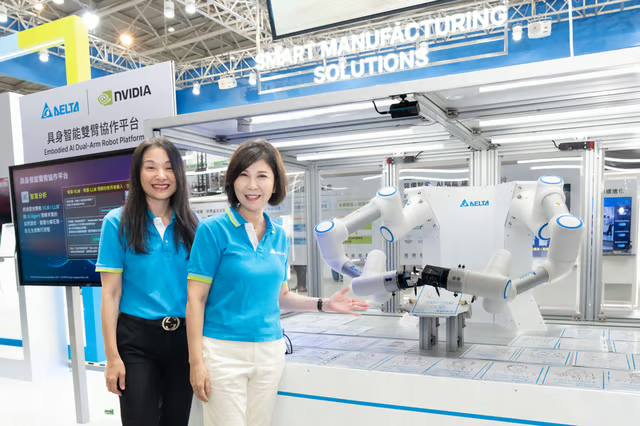
Factory robots are good at repeating the same task. Delta wants them to get better at figuring out what to do when the task changes.
The company unveiled its Embodied AI Dual-Arm Robot Platform at Automation Taipei 2026 on Wednesday, combining AI models, robotic controls, and real-time environmental awareness in a single system. Delta is positioning the platform for increasingly autonomous manufacturing, including potential high-precision work on AI server assembly lines.
The larger goal is to move factories beyond fixed automation toward machines that can adapt to new products, instructions, and surroundings without requiring every task to be programmed from scratch.
The platform runs on Delta’s AI Robotic Control Platform, which connects AI-model inputs with the company’s modular robots. Nvidia’s Jetson AGX Orin provides up to 275 TOPS of onboard AI processing, while Isaac ROS Nvblox and cuMotion help the robot map its surroundings in 3D and plan movements around obstacles in real time.
Lisa Kao, general manager of Delta's Industrial Automation Business Group, said, "Glocalization is driving cross-region smart manufacturing. Along with labor shortage, factories will need to transit from automation to autonomy, where AI, smart robotics, and digital twins play pivotal roles."
AI cuts defect model development time
Delta is also applying AI to the virtual side of manufacturing, using enhanced production-line digital twins to simulate assembly, equipment and production processes before physical deployment.
The company combines its DIATwin virtual machine development platform with NVIDIA Omniverse libraries to generate optimized machine paths, test them through high-fidelity simulations and translate the results into machine recipes. Delta said the approach has already been deployed at its Thailand plant for AI server power supply production lines.
Another major gain comes from AI-assisted defect detection. Delta said its use of NVIDIA's Defect Image Generation technology reduced the time needed to prepare inspection models for new and unknown product defects from three months to two weeks. The company also reported a 17% improvement in automated optical inspection rates.
The bigger manufacturing bet
Delta is positioning the platform as part of a broader shift from fixed automation toward factory systems that can adapt to changing products and conditions. By combining physical robots, AI control and digital twins, the company is targeting a manufacturing model in which factories can adjust to changing products without rebuilding automation systems from scratch.
More autonomy also raises the stakes for reliable perception, safe motion planning, and accurate simulation. Delta’s demonstrations show how AI, robotics, and digital twins can be combined into a more flexible manufacturing stack, but the harder test will be whether those systems can maintain the same reliability amid the variability of a working factory floor.
Other News: China’s humanoid robotics boom is facing a commercial reality check as manufacturers at the World Robot Conference try to prove their machines can move beyond flashy demonstrations to reliable, cost-effective factory work.