







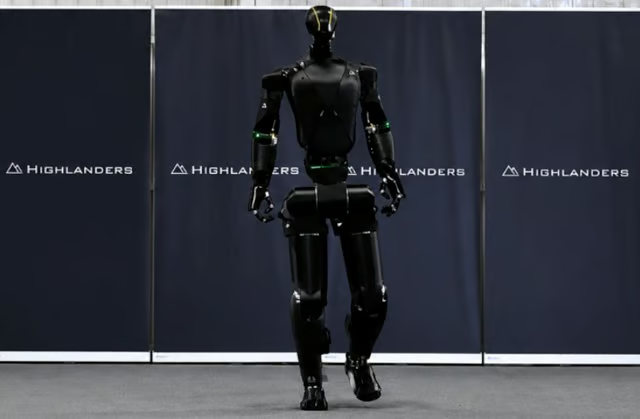
Mitsubishi’s Kyoto plant may soon produce more than cars.
Mitsubishi signed a partnership with Japanese robotics startup Highlanders to jointly develop and mass-produce humanoid robots at its Kyoto plant. The companies said the collaboration is designed to tackle growing labor shortages in Japan's manufacturing sector while creating a production system where humans and robots work side by side.
From carmaker to robot manufacturer
Under the memorandum of understanding, Mitsubishi will first deploy Highlanders' humanoid robots inside its own manufacturing facilities to gather operational data, evaluate real-world performance, and build expertise in humanoid robotics.
At the same time, the automaker will explore manufacturing Highlanders' robots using its automotive production know-how, including quality assurance, durability engineering, safety design, mechatronics, and factory operations.
The companies will study whether production can begin in early 2027 by repurposing unused buildings at Mitsubishi's Kyoto plant. According to reports, the factory is expected to target production of up to 1,000 robots per month if the project moves ahead.
Mitsubishi joins a growing list of automotive companies investing in humanoid robots as manufacturers search for new ways to improve productivity and offset labor shortages. Industry rivals, including Hyundai Motor Group, Toyota, BMW, and Renault, have announced humanoid robot initiatives, while Tesla continues to develop its Optimus robot.
A response to Japan's labor crunch
Mitsubishi said Japan's manufacturing industry is facing several long-term challenges, including labor shortages, increasingly complex production processes, and demand for more flexible manufacturing systems.
The company sees humanoid robots as one way to help address those pressures while opening a new business opportunity beyond vehicle production.
"Our collaboration with Highlanders represents a challenge aimed at building a new industrial foundation in which humans and robots work together," Mitsubishi Motors CEO Takao Kato said in the company's announcement.
"By utilizing humanoid robots in our own manufacturing facilities and supporting the production of Highlanders products, we aim to leverage the outcomes of this collaboration to drive our growth and enhance corporate value."
Highlanders CEO Hiroya Masuoka said the partnership combines robotics research with large-scale manufacturing.
"We believe that achieving mass production of domestically developed humanoid robots through this partnership with Mitsubishi Motors, which brings decades of manufacturing expertise, represents a significant step toward achieving this goal," Masuoka said.
Beyond building cars
The partnership could reshape Mitsubishi's business in more ways than one. Instead of using robotics solely to improve vehicle production, the company is positioning itself to become a manufacturer of humanoid robots for a broader market.
That strategy also allows Mitsubishi to use spare production capacity at its Kyoto plant while giving Highlanders a path to scale up from a startup developing prototypes to a company capable of commercial manufacturing.
The opportunity, however, comes with challenges. The companies still need to prove that humanoid robots can operate reliably in real factory environments, meet production targets, and compete with established robotics companies that are advancing quickly in the US and China.
If successful, the project could give Mitsubishi a new growth business while strengthening Japan's position in an increasingly competitive global robotics industry.
Also read: Humanoid robots in surgery reached a preclinical milestone at UC San Diego, where teleoperated robots completed laparoscopic procedures on live animal models.