







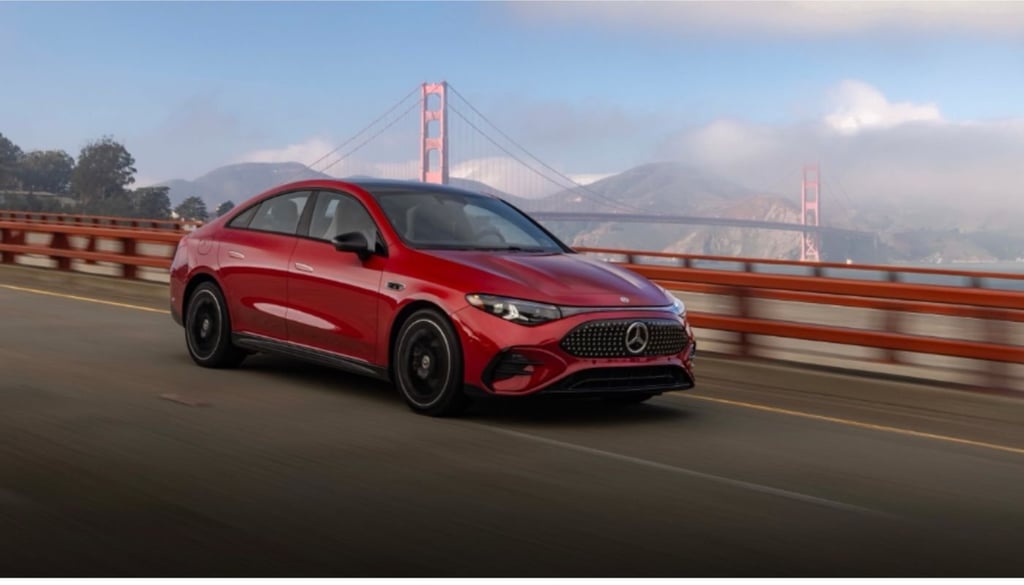
Nvidia and Mercedes-Benz are positioning themselves to join the growing group of self-driving operators offering robotaxi services in major cities, announcing an acceleration of plans to debut the technology in Mercedes S-Class cars.
The two companies will be joined by Uber, which will provide the app used to book the robotaxis. Alongside other European carmakers and parts suppliers, the three companies have begun coordinating operations and launch strategies to push self-driving adoption across the continent.
Mercedes-Benz plans to launch a level-2 driver-assistance system in the US this year using Nvidia’s software platform, starting with the Mercedes-Benz CLA. In Nvidia’s press release, the company suggests over-the-air updates could unlock higher levels of autonomy over time, potentially upgrading vehicles to level-3 driver assistance.
The robotaxi plans, first reported in Bloomberg, are just one of the several Nvidia is involved in, underscoring the importance it places on the market. Like AI more broadly, training self-driving systems in both real-world and simulated environments requires vast amounts of GPU compute power, an area where Nvidia remains dominant.
The timeline for launching a full robotaxi service remains unclear, and none of the partners have announced which cities are under consideration. Mercedes-Benz has been working on self-driving technology since at least 2017 and has formed strategic partnerships with Bosch for automotive-grade components and with Chinese software developer Momenta.
The long road to the robotaxi
Predictions about the “year of the robotaxi” have been repeatedly delayed. In the mid-2010s, carmakers, tech giants, and industry evangelists pointed to 2020 as the breakthrough year, fuelled by early investments and impressive demonstrations from companies such as Waymo.
It took far longer for robotaxis to gain acceptance, even in tech-friendly hubs like San Francisco, Phoenix, and Beijing. Several autonomous driving efforts, including those led by Uber, Cruise, and Ford, were shelved along the way. Last year felt like a shift by the industry, pushed by Waymo, slowly from testing to scale.
Waymo has led the charge, with ambitions to launch in 12 new cities in 2026, including outside of the US for the first time in London and Tokyo. Chinese operators Baidu Apollo, Pony.ai, and WeRide have also expanded their operations out of China, with robotaxi services in Southeast Asia and the Middle East.
Europe’s slower rollout
While the US, China, and the Middle East continue to expand robotaxi trials, Europe has lagged behind in large-scale deployments.
The underlying technology is largely in place, with German automakers leading development of level-2 and level-3 driver-assistance systems. However, stricter safety regulations and liability frameworks have made European cities more cautious, with few willing to act as large-scale testing grounds for self-driving services.
Caution may not be misplaced, sd public opinion can turn sharply against robotaxi operators following serious incidents, as Cruise discovered after a fatal accident forced the company to shut down operations.
Related reading: Waabi has also raised major new funding as it works with Uber to scale robotaxi deployments worldwide.