






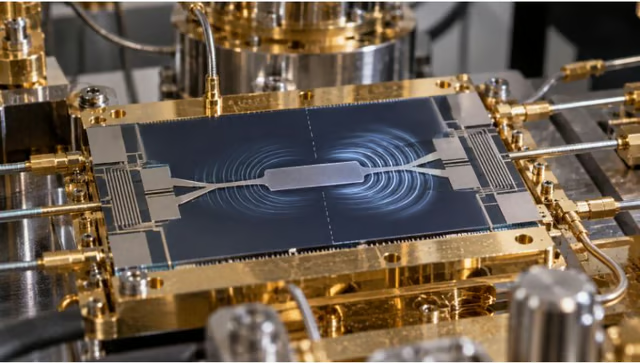


Sound usually fades smoothly into silence. At the quantum scale, Stanford scientists have now watched it disappear one step at a time.
Researchers directly observed an individual phonon, the quantum unit of sound, jumping between energy states in real time using a microscopic mechanical resonator paired with a superconducting qubit. The experiment gives physicists a way to track exactly when a mechanical quantum state changes, an ability that could eventually help researchers detect quantum-computing errors and build extremely sensitive sensors.
The finding also turns a century-old quantum prediction into something researchers can watch unfold.
How Stanford caught a quantum jump in sound
Quantum jumps are abrupt transitions between discrete energy levels. Scientists demonstrated them in trapped ions in 1986 and photons in 2007, but directly following an individual phonon through such a jump remained out of reach.
Stanford's team, led by applied physics professor Amir Safavi-Naeini, reported the first direct real-time observation in Science. Unlike a photon, a phonon represents coordinated motion involving many atoms, extending real-time quantum-jump observation into a mechanical system.
The experiment relied on three key elements:
- A chip-scale mechanical resonator: Researchers fabricated a microscopic resonator capable of vibrating for about two milliseconds.
- Hundreds of measurements: The unusually long "ringdown" time allowed the team to pinpoint when the resonator's vibrational energy dropped from state 1 to state 0.
- A superconducting qubit: Co-first authors Takuma Makihara and Erik Szakiel paired the resonator with a qubit that repeatedly checked whether the phonon was still present without disrupting the system.
"We have seen that vibrating objects can exhibit quantum behavior, which is the prerequisite for many of the operations needed by quantum computing and sensing," Safavi-Naeini said, per Stanford.
What eWeek found: Control is the bigger breakthrough
The experiment is not the first evidence that sound can exhibit quantum-mechanical behavior.
Interesting Engineering noted that earlier studies had already pointed to phonon quantum jumps. Stanford’s advance is the ability to monitor a mechanical quantum system closely enough to identify the exact moment when a single excitation disappears.
Stanford is also careful not to overstate what the experiment means for near-term applications. The university described the work as a “foundational first step,” with quantum computing and sensing still representing future possibilities rather than finished technologies.
Area | What the experiment demonstrated | What remains ahead |
| Quantum jumps | Researchers tracked a phonon as its energy changed from state 1 to 0 in real time. | Applying the technique to more complex quantum operations. |
| Error correction | The system can detect when a change in quantum state occurs. | The study did not demonstrate error correction itself. |
| Quantum sensing | The resonator-qubit platform enables highly sensitive mechanical measurements. | Applications such as identifying proteins in cells are still being explored. |
| Scaling | The resonator can be fabricated using chipmaking techniques, and multiple units could fit on a single chip. | Researchers have not demonstrated a large-scale array or commercial processor. |
Quantum error correction is one of the clearest longer-term paths.
Phys.org noted that in many architectures, an unwanted quantum jump can represent an error. Knowing precisely when one occurs could help researchers identify and eventually correct failures before a computation is lost.
Quantum sound could reach beyond computing
The same platform could serve as an ultrasensitive sensor. Safavi-Naeini's group is already working with Caltech researchers on using the technology to detect and identify proteins inside cells.
Stanford researchers said the same approach could eventually improve devices that rely on acoustic components, including smartphones. Any practical use in consumer devices is still at the research stage.
For now, the more important achievement is visibility and control: researchers can watch a mechanical quantum state change as it happens rather than infer the transition afterward. Turning that capability into practical error correction, scalable processors, or useful sensors is the next challenge.
For another approach to speeding up quantum computing, see how a new quantum gate method promises 1,000x faster operations for bosonic codes.