







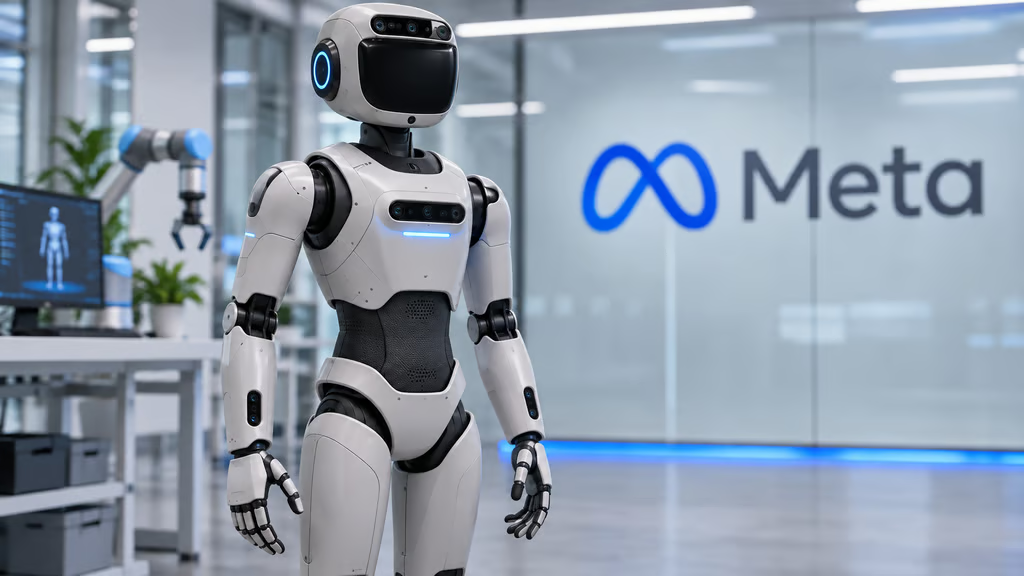
Meta may be taking its AI ambitions beyond screens and into the living room.
The company reportedly built a humanoid prototype with Chinese robotics firm Fourier in about three months, with a second version already in development.
The robot, called Max, reportedly uses NVIDIA's Jetson Thor processor, five-fingered hands, and a screen for facial expressions. Meta is exploring future household assistance, but the available reports offer no independent demonstration of Max completing chores, and the current units aren't for sale.
For Chinese robotics manufacturers, the reported partnership could highlight their role in international AI development. For developers and buyers elsewhere in Asia-Pacific, it raises questions about performance, safety, and support before humanoids can be put to work.
Meta's Max prototype reportedly took three months
Reuters reported the project on Oct. 31, citing The Information. Reuters said it could not independently verify the original report.
According to The Next Web, Meta employees worked at Fourier's Shanghai factory, where robotics vice president Li-Chen Miller reportedly spent almost two months. Max is approximately 1.5 meters tall and weighs 48 kilograms.
Work on Max 2 reportedly began in September. Planned changes include redesigned hands and torso, additional sensors, and a projector to assist with stairs. Meta reportedly said the current units are for internal research, not sale.
Fourier's humanoid technology provides context
Fourier's separate GR-3 humanoid has cameras, microphones, and tactile sensors, according to its official documentation. GR-3's capabilities cannot be assumed to apply to Max.
The reported Shanghai work could allow Meta to build on existing Chinese hardware instead of starting from scratch. But the benefits of that approach have not been independently established.
China's Yicai Global contacted Fourier founder and CEO Gu Jie, who declined to comment on the reported partnership.
What eWEEK found: Building a robot is not the same as making it autonomous
The reported three-month development timeline is notable, but it does not establish how independently Max can operate.
Three distinctions matter when evaluating the project:
- Hardware does not guarantee autonomy. Sophisticated hands and sensors still require advanced software to interpret surroundings, manipulate objects, and adapt to unexpected changes.
- Rapid prototyping does not mean commercial readiness. Max and its reported successor remain research projects, with no announced release date, pricing, or independently verified performance results.
- Existing technology does not prove Max's capabilities. Most details originate with The Information, while Fourier's documented GR-3 platform cannot establish how Max performs.
Household environments present challenges that controlled demonstrations may not capture. Objects vary in shape and placement, obstacles can appear unexpectedly, and robots must adapt when tasks fail. Reliable operation requires more than powerful hardware; it depends on how effectively AI systems translate decisions into physical actions.
Developers can assess these capabilities through task completion rates, human intervention requirements, and recovery from errors. Meta's separate PARTNR research has examined similar challenges in human-robot collaboration, although it did not evaluate Max.
For now, the reported project highlights the potential speed of humanoid development. Its broader significance will depend on whether future testing demonstrates reliable performance in real-world environments.
Chinese robotics suppliers may find new partners, but buyers need proof
The reported Meta-Fourier collaboration could open opportunities for Chinese robotics companies looking to work with international AI developers. However, no additional partnerships or contracts have been confirmed.
For businesses across APAC, the bigger concern is whether humanoid robots can perform reliably outside controlled demonstrations.
Different groups should consider the following before investing in similar projects:
- Robotics manufacturers and suppliers in China: Partnerships with international AI companies could increase demand for customized robotic hardware.
Before entering similar agreements, suppliers should clarify development costs, intellectual property rights, and who will handle repairs, software updates, and future upgrades.
- Developers and system integrators in China: Testing needs to go beyond rehearsed demonstrations.
Teams should assess how robots handle unfamiliar objects, changing room layouts, and Mandarin-language instructions. They should also measure how often human intervention is needed and whether robots can recover from mistakes without restarting a task.
- Enterprise buyers across APAC: Hotels, warehouses, and care facilities considering humanoid robots should request demonstrations in their own environments.
IT and procurement teams should assess safety requirements, maintenance costs, and the availability of local technicians and replacement parts. They also need to understand how camera and microphone data are processed, particularly when equipment or technical support involves providers in other countries.
Meta has not announced commercial availability for Max, so businesses cannot yet evaluate it as a purchasing option. However, the reported project offers a useful reminder for companies assessing other humanoid robots.
For companies assessing other humanoid robots, one question is particularly revealing: What happens when the robot makes a mistake?
If it drops an object or loses its way during a demonstration, ask the vendor to show how it recovers rather than restarting the presentation. That response may reveal more about its real-world readiness than another flawless demonstration.
Also read: As Meta experiments with its Max prototype, companies including Tesla, Figure AI, and Agility Robotics are racing to bring humanoid robots into real-world workplaces by 2027, with a growing focus on practical applications in factories and warehouses.