







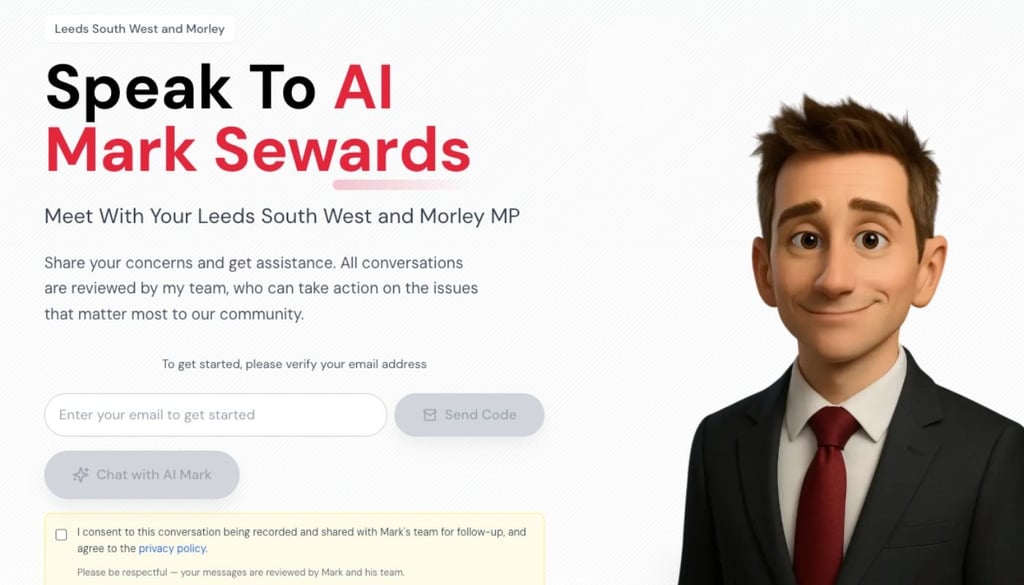
A UK Member of Parliament has become the first to offer an artificial intelligence bot capable of answering questions from constituents at any time. The avatar of Labour MP Mark Sewards combines a cartoon rendering of his photo with his real voice.
It was created by Neural Voice, a company that typically creates AI voice assistants to handle customer service and sales calls. Accessible via the Neural Voice website, Sewards’ bot greets users and displays a transcription of its responses in the chat. Users speak their questions out loud — which are also transcribed — and the AI voice responds as if it were the Leeds South West and Morley MP.
“This prototype AI model offers my constituents an additional way to engage with their MP on local casework and policy issues,” Sewards wrote on X. “It can’t ever replace any of the o(t)her work I do and it simply gives people another option to contact me, anytime of day.”
He added that Jeremy Smith, co-founder of the AI startup, is one of his constituents and suggested the idea to create his bot. All conversations will be reviewed by Sewards’ team, which can take action on the most pressing issues, and will also “be used to train it to make it better.”
Critics accuse Sewards of laziness
Reception on social media has been largely negative, with responders accusing Sewards of laziness or trying to avoid personal engagement with constituents. Others questioned the usefulness of the bot, dismissing it as a poor substitute for direct representation, and citing the huge toll the technology has on the environment.
Sewards has admitted to struggling with the workload of an MP. Three months after taking office, he told the BBC that he’d “tried (his) best” to get through all the 6,000 pieces of case work that had accumulated in that time, but that “it’s not possible for one person to do that.”
AI avatars are not without risk
While it may well free up some time for Human Mark, AI Mark does not come without risk. Blunt, robotic, or even threatening responses to sensitive topics may cause constituents more distress than if they broached the topic with a human MP. Google Gemini once told a user to “please die” after it was asked innocuous questions about elderly people.
There is also the question of data security, as similar chatbots have exposed conversation details to the public and third-party contractors. Those trained on publicly available data from the internet are known to inherit biases and spread misinformation, which could be dangerous if one represents a politician.
While Neural Voice advertises that its bots can be trained on custom data, it is unclear what data sources inform their baseline knowledge. News outlets have reported that Sewards’ chatbot declines to discuss topics such as the death penalty, Prime Minister Keir Starmer, other MPs, and US President Donald Trump, suggesting there may be limits to its usefulness for constituents.
Indeed, Neural Voice told The Washington Post that it doesn’t “have that information in my knowledge base” when asked what the most important issues for Sewards’s constituents were. The Guardian found it struggled to transcribe questions asked by a person with a strong Yorkshire accent.
AI is cropping up more and more in UK government
While this is the first instance a politician has offered such an AI service in the UK, an AI MP did stand in the country’s 2024 general election. “AI Steve” was a digital avatar also created by Neural Voice that stood as a real candidate for Brighton Pavilion, although the actual person behind the avatar, Neural Voice’s Chairman Steve Endacott, would have taken the seat if elected.
Endacott told The Independent that the intention was to allow voters to “tell (their MP) what they want from the comfort of their own home.”
The UK is intensifying efforts to integrate AI across government operations to improve efficiency. In January, it introduced “Humphrey”, a suite of AI tools designed to expedite policy-making, many of which are powered by OpenAI’s models like GPT-4o.
The government aims to apply similar solutions to other taxpayer-funded services, such as justice, defence, and education, through a partnership with OpenAI. The goal is to make them more useful for British businesses and citizens.
Read eWeek’s coverage of how AI therapy chatbots are raising red flags in mental health conversations, especially with vulnerable users.