







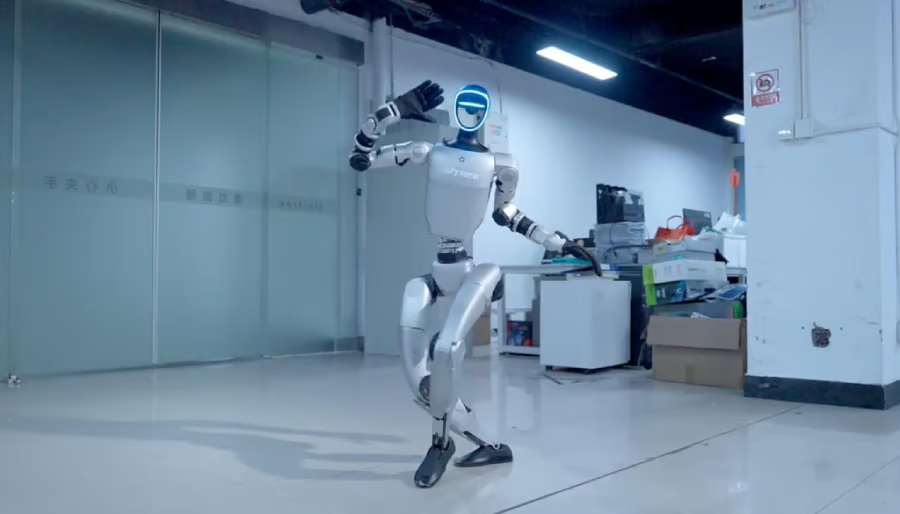
Unitree Robotics brought China’s humanoid robot boom to the public markets with a spectacular first day of trading.
Shares of the Hangzhou-based robotics company surged as much as 629% in their Shanghai debut Wednesday, opening at 1,100 yuan from an IPO price of 150.80 yuan before closing at 845 yuan, up 460%, according to Bloomberg.
The listing makes Unitree the first humanoid robot maker to trade on a mainland Chinese exchange, giving investors a direct public-market bet on embodied AI — and immediately raising questions about how much future robotics growth is already priced in.
Unitree raised about 6.1 billion yuan ($904 million) through the IPO, which valued the company at roughly $9 billion before trading began. After the stock surged, its market capitalization briefly climbed above 400 billion yuan at the intraday peak.
Retail demand was extraordinary. Nearly 9.8 million investment accounts competed for just 9.7 million shares in the online offering, producing an allocation rate of only 0.018%, according to the South China Morning Post.
From robot dogs to humanoids
Unitree, founded in 2016 by Wang Xingxing, has built a reputation through its four-legged robots and increasingly capable humanoids. Its machines have gained wide attention after performing acrobatics and martial arts at China's annual Spring Festival gala.
The company reported 1.7 billion yuan in revenue in 2025, more than four times the previous year's figure, according to SCMP. It sold more than 5,000 humanoid robots during the year, while overseas markets generated more than 40% of revenue.
Unitree said IPO proceeds will support embodied AI model development, robot research, manufacturing expansion and new products. That growth is arriving as China treats robotics as a strategic technology and competition with the U.S. expands beyond AI models into machines that can physically interact with the world.
Investors are pricing in a lot
The explosive debut also raises a difficult question: how much future growth is already baked into Unitree's stock?
Vey-Sern Ling, managing director at Union Bancaire Privée, told Bloomberg, “There’s clearly no fundamental basis for the share price surge.” He said valuations were extremely high while humanoid adoption remained uncertain.
Morningstar analyst Kangyuxiao Li offered a similar caution, saying, “The real competitive test will be whether companies can achieve reliable performance and attractive returns on investment in large-scale industrial and commercial deployments.”
That distinction matters. High shipment numbers do not necessarily mean robots are already being used profitably at scale, as many humanoids today remain focused on demonstrations, performances and research.
A new benchmark for robotics
Unitree's listing could nevertheless reshape the sector. Its valuation gives investors a reference point for other Chinese robotics companies preparing to go public, while the IPO proceeds give Unitree more money to develop the software and hardware needed for wider deployment.
But the company also faces geopolitical risk. The U.S. has restricted imports of new foreign-made humanoid and quadruped robots on national security grounds, and Unitree has warned that the measures could affect future U.S. sales, according to The Associated Press.
For now, investors are betting that humanoid robots are moving from demonstrations and research into a much larger commercial market. Unitree’s challenge is proving that its robots can justify a valuation that raced far ahead of the company’s IPO price on day one.
Other Unitree news:The company recently unveiled a “Superman” humanoid robot that it says can run at speeds approaching those of Olympic legend Usain Bolt.