






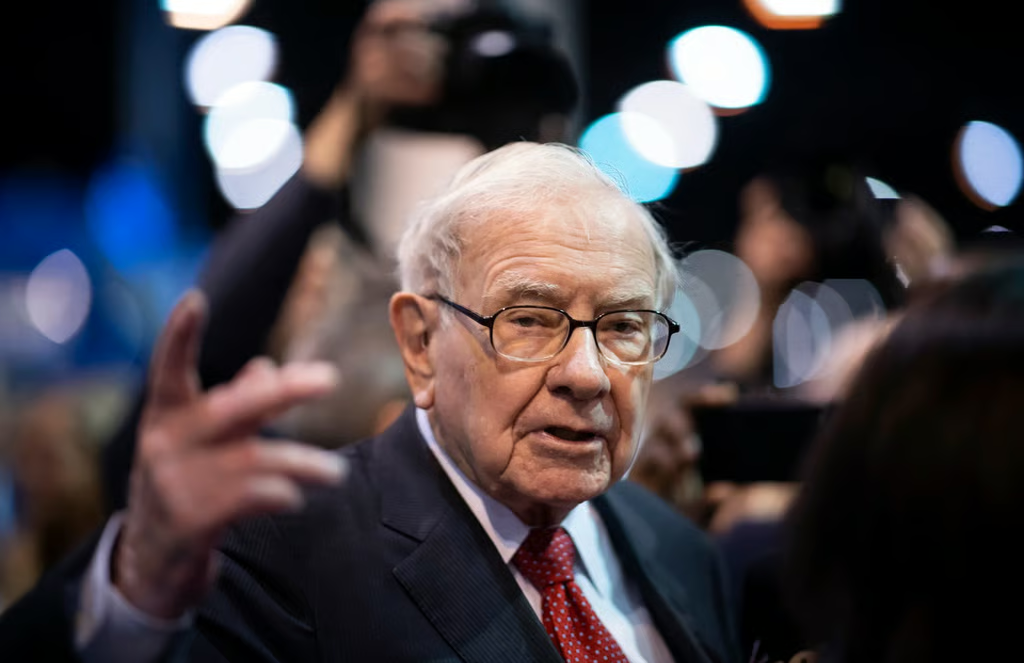


Warren Buffett spent decades warning investors not to chase whatever Wall Street was calling the next big thing. Now the company he built is backing one of the businesses that is spending most aggressively to build it.
According to the Associated Press, Berkshire Hathaway is investing $10 billion in Alphabet, Google’s parent company, buying $5 billion of Alphabet’s Class A shares and $5 billion of its Class C shares. The investment is part of Alphabet’s broader multibillion-dollar push to fund artificial intelligence infrastructure.
The move does not mean Buffett is suddenly recommending AI stocks. It suggests something more interesting: Google may be starting to look like the kind of durable, cash-rich business Berkshire has always preferred.
That distinction matters. Buffett remains Berkshire’s defining figure, but the Alphabet deal belongs to the company’s new era under Greg Abel. It also raises a very Buffett-like question for the AI age: Can Google turn search, cloud computing, YouTube, Gemini, and its data-center muscle into the kind of long-term moat that Berkshire has spent decades looking for?
Berkshire’s AI bet is not really about hype
Berkshire’s Alphabet purchase does not look like a bet on a single chatbot, model, or viral AI product. It looks more like a bet on Google’s ability to turn its enormous existing businesses into an AI distribution engine.
Alphabet controls Google Search, YouTube, Android, Chrome, Google Cloud, DeepMind, and a growing portfolio of AI products. That gives the company something many AI startups lack: massive distribution, deep technical infrastructure, and the ability to plug AI into services already used by billions of people.
That is where the Berkshire angle becomes more compelling. Buffett has long favored companies with durable competitive advantages, strong cash flow, and management teams that can reinvest capital over long periods. Alphabet’s AI strategy is expensive, but it is funded by one of the world's most profitable digital businesses.
In other words, Berkshire may not be betting on the flashiest part of AI. It may be betting on the company that can afford to industrialize it.
Why Alphabet fits the Buffett playbook
Buffett has not been known as a technology evangelist.
For much of his career, he avoided tech stocks because their futures were difficult to predict. But Berkshire’s eventual embrace of Apple showed that the firm could buy technology when the business looked less like a gadget maker and more like a consumer platform with pricing power, loyalty, and recurring demand.
Alphabet may be entering that same category.
Google’s search business still throws off enormous cash. YouTube gives Alphabet a dominant media platform. Google Cloud gives it a foothold in enterprise computing. DeepMind gives it world-class AI research. And Gemini gives the company a consumer and enterprise-facing AI product line that can be woven across its existing ecosystem.
That combination makes Alphabet a very different AI story from a speculative startup. It is a giant incumbent trying to use AI to defend and extend businesses it already dominates.
For Berkshire, that may be the point.
Why Alphabet needs so much capital
AI has become an infrastructure war.
Training and running large AI models requires enormous spending on chips, servers, data centers, networking equipment, electricity, and specialized engineering talent. Alphabet, Microsoft, Amazon, Meta, and OpenAI are all spending heavily to secure enough compute capacity for the next phase of AI products, a trend that has fueled a global race to expand AI infrastructure and data center capacity, according to a report from McKinsey.
Alphabet’s fundraising plans are designed to help fund that buildout. AP reported that Alphabet is raising about $80 billion to support infrastructure investment, while other financial coverage has put the figure closer to $85 billion. The exact number varies by source, but the direction is clear: Alphabet is raising a huge amount of capital to support its AI and compute ambitions.
That matters because the AI race is increasingly being shaped by scale. Companies need advanced models, but they also need sufficient infrastructure to serve them reliably to consumers, developers, and enterprise customers.
For eWeek readers, this is the more important story: AI competition is moving from demos to deployment. The winners may not be the companies with the loudest product launches, but the ones with enough infrastructure, distribution, and revenue to keep building.
The Post-Buffett twist
There is another wrinkle: Berkshire is no longer run day-to-day by Buffett.
Greg Abel, Buffett’s successor as CEO, is now leading Berkshire through its first major post-Buffett chapter. AP reported that Berkshire’s Alphabet investment came alongside another major move, its planned acquisition of homebuilder Taylor Morrison, signaling a more active start to Abel’s tenure.
That makes the Alphabet investment a story about AI, but also a story about succession. Buffett remains inseparable from Berkshire’s public identity, but Abel is beginning to put capital to work in ways that will define the company’s next era.
The result is a useful tension: Berkshire is still carrying Buffett’s investing DNA, but its first big AI-era moves are happening under new leadership.
Google’s AI empire faces pressure
Berkshire’s investment does not eliminate the risks associated with Alphabet’s AI strategy.
Google is still under pressure to prove it can defend its search business as AI-powered answer engines change how people find information online. It also faces fierce competition from OpenAI, Anthropic, Microsoft, Meta, and Amazon, all of which are trying to own different layers of the AI stack.
Talent is another concern. Barron’s noted that Alphabet shares fell after John Jumper, a prominent Google DeepMind researcher, left for Anthropic, underscoring how closely investors are watching the AI talent race.
There is also the basic financial question: Will the billions being spent on AI infrastructure produce returns fast enough to satisfy investors?
That is the tension behind Berkshire’s move. Alphabet may be one of the best-positioned companies in AI, but it is also spending like a company that knows the window to secure dominance will not stay open forever.
What this says about AI investing
The Berkshire-Alphabet story suggests a shift in how AI investing is being understood.
The first wave of AI market excitement centered on chips, especially Nvidia. The next phase may focus more on the platforms that can turn compute into products, products into revenue, and revenue into long-term competitive advantage.
Alphabet sits squarely in that second category. It has cloud infrastructure for enterprises, consumer products that can quickly distribute AI features, custom AI chips, research talent, and advertising systems that could eventually be reshaped by generative AI.
That makes Berkshire’s bet notable. Buffett built his reputation by avoiding fads and buying durable businesses. Alphabet now gives Berkshire a way to participate in AI without betting on a moonshot.
For Warren Buffett’s Berkshire, that may be the closest thing to a classic value investment in the AI era: not the most speculative name, not the newest startup, but a dominant business trying to convert its empire into an AI engine.
And for Alphabet, the message is clear. Google’s AI ambitions are no longer just a Silicon Valley story. They now have the backing of the investment empire Warren Buffett built.
For more on how Google is thinking about the security risks behind its AI ambitions, read eWeek’s coverage of DeepMind’s roadmap for controlling AI agents.