






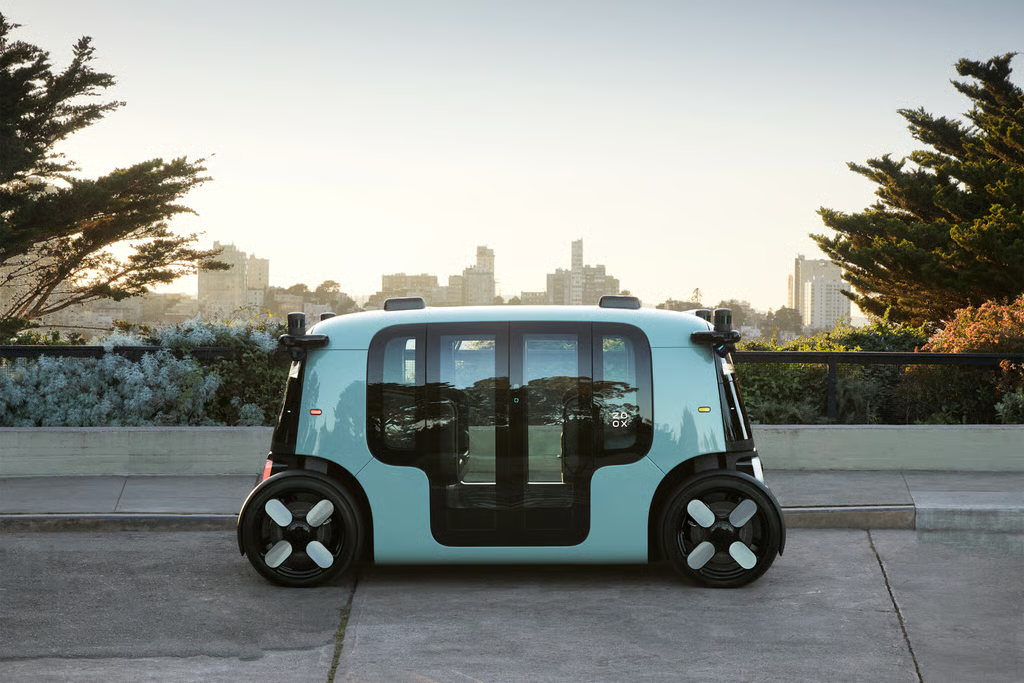


Amazon-owned Zoox has updated its purpose-built robotaxi for production, but its path to commercial service still depends on a federal exemption for a vehicle built without traditional human controls.
Unlike competitors adapting existing cars, Zoox is building a driverless vehicle from the ground up — one with no steering wheel, pedals, or traditional driver’s seat. That design puts the company’s robotaxi in tension with safety rules written for human-operated vehicles.
The refresh improves passenger comfort and usability. The bigger question is whether the National Highway Traffic Safety Administration will let Zoox deploy vehicles that do not fully comply with federal safety standards, allowing it to move from limited, free rides toward paid service.
A vehicle designed outside the rulebook
The latest product update, reported by The Verge on June 24, includes a refreshed version of Zoox’s purpose-built robotaxi with softer seats, a lighter interior, a sharper passenger screen, larger cupholders, rotating bidirectional reflectors, and upgraded two-way audio near the doors.
NHTSA issued Zoox a demonstration exemption on Aug. 6, 2025, allowing its purpose-built driverless vehicles to operate under the agency’s expanded Automated Vehicle Exemption Program. As a condition, Zoox had to remove or cover claims that its vehicles comply with applicable Federal Motor Vehicle Safety Standards, and NHTSA closed its self-certification investigation.
Zoox is now seeking a two-year temporary exemption covering up to 2,500 exempted vehicles in each year of the requested exemption. The petition covers parts of eight safety standards, including rules for braking, rear visibility, occupant crash protection, glazing, lamps, wipers, and defrosting.
NHTSA has not ruled on the petition. Approval would allow Zoox to manufacture, sell, or deploy vehicles that do not fully meet those standards, subject to agency conditions. Similar regulatory questions are shaping other robotics markets, including surgical robots entering European markets.
From demo rides to commercial service
Zoox’s regulatory challenge stems from its core design choices. The robotaxi has no steering wheel, accelerator, brake pedals, or conventional driver’s seat, making it incompatible with safety standards built around human drivers.
Its bidirectional layout allows the vehicle to travel in either direction without turning around, a feature Zoox says could improve fleet efficiency. But the business case still depends on regulatory approval, operating costs, and production scale. That same scaling challenge is playing out across enterprise robotics, including Agility Robotics’ push to scale humanoid warehouse robots.
Zoox’s March 2026 expansion added new operating environments while the company waits for NHTSA. It expanded service areas in San Francisco and Las Vegas and announced limited rollouts in Austin and Miami. Zoox also said its fleet has logged nearly 2 million driverless miles and carried about 350,000 passengers.
For now, rides remain free under the company’s demonstration-stage service, with access varying by market. That leaves Zoox in the same demo-to-deployment gap facing other physical AI projects, including AGIBOT’s factory-floor humanoid robot livestream.
Zoox is preparing the refreshed vehicle at its Hayward, California, facility, which Business Insider reported can scale to up to 100 vehicles a week. That capacity only becomes meaningful if Zoox can deploy vehicles in paid service.
A favorable NHTSA ruling would not instantly create a nationwide robotaxi network. It would, however, give Amazon’s autonomous vehicle unit a path to turn a purpose-built driverless design into a commercial mobility business.
Also read: JD.com’s robotics push shows how automation could reshape delivery work as companies test where machines can replace human-operated routes.