








A surgeon’s hands may soon reach farther into Europe without the surgeon entering the operating room.
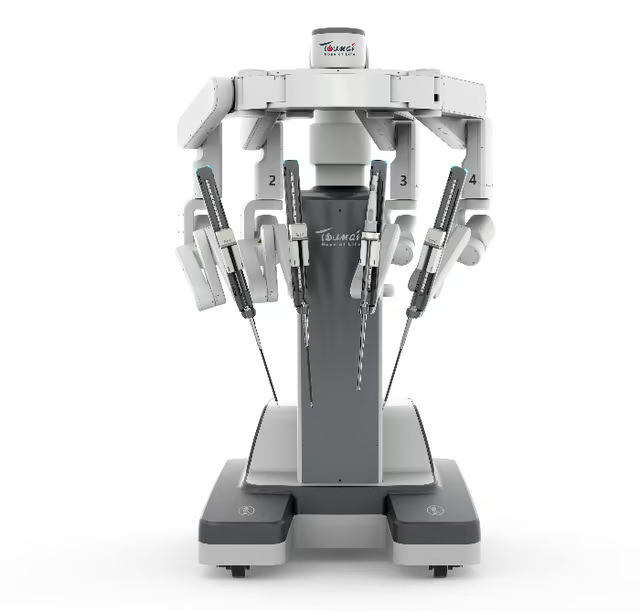
Shanghai MicroPort MedBot’s Toumai Remote surgical robot has received EU approval, giving the telesurgery system access to one of the world’s most closely watched medical device markets.
The milestone moves China’s medical robotics ambitions into a tougher global arena, where precision, safety, and trust matter as much as technical ambition.
‘The first remote surgical robot to obtain the CE mark’
Toumai Remote has received the EU’s CE mark, the certification needed for a product to be sold and used across the bloc.
MedBot called Toumai “the first remote surgical robot to obtain the CE mark,” the South China Morning Post reported, and said the approval means Europe is “legally recognising teleoperation as a safe, effective and commercially viable medical approach.”
MedBot said the clearance covers remote laparoscopic procedures in urology, general surgery, thoracic surgery, and gynecology.
Telesurgery faces a high bar because the system has to support precise surgical control across distance.
Toumai keeps the surgeon in control
While Toumai is a remote surgical robot, it is not autonomous.
A surgeon operates from a console, using the system to control robotic arms beside the patient. MedBot says Toumai has three main parts: a surgeon console, a patient cart, and a vision cart.
The robot is designed for minimally invasive laparoscopic surgery, where instruments enter the body through small incisions. Its remote mode can run over 5G, broadband, dedicated fiber, or satellite infrastructure.
Remote surgery raises the difficulty level. The system has to translate a surgeon’s movements with minimal delay, keep the surgical view stable, and maintain reliable links during a procedure. A patient-side team must still be in the room, ready to support the operation if the connection or equipment fails.
A 2,400-km procedure showed the system at work
Before the EU approval, Toumai had already been used in a long-distance operation.
In March, a surgeon in London performed a prostate removal on a cancer patient in Gibraltar, about 2,400 km away. The procedure used fiber-optic cables with a backup 5G link, and a local medical team remained on standby.
The connection held throughout the operation.
A new route for specialist care in Europe
The London-to-Gibraltar operation also shows why remote surgery could matter in EMEA.
Gibraltar has one hospital. Patients with more complex needs often have to travel abroad for care, adding time, cost, and medical risk to an already stressful process. In this case, the patient stayed local while the surgeon’s expertise crossed the border instead.
That is the promise Europe will now have to test in the real world. EU clearance gives Toumai a regulated path into hospitals, but adoption will depend on more than a CE mark. Health systems will need reliable connectivity, trained patient-side teams, clear emergency protocols, and sufficient confidence among clinicians and patients to enable the model to move beyond headline-making procedures.
If hospitals can clear those hurdles, remote surgery could become more than a technical showcase. It could give smaller or harder-to-reach communities a new way to access specialist care before geography becomes the first barrier to treatment.
A Unitree G1 robot has taken on one of Earth’s highest-altitude proving grounds ahead of a planned Everest climb.