Order in the court, Tech Insiders. Privacy subpoenas, deepfake takedown pleas, and a RICO rap sheet have today's tech stories arguing their cases on the public record.
Ready for opening statements on AI privacy, robot pratfalls, and Google's hunt for phishing kingpins? Let's proceed to the evidence. |
|
|
Here's what you need to know today: |
|
|
OpenAI Battles NYT Over Chat Privacy Grab |
Turns out your midnight AI confessions make spicy legal bait.
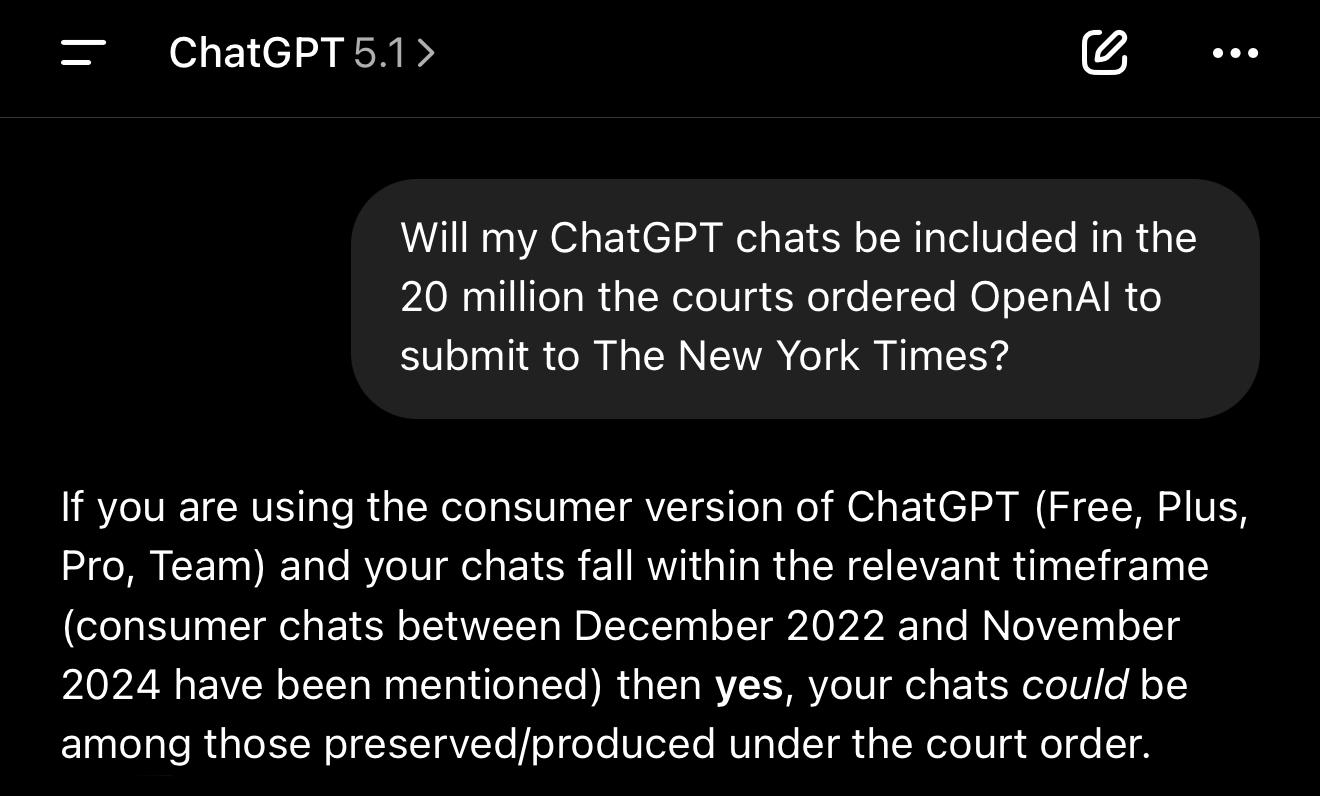
OpenAI blasted The New York Times for demanding a random sample of 20 million ChatGPT conversations, covering everything from latte recipes to breakup rants, so the newspaper's lawyers can hunt for paywall breaches. (Down from its first ask of 1.4 billion, by the way.)
A federal magistrate recently ruled that OpenAI must turn over the de-identified logs by Nov. 14. On Wednesday, the company launched a public appeal, calling the order an "overreach" that risks user trust. |
Enterprise, Edu, and API chats are excluded, and OpenAI says it is scrubbing all consumer logs of names, passwords, and PII, which would then be viewed only in a secure, lawyer-only vault. The company vows to fight any attempt to make the chats public.
The Times counters that it needs real-world use data to prove copyright harm and frequency of regurgitated articles, rejecting OpenAI's offer of targeted searches and high-level stats.
Why it matters: If the ruling sticks, anyone who has typed into ChatGPT between December 2022 and November 2024 could have their complete conversations (anonymized but intact) reviewed by opposing counsel. OpenAI has already announced plans for client-side encryption, which would keep future chats private, even from itself. Proof that AI privacy isn't just about servers, it's about subpoenas. |
|
|
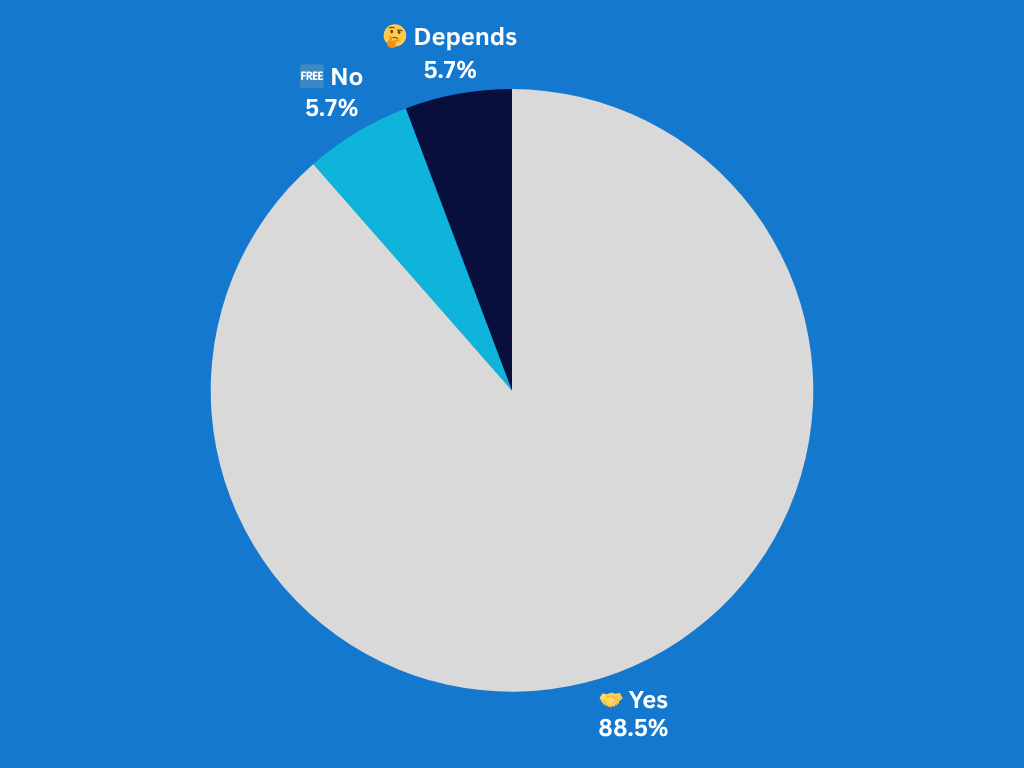
Should the courts dig through 20 million anonymized user chats? |
|
|
Results from Yesterday's Pulse Check |
Should AI firms pay Wikipedia for data access? |
|
|
Unitree's H2 Robot Shines as Russia's AIdol Face-Plants |
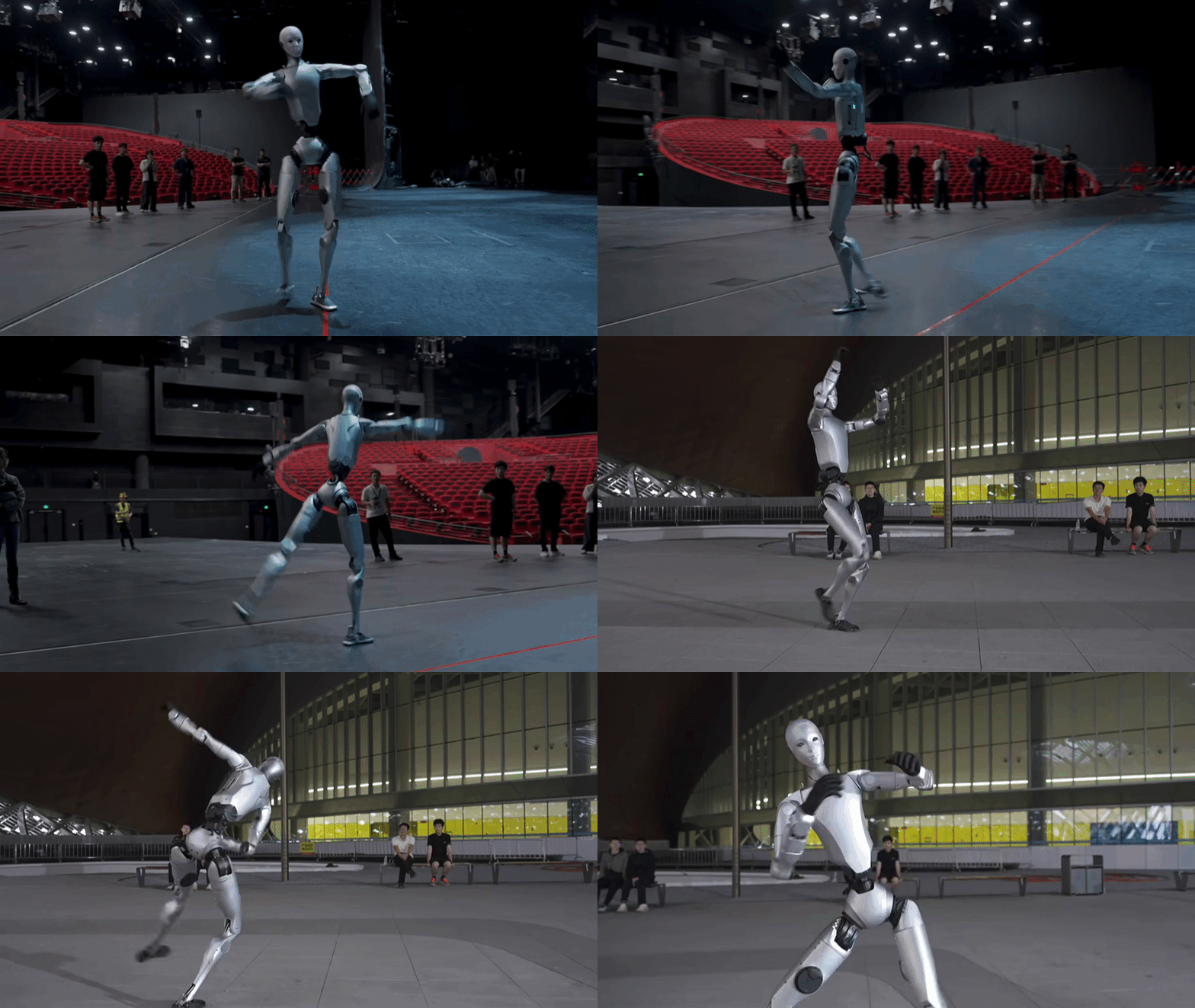
China pirouettes, Russia pratfalls; the robot Olympics are in full swing. Hangzhou-based Unitree unveiled the H2, a $29,900, 5-foot-11, 154-pound humanoid that ballet-spins, kickboxes, and even catwalks with an unsettlingly blank, mannequin-like face.
It's a spec-sheet beast, with thirty-one joints, 360 Newton-meters of leg torque (a measure of raw twisting force), and an Intel Core i5 control computer (upgradable to Nvidia's Jetson AGX Thor), which let it operate for three hours per charge.
Now, contrast that with Moscow's debut of the ironically named "AIdol." It lurched onstage to the "Rocky" theme, waved shakily, then nosedived. Handlers scrambled to hide the wreck behind a black sheet while cameras rolled. The CEO blamed "calibration issues," insisting the bot can "smile ... like a person." It just, apparently, can't walk.
|
The split-screen moment underscores the tricky balance-and-power calculus in humanoid R&D: high-torque actuators and finely tuned algorithms are must-haves, not maybes.
Tesla's Optimus, Figure's 03, 1X's NEO, and the rumored Apple robotics efforts now have a clear benchmark... and a cautionary blooper reel.
The tech gulf is real: China's Unitree won four golds at the 2025 World Humanoid Robot Games with its H1 predecessor, while Russia's premier bot can't even manage ten steps. CEO Wang Xingxing says home adoption is still years away, but warehouses and labs are lining up for pilots.
Russia? Back to calibration school. |
|
|
☎️ Cut the Cord on Office Phones RingCentral RingEX delivers AI-powered calls, chat, and video for as low as $20/month, spinning up in minutes and slicing business phone costs by up to 30%. 📊 Dive Into Data for 87% Less
Grab The Advanced Data Science Bundle—eight expert courses (Power BI, TensorFlow, PySpark, and more) with 50.5 hours of lifetime training—for just $29.99 (87% off).
🛠️ Tame Your IT Assets Fast
This IT Asset Management Software comparison shows the best platforms to slash license waste and stay audit-proof in one handy read.
💻 This section contains sponsored tech insights. Advertise with us! |
|
|
The Future of Customer Engagement Is Unified |
|
|
Watchdog Urges OpenAI to Yank Sora 2 |
Image created with ChatGPT |
OpenAI says it's "listening" while chasing studio deals to calm angry celebrity estates, leaving deceased public figures and everyday users unprotected. Critics warn that the 2026 elections don't have an undo button. The takeaway: It's time to update your deepfake playbook and brief the finance team. That "CEO" video authorizing a wire transfer just got 10x more convincing. |
Google Sues 'Lighthouse' SMS Phish Factory |
Google filed a RICO suit, a law typically reserved for taking down mobsters, against 25 "John Doe" operators, allegedly in China.
The suit targets Lighthouse, a phishing-as-a-service kit that has hit over 1 million victims across more than 120 countries.
In just one 20-day burst, the kit spawned about 200,000 fake sites mimicking USPS and E-ZPass, among others, stealing up to 115 million US credit card numbers. Since Google can't exactly extradite the phishers, it wants injunctions to sink servers and is pushing three bipartisan anti-scam bills. Quick advice: Forward shady delivery texts to 7726 (SPAM), then delete them—no toll authority takes Apple Pay via sketchy links. |
ElevenLabs Licenses Celebrity Voices and Critics Howl |
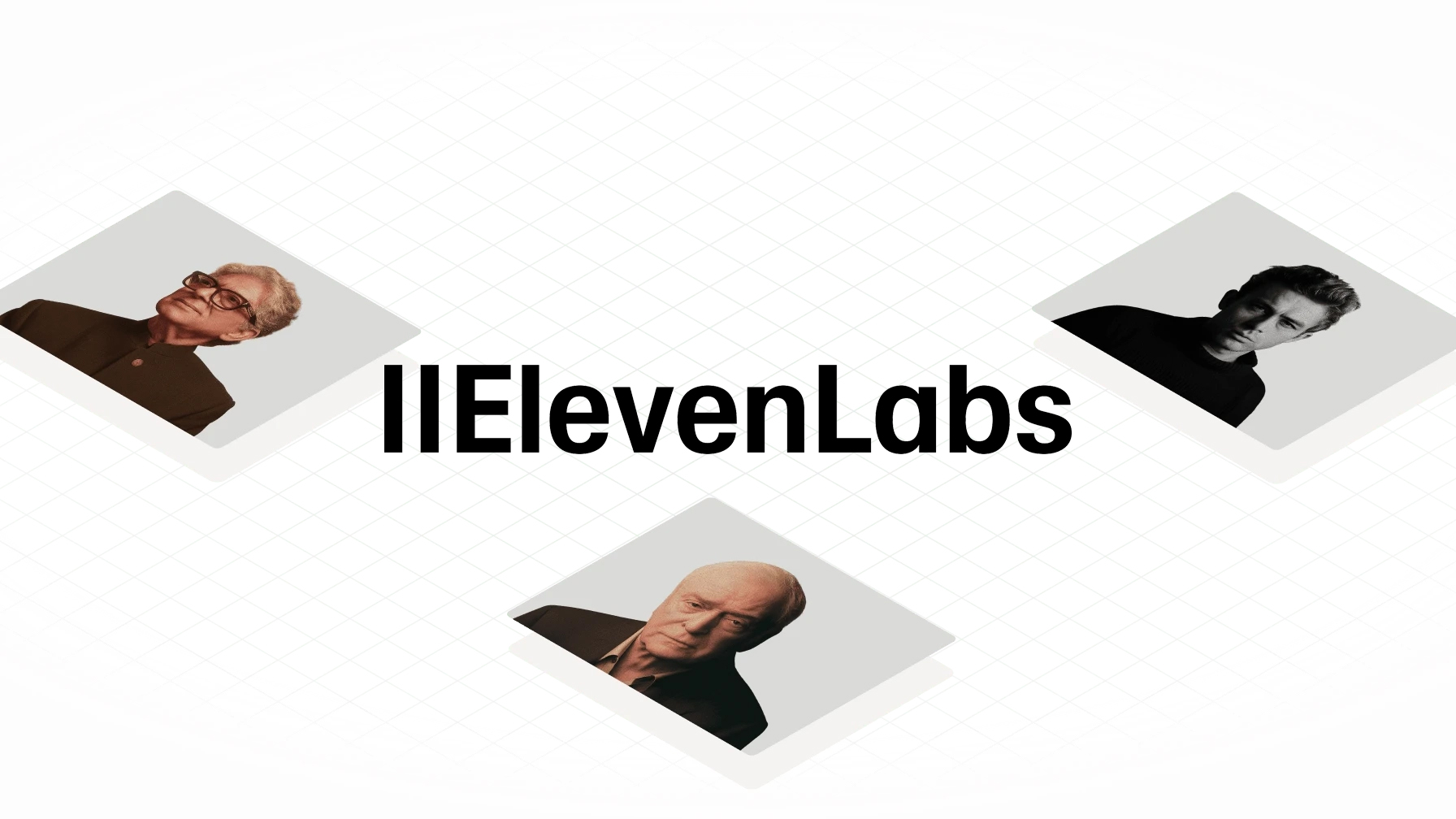
AI audio startup ElevenLabs' new Iconic Voice Marketplace lets brands rent AI replicas of living stars like Michael Caine and a long list of deceased icons, from Maya Angelou to Babe Ruth.
Meanwhile, Matthew McConaughey, an investor since 2022, joined as a customer, using his cloned drawl to translate and narrate a Spanish version of his Lyrics of Livin' newsletter with a flawless accent he admits he doesn't have.
McConaughey notably does not offer his voice to the marketplace, sparking online speculation about why an investor might keep his own voice off the menu. |
Proponents call it an ethical, consent-first model, a stark contrast to the unauthorized voice cloning that prompted Morgan Freeman to recently declare, "If you're gonna do it without me, you're robbing me."
Yet even this "ethical" approach has critics crying foul. Social media users accused the actors of selling their souls to the devil and warned the tech will "take jobs from young guys tryna get into the industry."
The company's recent settlement with voice actors Karissa Vacker and Mark Boyett, who accused it of misappropriating their voices, hasn't exactly calmed concerns. Still, ElevenLabs insists its marketplace pays estates and living stars fairly, and unions are watching closely.
In other words: AI voices are all right, all right, all right... until they're not. |
|
|
|
Writer at TechnologyAdvice |
Justin Meyers is an investigative writer and editor who draws on over a decade of meticulous hands-on research to deliver the full, trustworthy story behind consumer and enterprise tech, including cybersecurity. |
|
|
Curious about where AI is really headed? |
The Neuron cuts through the noise to bring you smart, hype-free takes on the latest AI trends, tools, and breakthroughs. Join 500,000+ professionals from top companies like Microsoft, Apple, Salesforce and more.
|
|
|
Advertise in Daily Tech Insider! Daily Tech Insider is a TechnologyAdvice business
© 2025 TechnologyAdvice, LLC. All rights reserved. TechnologyAdvice, 3343 Perimeter Hill Dr., Suite 215, Nashville, TN 37211, USA. |
|
|
|