Bundle up, Tech Insiders.
Data-center spending is snowballing past $650 billion, Flickr's shivering from a partner breach, and Unitree's humanoid just hiked through –53°F like it owned the tundra. Grab your thermal gear—we're trekking into the cold front of computing. |
|
|
Here's what you need to know today: |
|
|
Big Tech's $650B AI Arms Race |
Turns out the hottest stadium this week is a data center.
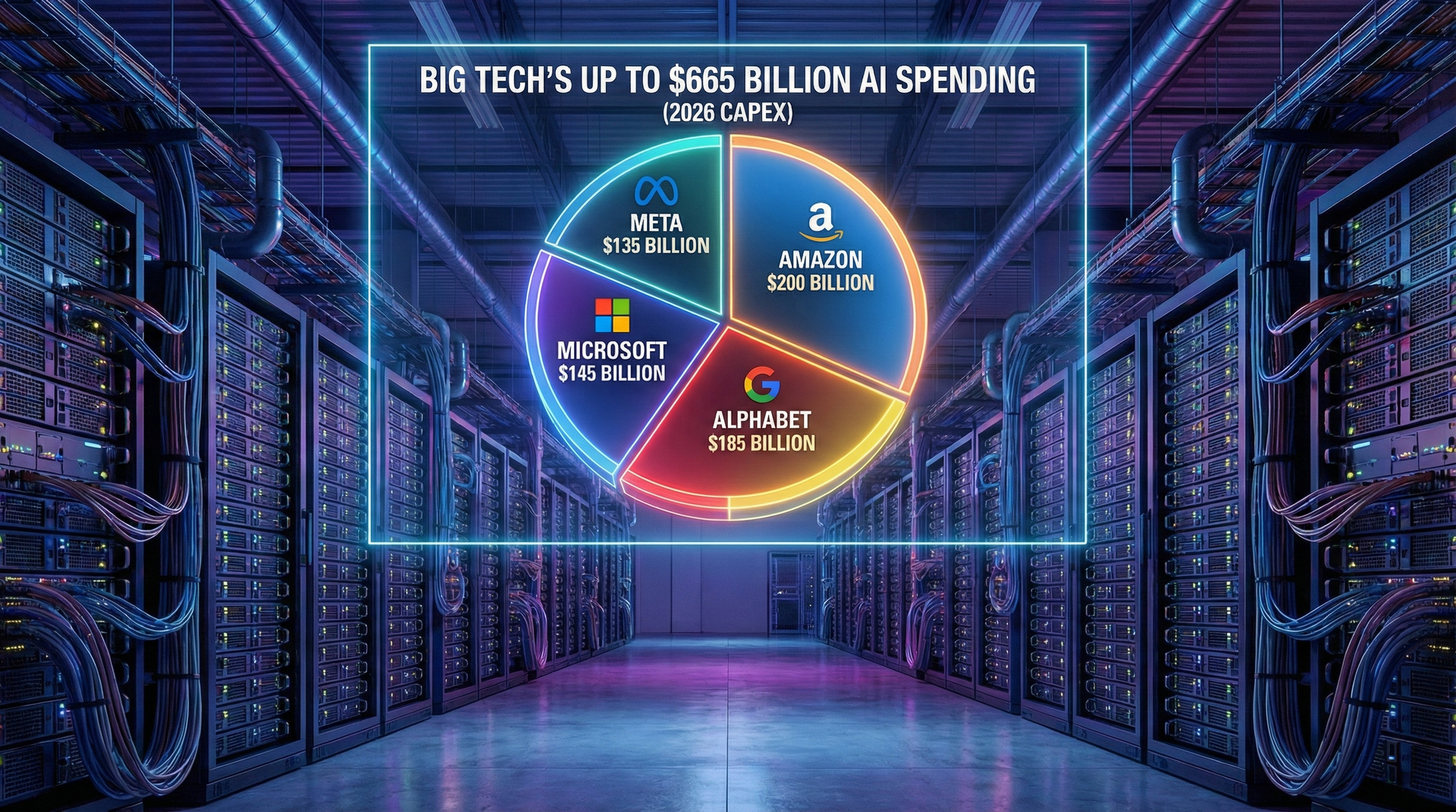
Alphabet, Amazon, Meta, and Microsoft have sketched out a combined $650 billion capital-spending playbook for 2026, which is roughly 70% more than last year. That's more than three times the combined spending of 21 US industrial heavyweights (think Exxon, Walmart, GE, and Intel).
At the $665 billion high-end estimate, Amazon leads with a $200 billion tab, followed by Alphabet ($185B), Microsoft (~$145B), and Meta ($135B). Even the $635 billion low-end projection represents a massive surge in spending.
The bulk of that cash is earmarked for "plumbing"—data centers stuffed with GPUs, networking gear, and backup power. Analysts liken the splurge to the 1990s telecom boom and the 19th-century railroad build-out, but scaled for the AI era's insatiable compute appetite. |
Image created with Nano Banana Pro |
Investors aren't doing a victory dance. The quartet has lost more than $950 billion in market value since flashing their budgets, and Amazon is now flirting with negative free cash flow.
And yes, the Super Bowl LX ads showed up, too. But don't confuse the two: While the $650 billion goes to "capex" (chips and concrete), the $8 million Super Bowl spots are pure "opex" (marketing) on top. While the Big Four scale their empires, challengers like OpenAI and Anthropic, who are launching their own multibillion-dollar infrastructure builds, used their airtime to battle for mindshare. OpenAI pivoted from "algorithms" to "everyday builders," while Anthropic took sharp swipes at OpenAI's new ad-tracking model.
Why it matters: These hyperscalers are effectively setting cloud prices, power-grid priorities, and the pace of AI for everyone else. If $650 billion is flowing into the foundation, expect ripple effects on everything from software bills to hiring plans. |
|
|
If you controlled Big Tech's $650B checkbook, you'd... |
|
|
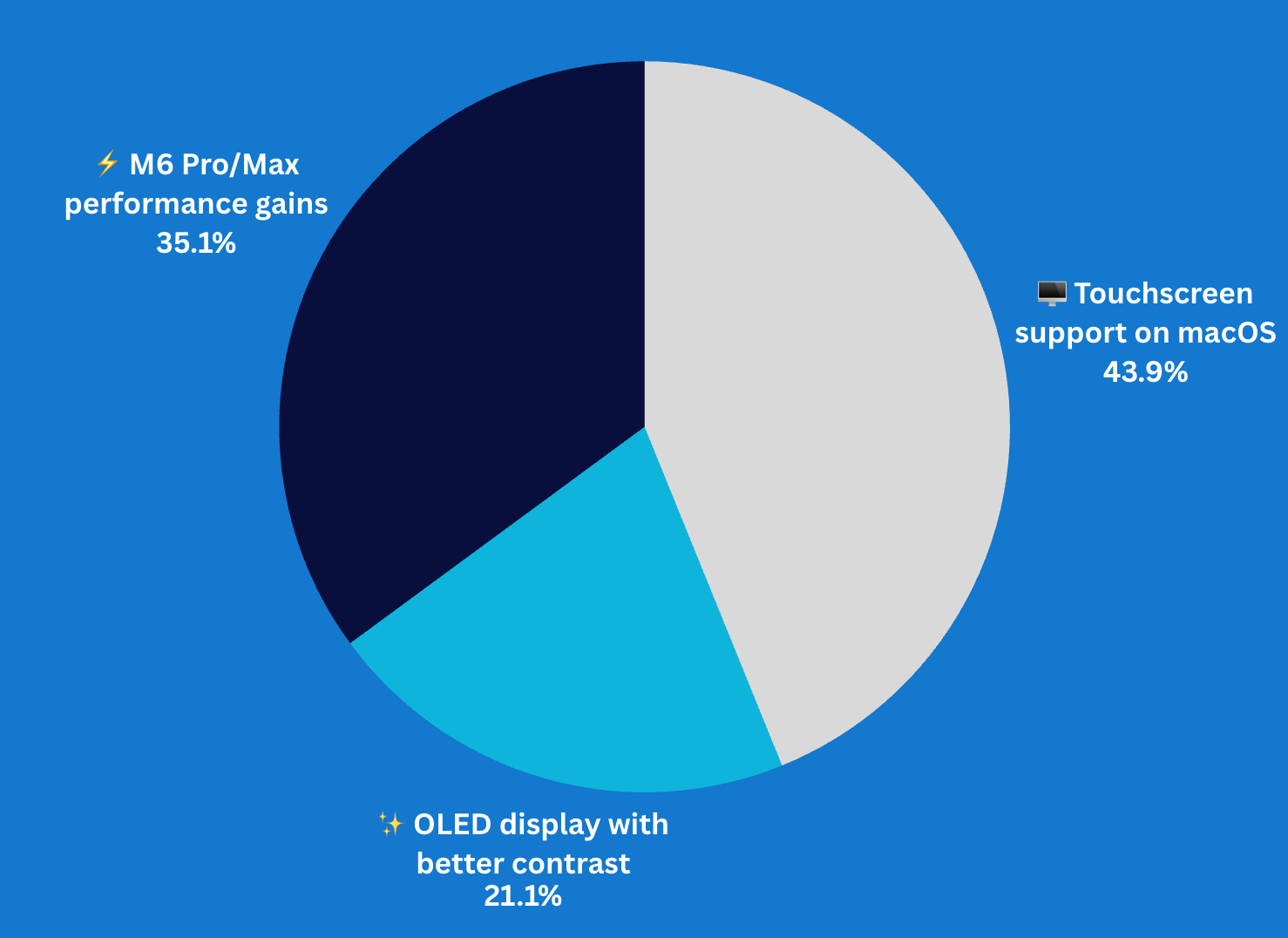
Results from Yesterday's Pulse Check |
Which rumored MacBook Pro upgrade matters to you most? |
|
|
Apple's $599 iPhone 17e Gets Flagship Muscle |
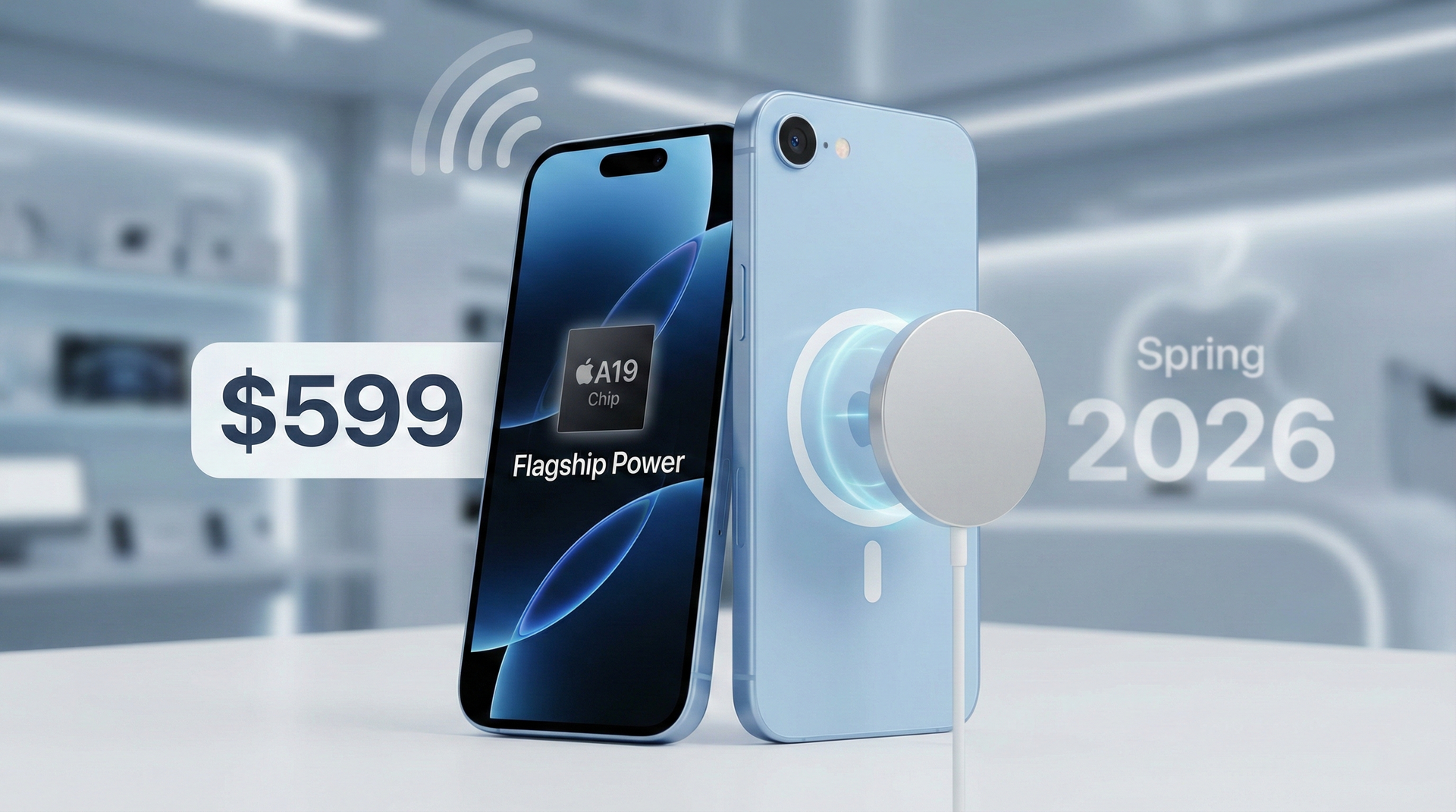
The bargain iPhone just signed up for CrossFit; now it can lift MagSafe. Apple is expected to unveil the iPhone 17e imminently, with rumors pointing to Feb. 19, exactly one year since the 16e's announcement.
The "budget" model is keeping its approachable $599 entry price while swapping in the same AI-ready A19 processor found in the standard iPhone 17. That leap will likely deliver the full suite of Apple Intelligence features, noticeably zippier performance, and better battery life, pushing the budget model closer to its premium siblings. MagSafe wireless charging finally joins the party at speeds up to 25W, fixing last year's biggest 16e complaint and opening the door to a universe of snap-on wallets and battery packs. |
Image created with Nano Banana Pro |
Under the hood, Apple's new C1X modem and N1 wireless chip promise speedier 5G, Wi-Fi 7, and Thread connectivity—handy if Apple wants this phone to moonlight as an IoT hub for enterprises and emerging-market users. Don't expect the Dynamic Island or an extra camera lens, though. Apple is probably sticking with a single-sensor rear shooter and the familiar notch to hit its price target. Even so, analysts say the 17e's value proposition looks stronger than Google's incremental Pixel 10a update and Samsung's high-end-only focus. The 17e will headline a busy Apple spring that also includes an A18-powered iPad (bringing AI to the base model), an M4-powered iPad Air, an M5-powered MacBook Air, and new high-end M5 Pro and Max MacBook Pros. Turns out the "e" stands for "everything you actually need." |
|
|
Reserve Your Access: ITSM That Works |
Still wrestling with ITSM complexity? It may be time to rethink your approach.
Join Freshworks, alongside Ultradent, for Complexity to Clarity: ITSM Customer That Switched on Feb. 11 at 1:00 p.m. ET for practical insight into modern ITSM transitions. |
|
|
Flickr Breach: Partner Flaw Snares User Data |
Flickr is warning its community of 35 million monthly users across 190 countries after a Feb. 5 flaw at a third-party email provider. Access to the system was cut within hours, and regulators were alerted, but member data may have been exposed.
Exposed fields include names, emails, usernames, IP addresses, locations, and activity logs, though passwords and payment info stayed safe. Such details can fuel convincing phishing scams. |
Image created with ChatGPT |
The fix: Update reused passwords, enable 2FA, and treat Flickr-branded emails with extreme suspicion. Companies should also audit third-party security and drill breach playbooks that assume partners are always potential attack vectors. Treat unexpected Flickr emails like blurry photos; delete and shoot again. |
Patch Now: BeyondTrust RCE Imperils Remote Access |
A critical flaw (CVE-2026-1731, CVSS 9.9) in BeyondTrust Remote Support (RS) and Privileged Remote Access (PRA) allows pre-auth command execution.
Hacktron AI, which reported the vulnerability, describes the exploit as "straightforward" and found ~11,000 instances online, roughly 8,500 of them on-premises and potentially vulnerable. Unpatched RS 25.3.1 or PRA 24.3.4 appliances are fair game for data theft and persistence. SaaS is fixed, but on-premises admins must upgrade to RS 25.3.2 (patch BT26-02-RS) or PRA 25.1.1 (patch BT26-02-PRA). Older versions (pre-RS 21.3 / PRA 22.1) need a full upgrade first.
Action items: Restrict VPN access, segment networks, and stream logs to your SIEM before attackers run your isolation drills. If your box faces the internet, so do the threat actors. |
Robot Braves -53°F, Walks 130K Steps for Milano Cortina |
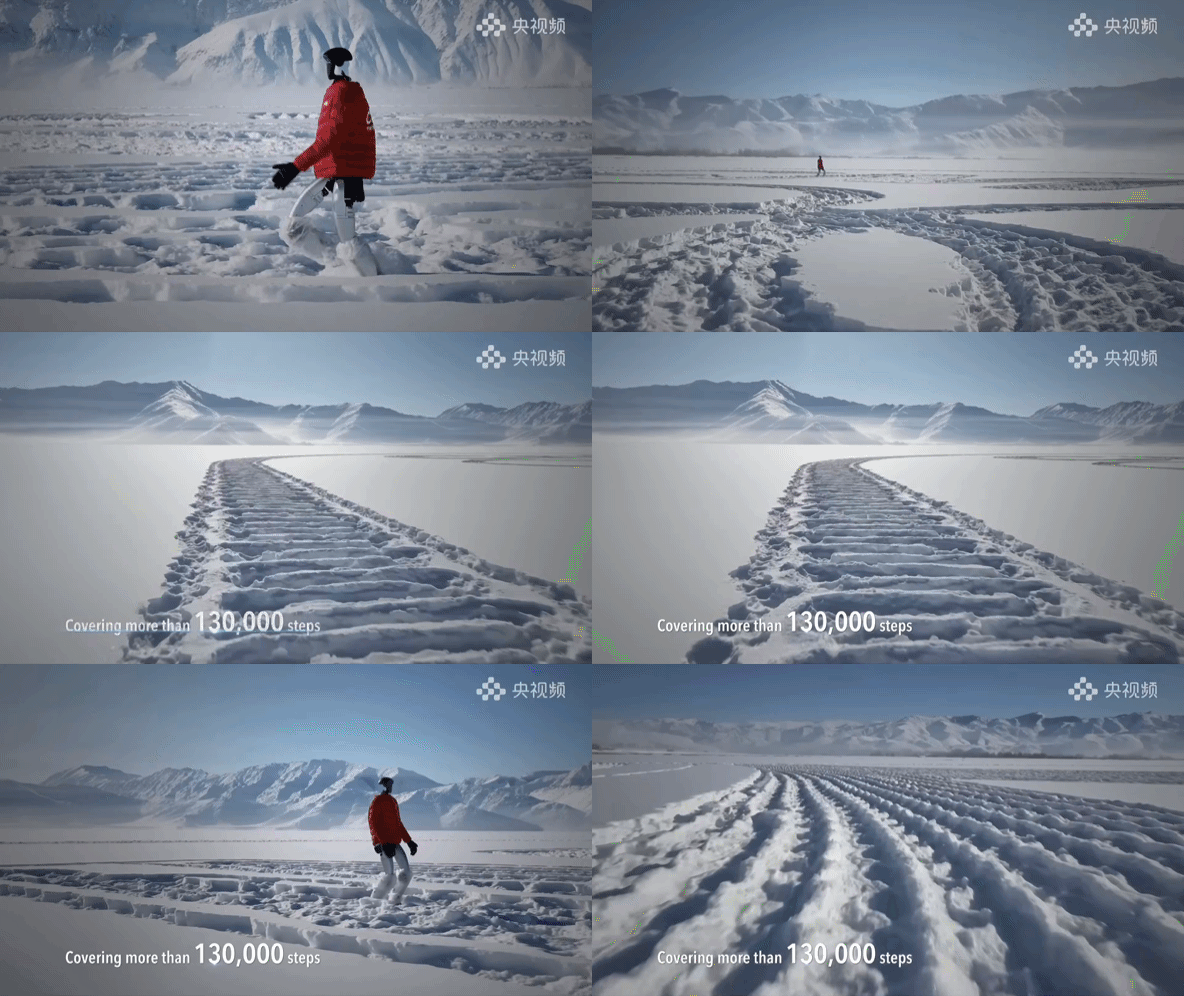
China's Unitree just sent its 4.2-foot-tall G1 humanoid on a record-setting trek across Xinjiang's snowfields, where temperatures bottomed out at -47.4°C (-53°F).
Bundled in an orange puffer and plastic booties, the 35-kilogram (77-pound) robot autonomously logged 130,000 steps while carving a giant China Media Group Winter Olympics broadcast emblem, marking the first confirmed cold-weather marathon by a bipedal bot. |
While the G1 braved the elements alone, Unitree hasn't said how many battery swaps its two-hour packs needed to finish the trek. The test relied on Beidou satellite positioning for centimeter-level accuracy and adaptive path-planning to keep the G1 upright on uneven snow.
Unitree says the stunt proves its workhorse can survive conditions far beyond typical lab demos, a key selling point as it eyes a mid-2026 IPO rumored to be worth roughly $7 billion.
Rivals tout -20°C (-4ºF) ratings, but Unitree pushed well past that limit, hinting at search-and-rescue or polar-site potential—provided you don't mind outfitting your robot in improvised ski-resort fashion. Looks like the future of robotics comes with a dress code: arctic chic. |
|
|
|
Writer at TechnologyAdvice |
Justin Meyers is an investigative writer and editor who draws on over a decade of meticulous hands-on research to deliver the full, trustworthy story behind consumer and enterprise tech, including cybersecurity. |
|
|
Curious about where AI is really headed? |
The Neuron cuts through the noise to bring you smart, hype-free takes on the latest AI trends, tools, and breakthroughs. Join 500,000+ professionals from top companies like Microsoft, Apple, Salesforce and more.
|
|
|
Advertise in Daily Tech Insider! Daily Tech Insider is a TechnologyAdvice business.
© 2026 TechnologyAdvice, LLC. All rights reserved. TechnologyAdvice, 3343 Perimeter Hill Dr., Suite 215, Nashville, TN 37211, USA. |
|
|
|