






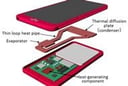

An innovative, thin heat pipe that’s less than 1 mm thick is being developed by Fujitsu to improve internal cooling in tomorrow’s smartphones, tablets, laptops and other compact electronic devices.
The low profile heat pipe, which fits inside a device and wicks heat away from heat-generating components that are inside is being developed by Fujitsu Laboratories, according to an April 14 report on Phys.org. Inside the heat pipe is a liquid that, when passing over the heat sources, turns into a vapor, which then turns back into a liquid as it is cooled, similar to the process used in air conditioning systems.
“Smartphones, tablets, and other similar mobile devices are increasingly multifunctional and fast,” the article stated. “These spec improvements, however, have increased heat generated from internal components, and the overheating of localized parts in devices has become problematic.”
To battle the worsening heat problems, Fujitsu’s thin heat pipe is capable of transferring approximately five times more heat than current thin heat pipes, the story reported, making it possible for CPUs and other heat-generating components to run cooler and to avoid concentrated hot-spots inside devices.
The heat pipe technology was detailed by Fujitsu at the Semiconductor Thermal Measurement, Modeling and Management Symposium 31 (SEMI-THERM 31) in March in San Jose, Calif. The idea of heat pipes are not new, but they continue to find new places where they can be featured, including this recent research by Fujitsu.
So what’s this mean for future smartphone, laptop, tablet and other mobile device owners?
Well, it could mean that the devices we buy in the future could run cooler, a feature that is important for reliability, battery life and longevity. And ultimately it could also mean increased comfort when holding a very warm mobile device in one’s hand.
Research like this again shows the amazing nature of innovation among scientists and researchers who are seemingly always finding ways to solve some of the continuing challenges that affect devices we use every day.
You certainly can’t put a big cooling fan inside a thin device like a smartphone or tablet, so new fixes have to use creative thought processes. Fans won’t fit? So what about a thin tube that circulates fluid which changes from liquid to vapor in a constant cycle, helping to remove heat and keep the device cooler? Very cool.
To me, this idea for thin loop heat pipe innovations is very fitting this week during the 45th anniversary of the Apollo 13 spaceflight, when NASA mission specialists helped bring the crew home safely after a critical oxygen tank exploded on the way to the moon in April 1970. Incredible thinking by NASA during that amazing mission brought astronauts James Lovell, Fred Haise and Jack Swigert back to Earth after a huge mishap.
Similar smart thinking around Fujitsu’s new heat pipe could help keep tomorrow’s mobile devices a lot cooler. And like the Apollo 13 wizardry that found a way to battle every obstacle during the mission, this is innovation at its finest.