






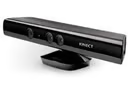

Soon after its release, intrepid hackers expanded on Kinect’s capabilities beyond the realm of video games. Now, health care technologists are using Microsoft’s sensor to improve the recovery rates of stroke victims.
Originally an add-on for the company’s Xbox 360 console, the Kinect camera and motion sensing device have proved popular among inventors, PC enthusiasts and startups as a low-cost way to bring the real world into computing environments, and vice versa. Jintronix, based in Montreal and Seattle, is using the technology to provide therapy at home.
Currently in closed beta, the company’s offering provides “an affordable motion-capture system for physical rehabilitation that uses Microsoft Kinect for Windows,” said Microsoft in a Jan. 22 Kinect for Windows Blog post. Installed at the patient’s home, the system improves the chances of restoring physical functions after a stroke by gamifying exercises.
Jintronix’s technology aims to help patients stick to their rehabilitation programs and remove the time, cost and distance barriers of making regular visits to clinics. “Jintronix tackles all of these issues by providing patients with fun, ‘gamified’ exercises that accelerate recovery and increase adherence,” noted Microsoft.
Beyond fun and games, “Jintronix gives patients immediate feedback, which ensures that they perform their movements correctly. This is critical when the patient is exercising at home,” added the company.
The system relies on motion capture data generated by the first-generation Kinect for Windows camera, eliminating the need to place physical sensors on a patient’s body. (The Xbox One system launched on Nov. 22 bundled with the second-generation Kinect.)
The data enables Jintronix “to track such metrics as the speed and fluidity of patients’ movement.” In addition, Jintronix “also records patients’ compensation patterns, such as leaning the trunk forward to reach an object instead of extending the arm normally.”
Kinect’s technology keeps costs in check. “Jintronix doesn’t require any extra hardware, cameras, or body sensors, which keeps the price affordable,” said Jintronix CEO Shawn Errunza. “That low price point is extremely important, as we want to see our system in the home of every patient who needs neurological and orthopedic rehab.”
Meanwhile, Microsoft Research Asia is pursuing a similar system called Stroke Recovery with Kinect. The project, a collaboration with Seoul National University, “provides a virtual reality system to help stroke survivors improve their upper-limb motor functioning in the comfort of their own home,” wrote Miran Lee, a senior manager for Microsoft Research Connections, in a separate blog post.
The organizations plan to add a social layer to the gamified experience. “Long-term plans for Stroke Recovery with Kinect include integrating social networking into the system so that stroke patients can connect with one another and participate jointly in the rehabilitative programs, building a sense of camaraderie that could offer emotional and psychological support and motivation,” informed Lee.