







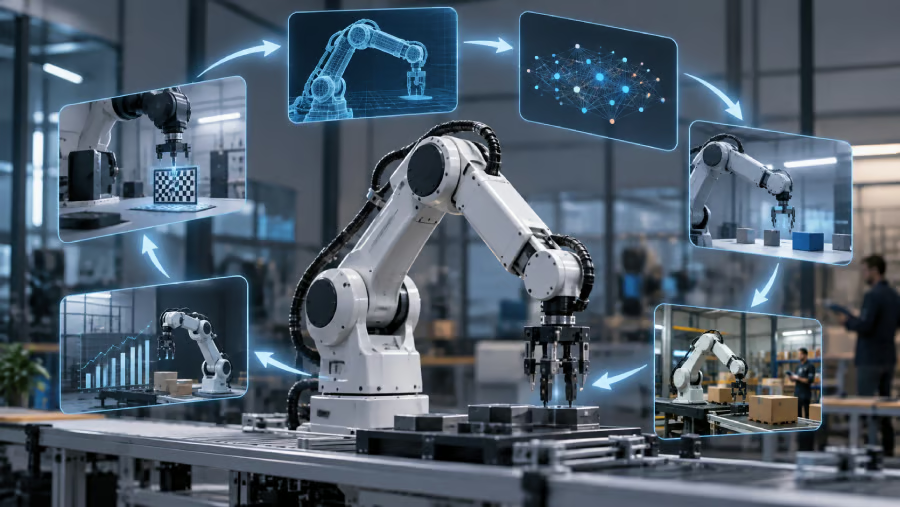
Robots can learn new tricks, but getting them ready for work is still a very human job. General Robotics wants GRID to change that.
The Nvidia-backed Redmond startup, founded by former Microsoft robotics researchers, has expanded GRID with an Auto Engineering system built to cover the robot development and deployment lifecycle, from onboarding hardware and importing AI models to simulation, skill creation, testing, and real-world evaluation.
The pitch is to cut work that can take days or weeks to hours, while reusing what GRID learns from each deployment to speed up the next robot or task.
How GRID turns robot development into a closed loop
General Robotics calls its approach “Auto Engineering.”
When GRID receives a task, the company said the platform determines which skills it needs, selects a mix of AI models and robotics techniques, and builds the simulation environment used to train and evaluate them. According to Business Wire, once the skill reaches real hardware, GRID monitors failures and performance and uses those results to decide what needs to change next.
GRID also uses knowledge graphs to retain information from earlier deployments. Robot configurations, completed tasks, imported models, calibrations, and failures become reusable knowledge rather than engineering work repeated for every project.
Forbes described four robotics “harnesses” within GRID covering robot configuration and calibration, simulation, skill creation, and real-world deployment and evaluation. In one company example, GRID watched a short video, recreated the motion in simulation, generated its own training data, trained the skill, and deployed it to a robot.
Why robot deployment still takes so much work
Much of that work has traditionally required specialized robotics engineers and custom integrations. General Robotics said the development stack remains fragmented, with different software tools, communications protocols, and programming approaches often needed for each robot and deployment.
CEO Ashish Kapoor told GeekWire that robot manufacturers can produce capable hardware but may lack the expertise needed to adapt it to a particular environment or task. “That last layer is missing,” he said.
Kapoor previously created Microsoft’s AirSim simulator, while co-founders Sai Vemprala and Shuhang Chen also came from Microsoft’s robotics team. Nvidia is an investor in General Robotics, and its Isaac Sim simulation software is built into GRID.
GeekWire reported that General Robotics has roughly a dozen customers across manufacturing, logistics, energy, and defense. The platform supports industrial arms, humanoids, quadrupeds, wheeled robots, and drones, giving the company a broad test for whether the same development system can work across different types of hardware.
What eWeek found
According to Robotics 24/7, General Robotics says GRID can reduce robot onboarding from about a month to as little as two hours. Importing a new AI model can fall from three days to as little as 20 minutes, while transferring a skill between different robot form factors can drop from three days to as little as 90 minutes.
Development task | Before GRID | With GRID |
| Robot onboarding | About 1 month | As little as 2 hours |
| Model ingestion | 3 days | As little as 20 minutes |
| Skill transfer across form factors | 3 days | As little as 1.5 hours |
| New skill creation and deployment | Not provided | As little as 2 days |
For companies trying to move robotics projects into production, those time savings could shorten the wait between choosing a robot and actually testing it on the job. Faster model ingestion could also let teams experiment with new AI capabilities without spending days on each integration.
Skill transfer could have an even wider effect as companies deploy different kinds of robots.
If work developed for one form factor can be adapted to another in 90 minutes instead of three days, teams could reuse more of what they have already built rather than repeating the same engineering process for every machine.
The figures also put General Robotics’ “entire lifecycle” claim into perspective. GRID may automate work across many stages of development, but not every stage becomes nearly instant. Creating and deploying a new skill can take as little as two days, and General Robotics did not provide a previous baseline for that task.
The results are also company-reported rather than independently benchmarked. If they hold across more robots, customers, and working environments, however, GRID could help address a persistent problem in robotics: getting capable machines out of pilots and into repeatable production use.
For another example of robotics moving into real-world applications, read how Philips is using $33.7 million in funding to develop autonomous robots for stroke treatment.