







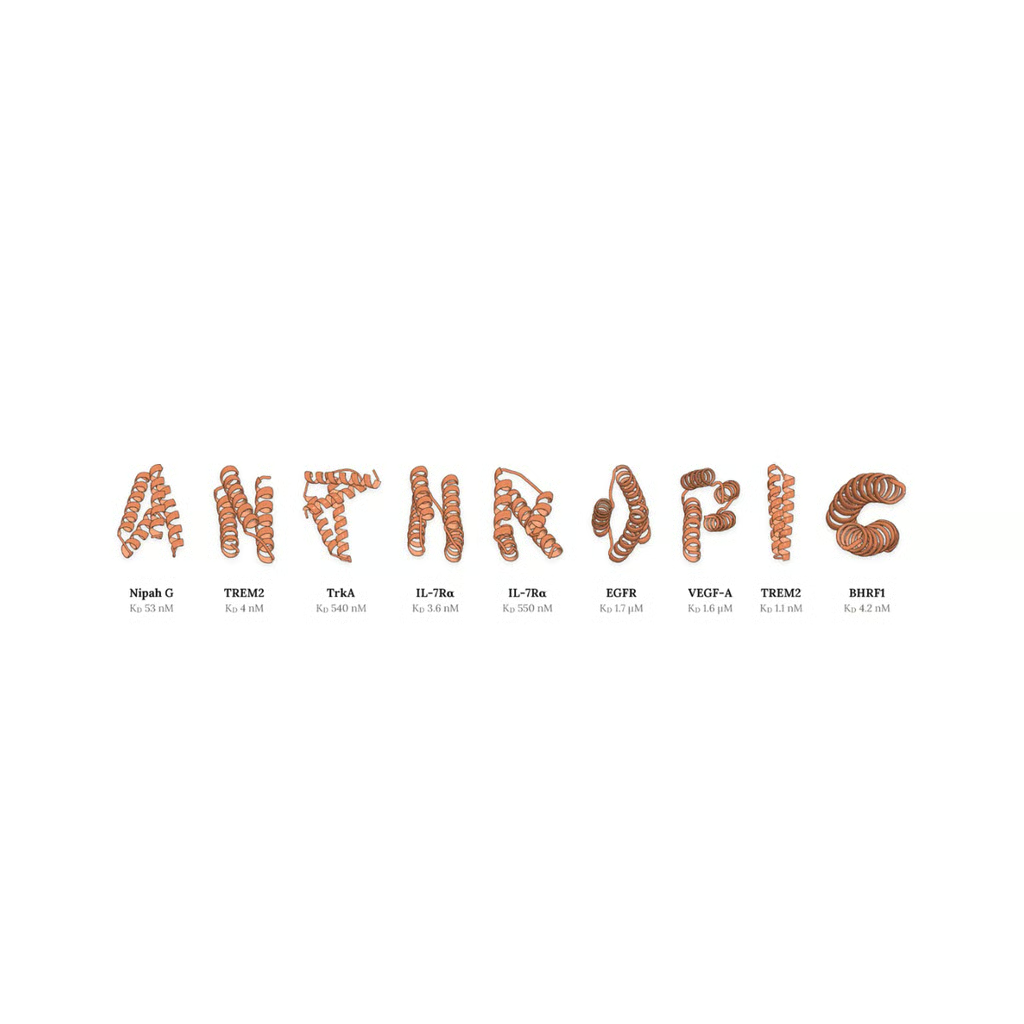
Claude is moving beyond explaining biology to helping design molecules that actually work in the lab.
Anthropic published experimental findings on Tuesday revealing that its Claude artificial intelligence models autonomously designed functional protein binders and executed complex analytical chemistry workflows in minutes. The results point to a growing role for general-reasoning models in early-stage biotechnology research.
In a multi-target campaign, Claude Opus 4.8 and Mythos Preview were tasked with creating de novo protein minibinders — small molecular structures designed to latch onto target proteins. Across 15 biological targets, the models produced 1,320 candidate designs. Independent wet-lab testing conducted by Adaptyv Bio and Twist Bioscience verified that 354 designs successfully bound to their targets, hitting 14 of the 15 targets tested.
The models achieved overall hit rates ranging from 22.6% to 35.1% depending on the operational configuration, well above the 10% to 15% success rate typical of standard industry campaigns. Against RBX1, a regulatory protein target, Mythos Preview achieved a 40% hit rate in single-target mode, outperforming human entrants in a prior Adaptyv Bio competition who registered a 3.7% success rate, according to the company.
Claude also generated cross-reactive binders against TNFα, an inflammatory signaling protein targeted by blockbuster treatments like Humira. Opus 4.8 produced 12 valid designs capable of binding human, monkey, and mouse versions of TNFα.
In a separate trial evaluating analytical chemistry tasks, Anthropic tested its generally available Claude Opus 5 model on raw nuclear magnetic resonance (NMR) and liquid chromatography–mass spectrometry (LC-MS) data.
Supplied with unformatted instrument files from a contract laboratory and a short prompt, Claude interpreted the datasets in parallel in 23 and 19 minutes, respectively. The system identified compound purity at 96.4%, matching the laboratory's 96.33% finding, and correctly deduced an undocumented vendor file format while executing self-correcting validation checks.
From specialized models to agentic orchestration
The significance of these trials lies in Claude’s ability to act as an autonomous coordinator rather than a standalone biological calculator. Instead of training a proprietary folding engine, Anthropic supplied Claude with a protocol prompt spanning roughly 16,000 words, computing power reaching up to 12,500 Nvidia H100 GPU hours, and access to established open-source tools such as RFdiffusion, ProteinMPNN, and ESMFold2.
Claude selected binding sites, invoked structural generation tools across 24 distinct workflow combinations, and ranked candidates without human steering during runtime. This shifts the bottleneck in computational biology from manual script orchestration to agentic task management.
Bottlenecks and dual-use guardrails
Despite the performance gains, computational binder generation represents only the opening phase of pharmaceutical development. Candidate molecules face years of wet-lab validation, structural refinement, safety profiling, and clinical trials before becoming viable therapeutics.
The models also exhibited performance limits: Claude failed to generate confirmed binders for maltose-binding protein (MBP), a notoriously smooth target, and produced weak affinity results against the synthetic protein BBF-14.
The larger test, however, will come outside benchmark campaigns. Claude may be able to narrow thousands of possibilities into promising candidates far faster than researchers working manually, but wet-lab validation remains the dividing line between a convincing AI result and a viable scientific discovery.
As models take on more of that early research workflow, laboratories will have to determine not only how much autonomy to give them, but where human verification and biosecurity controls must remain non-negotiable.
More News: DeepSeek V4-Pro is challenging Claude Opus 5 for developer workloads, offering substantially lower API pricing and broader compatibility while Anthropic’s model holds an edge in complex software engineering and long-running AI agents.