







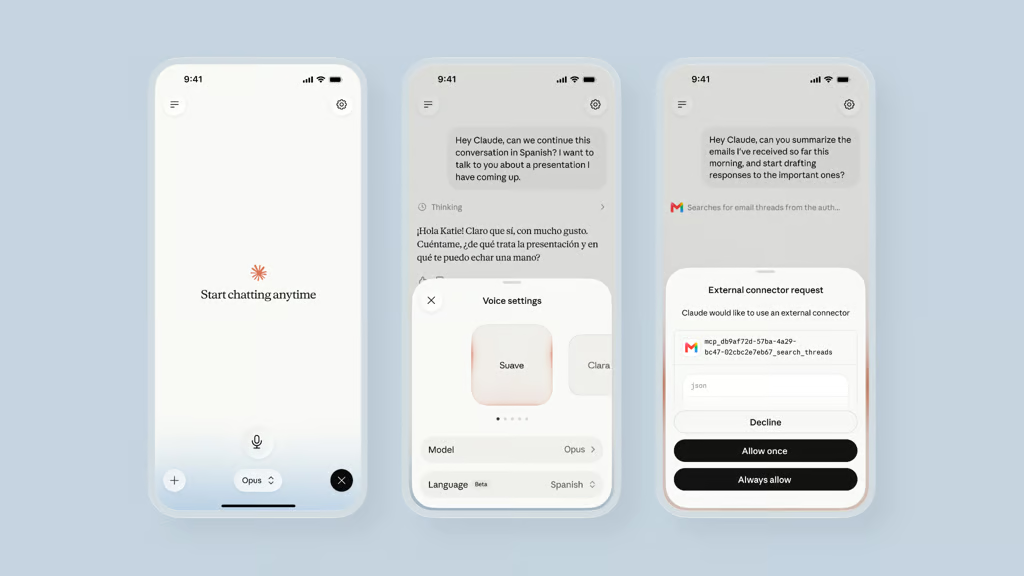
Claude can now think as hard out loud as it does on the page.
Anthropic has upgraded Claude's voice mode with its more capable Opus and Sonnet models, giving users deeper conversations, access to connected workplace tools, and broader language support as competition in AI voice assistants continues to heat up.
The update replaces Claude's earlier voice experience, which relied only on the lightweight Haiku model for fast responses. While Haiku prioritized speed, Anthropic said users increasingly began relying on voice mode for longer, more complex discussions that required stronger reasoning.
"Voice mode is for practicing for an important pitch meeting, deciding between multiple offers, reviewing your own process out loud, or brainstorming new ideas," Anthropic said in a blog post.
With the update, voice mode now supports Claude Opus, Sonnet, and Haiku. Users can switch models during an ongoing conversation, while voice mode automatically starts with the same model they last used in text chat.
Anthropic said the more capable models are designed to ask follow-up questions and help users think through problems instead of simply returning answers. Voice conversations remain turn-based, meaning Claude listens, pauses to process, and then responds.
The company also expanded voice mode beyond conversation by allowing it to work with connected services such as Gmail, Google Calendar, Google Docs, Slack, and Canva. Users can ask Claude to summarize emails, draft replies, reschedule meetings, or create documents using those connected apps after granting permission.
The feature is available in beta across mobile, desktop, and web. Free users can access Haiku, one connected tool, and all supported languages, while paid subscribers gain access to Opus, Sonnet, and multiple connected tools.
More languages, but with one limitation
Anthropic also expanded multilingual support in voice mode. Users can now speak with Claude in English, French, German, Hindi, Indonesian, Italian, Japanese, Korean, Brazilian Portuguese, and both Latin American and Spanish.
However, Claude does not automatically detect language changes. Users must either select their preferred language in settings or ask Claude to switch languages during the conversation. The company said voice mode allows users to move between voice and text within the same conversation without losing context.
A different direction from OpenAI
The latest release arrives just weeks after OpenAI refreshed ChatGPT's voice capabilities with more conversational models.
Unlike OpenAI's approach, Anthropic is emphasizing productivity over making conversations sound more human. While ChatGPT's latest voice experience focuses on more natural interactions, Claude's update centers on stronger reasoning and the ability to complete tasks through connected apps.
The update reflects a growing split in how AI companies are evolving voice assistants.
OpenAI has largely emphasized making conversations feel more natural, while Anthropic is betting that users will value assistants that can think through complex problems and complete tasks across workplace apps.
For professionals, that could make voice interactions more practical for daily work instead of serving mainly as a hands-free way to chat. The tradeoff, however, is that Claude's conversations may feel less fluid than competitors that prioritize natural speech and interruption handling.
As AI assistants become more integrated into productivity software, the ability to move from conversation to action may prove just as important as sounding human.
Also read: Google is testing Gmail Live voice search on Android and iOS, allowing select US users to ask Gemini spoken questions about their inboxes.