







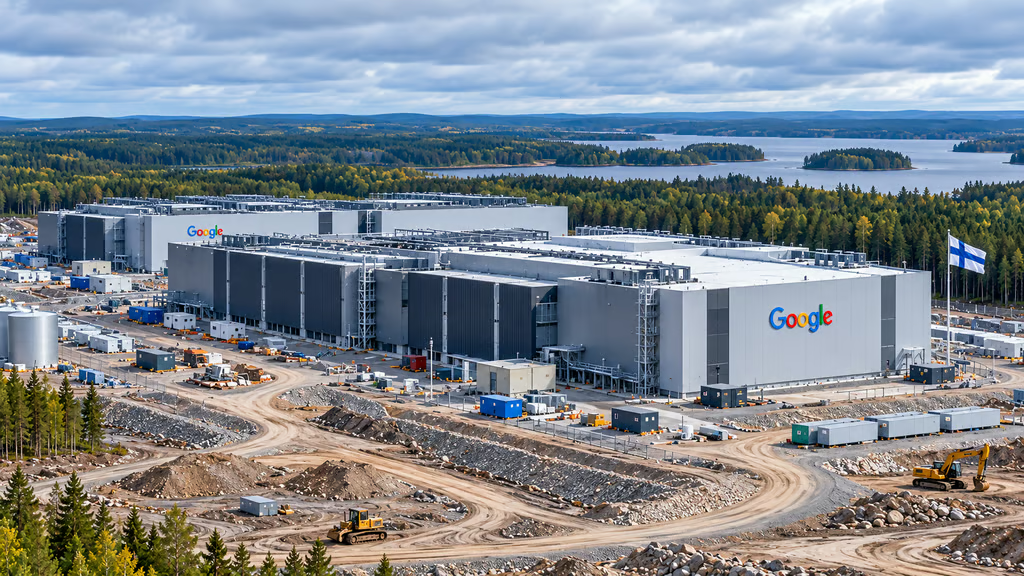
Google’s €13 billion (approximately $15.1 billion) bet on Finland has hit an early snag. Finnish authorities have called for environmentally significant preparatory work to stop at two planned data center sites while required environmental impact assessments remain unfinished.
The pause affects projects in Muhos and Kajaani, both part of Google’s Finland expansion through 2028. The setback matters beyond two construction sites because Finland is becoming one of Europe’s most sought-after locations for AI and cloud infrastructure, putting the dispute in the middle of a wider race for land, power, and permitting capacity.
Finland orders high-impact work stopped at two sites
Finland’s Licensing and Supervision Authority called on Tuike Finland Oy, the company behind Google’s projects, to suspend preparatory measures that significantly change the environment immediately, and no later than Oct. 23.
The Guardian reported that 330 hectares of forest had been felled in Muhos and that logging covered just under 200 hectares in Kajaani while environmental impact assessments were still underway. The regulator said the environmental impact assessment reports are expected to be completed during 2026.
The suspension notice does not cover all work. According to CNBC, planning, measurements, soil surveys, and other minor or easily reversible work may continue. Google said it had “fallen short of our own high standards” and would follow the authority’s guidance, while also saying it acted in good faith under Finland’s Forestry Act and had carried out nature surveys.
Finland’s data center appeal now comes with a permitting test
Finland has attracted data center developers partly because its cool climate can reduce cooling needs and its electricity mix offers low-carbon power. Google’s wider plan includes new facilities in Vaala and investment in its existing Hamina site. It also signed a 22-year power purchase agreement with Fortum covering up to half the capacity of the Loviisa nuclear power plant.
The BBC said that Google expects construction in 2027 and 2028 to support more than 37,000 jobs and contribute an average of €3.6 billion (approximately $4.2 billion) a year to Finland’s economy. That scale helps explain why the regulatory dispute matters beyond Google. Finland is betting on data centers as a source of investment and infrastructure growth, while hyperscalers look for new European capacity.
CNBC described land and power as increasingly scarce across much of Europe, which helps explain why Finland has become such an attractive option. The latest halt shows that access to both does not guarantee a smooth buildout. Environmental review and local permitting can still determine how quickly planned AI and cloud capacity moves from site preparation to construction.
What eWeek found
Issue | Current status | Why it matters |
|---|---|---|
Environmental review | EIAs remain unfinished at Muhos and Kajaani | High-impact site work must pause while the reviews continue |
Project scope | Google’s €13 billion (approximately $15.1 billion) Finland plan also covers Vaala and Hamina | The roadblock affects part of a wider Finnish buildout, not the entire investment |
Work still allowed | Planning, measurements, soil surveys, and minor reversible work can continue | The order is a partial halt rather than a project cancellation |
Google’s September investment announcement presented Finland as a model for responsible data center development. The October suspension notice exposes a gap between that framing and site preparation at Muhos and Kajaani. For enterprises evaluating future cloud and AI capacity, the practical takeaway is to assess environmental review and permitting progress separately from announced investment and power agreements.
For enterprises planning around additional data center capacity in Europe, the unresolved question is whether the suspension will change delivery timelines.
Tuike Finland must provide its explanation to regulators by Oct. 14, and significant preparatory work must stop by Oct. 23. The next steps are Tuike Finland’s response and completion of the assessment reports; the notice does not establish whether Google’s overall 2027–2028 investment schedule will change.
Also read: For more on who pays for the power behind the data center boom, Google, Meta, and Microsoft have backed a pledge to cover the full energy costs of their facilities.