







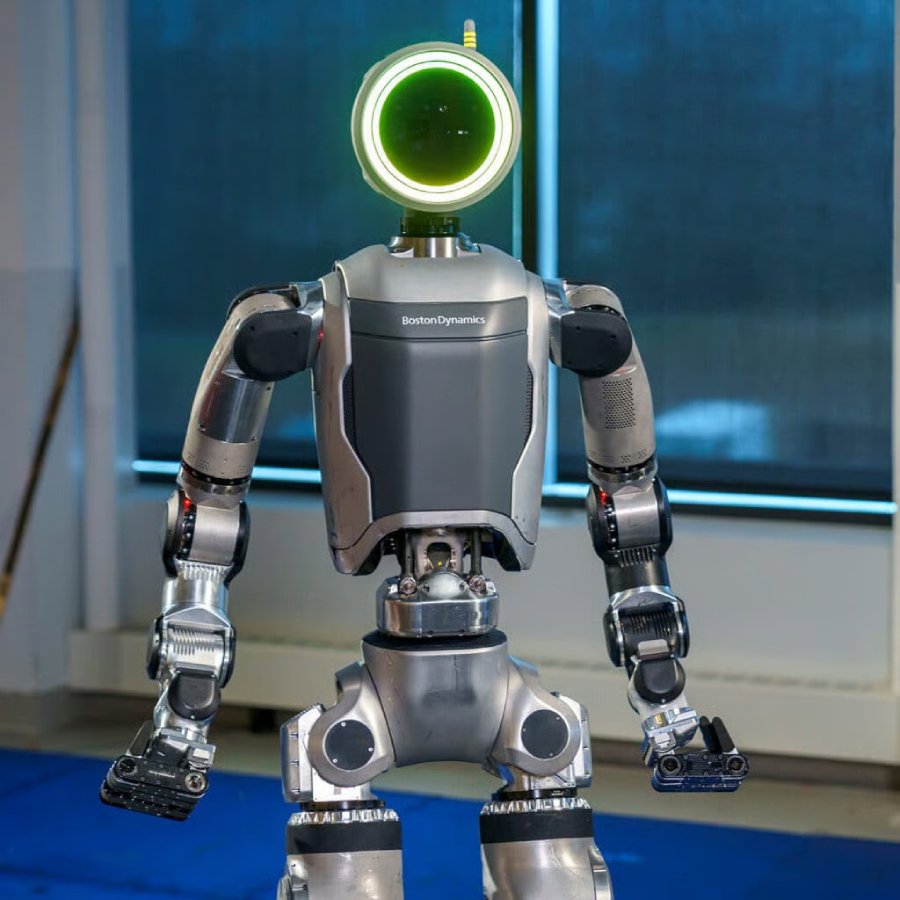
Atlas is heading to the chip factory. First, someone has to figure out its job.
Semiconductor manufacturer GlobalFoundries plans to begin on-site tests of Boston Dynamics’ humanoid robot in early 2027, becoming its first customer outside the automotive industry to trial Atlas. Meanwhile, the companies are expanding the use of Spot, the four-legged inspection robot, across manufacturing sites in the US, Germany, and Singapore.
Spot already has tens of thousands of inspections under its belt. Atlas has a harder assignment: proving a humanoid can find useful work inside a semiconductor facility.
"This expansion is a testament to the operational maturity mobile robots have reached,” a Boston Dynamics spokesperson told eWeek. “Spot has already transformed how GlobalFoundries monitors and maintains its plants, but the long-term impact of this partnership is the leap from automated inspection to automated physical work.
The spokesperson added, “Being the first semiconductor manufacturer to test Atlas means GlobalFoundries is writing the playbook for how humanoid robots will eventually handle complex tasks, ensuring the future of chip manufacturing is safer, more predictive, and highly resilient.”
Atlas needs a job description, not another demonstration
The GlobalFoundries program will evaluate potential tasks, facility readiness, and integration needs before developing application-specific skills, according to the companies’ Nov. 17 announcement. It is not an announcement that humanoids are already making chips.
That makes this a different milestone from the Atlas factory testing at Hyundai that eWEEK previously covered. The question is no longer just whether the robot can enter a working industrial facility, but whether its capabilities translate to another industry.
Boston Dynamics’ Atlas product page describes a material-handling robot that can replace its battery and connect to manufacturing and warehouse management systems via its Orbit software. The company lists part sequencing, machine tending, and order building among applications it intends to develop with selected customers.
Those are broader product ambitions, not confirmed GlobalFoundries assignments.
For those following the mini-fridge lifting experiment, the next question worth watching is: Can a learned movement become a repeatable workplace process?
A useful trial should establish more than whether Atlas completes a task once. It should show how frequently people intervene, what happens when something goes wrong, and whether the robot fits the existing workflow without creating more work elsewhere.
Spot shows why chipmakers want mobile robots
The less human-looking robot has the more concrete track record here.
The companies report that two Spot robots in Singapore completed more than 90,000 inspections since April, with a 99% mission success rate. Those are company-reported operational figures, not independently audited results or an Atlas performance benchmark.
An earlier GlobalFoundries case study explains the practical appeal. The manufacturer wanted information from equipment spread throughout a large facility without installing a fixed sensor at every inspection point.
Spot instead carried sensors to the machinery. The project used thermal observations and analog gauge readings to monitor equipment such as pumps, motors, and compressed-gas systems. Boston Dynamics partner Levatas supplied computer-vision capabilities to interpret those observations.
That is a more specific proposition than “AI-powered manufacturing”: Collect useful equipment data where the equipment already sits.
It also illustrates why the right robot need not resemble a person. eWEEK’s coverage of Stretch Gen 2 examines another task-focused approach, trailer unloading, rather than treating a humanoid body as the starting requirement.
For an operator, the useful comparison is between ways of completing the job, not between how impressive the machines look.
What eWEEK found: The meaningful result will be a repeatable task
The announcement separates current operations from future testing:
Question | What is established | What readers should not assume |
| When does Atlas testing begin? | Early 2027 | A production rollout has started |
| Where will Spot expand? | Malta, New York; Burlington, Vermont; Dresden; Singapore | Atlas will operate at every listed location |
| What do the Singapore figures measure? | Spot inspection missions | Humanoid reliability or chip-production gains |
| What remains undisclosed? | Atlas tasks, fleet size, pricing, and production timetable | A large-scale purchase commitment |
For businesses considering humanoids, the useful lesson is to define the job before judging the robot.
An evaluation should compare the proposed system with the current process, count the human attention it requires, and include integration and maintenance costs. Success should mean a measurable improvement in the work, not merely a technically successful demonstration.
Atlas’s next milestone is therefore less photogenic than a new movement: a named task, performed reliably, with evidence that deploying the robot makes operational sense.
Related reading: See how Google and Boston Dynamics are developing Spot’s reasoning capabilities.