







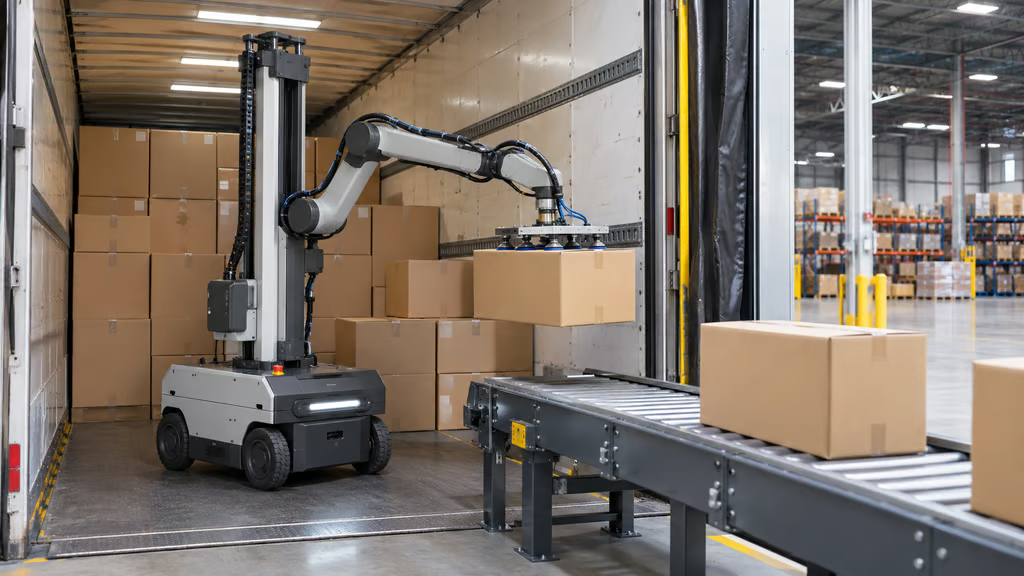
Unloading delivery trucks is repetitive work, and Boston Dynamics wants its latest robot to handle more of it with fewer maintenance headaches.
Boston Dynamics unveiled Stretch Gen 2 on Nov. 3, introducing an upgraded trailer-unloading robot that the company says can handle up to 1,000 cases per hour. The company also reports an 81% reduction in internal cabling, with the redesign informed by more than 100,000 operating hours. For warehouse operators, the redesign could simplify maintenance and support more consistent unloading, although the announcement provides no independent Gen 2 reliability or productivity results. The biggest test will be whether the robot can maintain its performance across different loads, long shifts, and routine servicing.
Stretch Gen 2 focuses on speed and easier maintenance
In its Nov. 3 announcement, Boston Dynamics said it examined more than 100,000 operating hours to investigate causes of unplanned downtime.
Internal cabling is down 81%, while new connectors and a redesigned gripper target faults and handling problems. The company says a full swerve-drive swap now takes about an hour rather than a full day. New onboard diagnostics are meant to help customer maintenance teams perform routine servicing. The announcement does not quantify the reduction in overall downtime.
Warehouse productivity depends on more than unloading speed
The claimed maximum of 1,000 cases per hour depends on carton weight and stacking conditions. Mixed shipments and conveyor capacity can affect throughput. Boston Dynamics also says the battery lasts two shifts and reaches 90% charge in about 75 minutes with a fast charger, figures buyers should test against their schedules.
For context, Automated Warehouse reported that Lidl's trials of the earlier Stretch regularly exceeded 500 cartons per hour and reached 600. Lidl valued the predictable output for logistics planning. Those results concern the earlier model.
While Boston Dynamics’ Atlas and Meta’s reported humanoid prototype pursue broader physical capabilities, Stretch Gen 2 focuses on trailer unloading. That narrower role gives warehouse operators a defined task against which to measure its performance.
What eWEEK found: Peak speed doesn't guarantee warehouse savings
Boston Dynamics’ specifications describe Stretch Gen 2’s unloading capacity and hardware changes, but they don’t establish how much a warehouse could save. Comparing the company's claims with earlier customer testing helps identify which benefits have supporting evidence and which still need to be demonstrated.
Performance area | Available evidence | What it means for warehouse operators |
|---|---|---|
| Unloading speed | Gen 2 can reportedly handle up to 1,000 cases per hour. Lidl's earlier Stretch trials regularly exceeded 500 cartons per hour and reached 600. | The figures involve different robot generations and operating conditions. Comparable full-shift testing is needed to establish Gen 2's productivity gains. |
| Maintenance | Boston Dynamics reports 81% less internal cabling and a full swerve-drive swap taking about an hour rather than a full day. | Repairs could become easier and faster, but reductions in overall downtime and maintenance costs have yet to be established. |
| Reliability | More than 100,000 operating hours from earlier deployments informed the redesign. | The operating experience helped identify areas for improvement but does not establish Gen 2's long-term reliability or expected service life. |
Lidl’s earlier testing provides useful context for Stretch’s performance, but those results cannot establish how Gen 2 will perform under similar conditions.
For warehouse operators, consistent output with fewer maintenance interruptions could be more valuable than maximum unloading speed. The strongest case for investing in Stretch Gen 2 will depend on measurable improvements in productivity, reliability, and total operating costs.
The real warehouse test is a full shift, not a speed record
As with Xiaomi’s humanoid robot factory trials, the business question extends beyond whether a robot can complete a task to whether it can do so consistently and economically. A robot capable of handling up to 1,000 cases per hour could help reduce unloading bottlenecks, but the financial benefits will depend on how consistently it performs and whether the facility can make effective use of its capacity.
Before committing to deployment, logistics and operations teams should evaluate three areas:
- Sustained productivity: Test the robot across complete shifts using different carton sizes, weights, and stacking patterns. Track average unloading rates, interruptions, and the number of packages requiring manual handling.
Compare those results with existing unloading operations to determine whether the robot improves overall throughput rather than simply achieving a higher peak speed.
- Maintenance and operating costs: Measure equipment downtime, repair frequency, technician hours, and replacement-part expenses. Boston Dynamics' redesigned hardware could simplify maintenance, but operators should confirm whether those improvements reduce servicing costs and lost production time.
Service agreements, spare-parts availability, and battery charging requirements should also factor into ownership costs.
- Facility integration and workforce planning: Evaluate whether conveyors, sorting equipment, and loading schedules can accommodate the robot's output.
Operations teams should also identify which tasks still require employees, establish procedures for handling irregular packages, and determine what training workers need to operate alongside the system safely.
A faster unloading process will offer limited value if downstream equipment cannot keep pace or frequent interventions interrupt operations. Warehouse buyers should therefore calculate the cost per case unloaded, factoring in equipment expenses, maintenance, staffing, and integration costs.
Stretch Gen 2’s redesigned hardware targets easier servicing and more reliable operation, but its commercial value will depend on measurable results. For logistics companies, the strongest case for adoption will come from consistent throughput, fewer operational interruptions, and lower total costs under everyday warehouse conditions.
Read more: Stretch’s unloading role offers one route to warehouse automation. Explore how Tesla, Figure AI, and Agility are progressing toward humanoid robot deployment and which operating results businesses should watch before investing.