







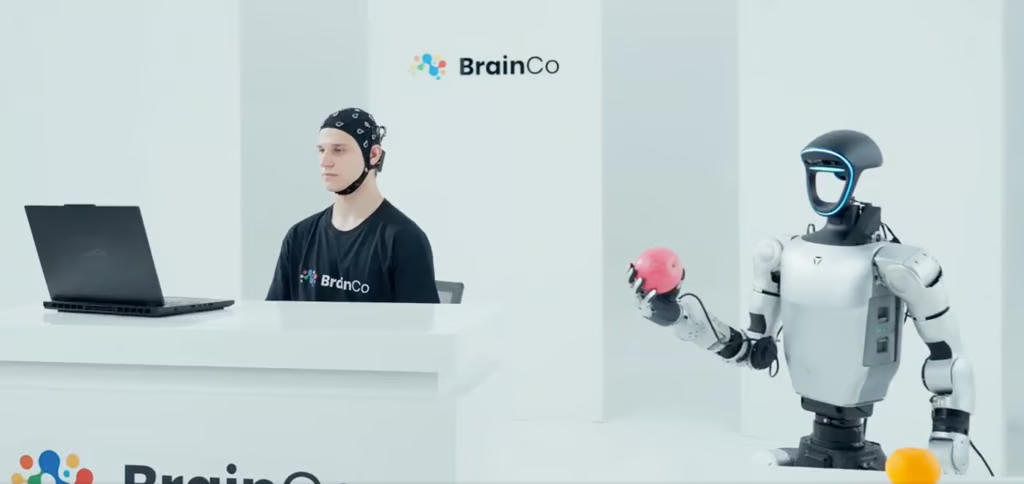
Chinese brain-computer interface company BrainCo has unveiled a brain-to-robot platform that it describes as the world's first integrated system for controlling robots using neural signals captured from a non-invasive EEG headset.
The company demonstrated the Brain-Controlled Robot AI Platform at the 2026 World Artificial Intelligence Conference (WAIC) in Shanghai, where a user wearing a lightweight headset controlled a robotic arm with their thoughts alone. The system detected brain activity, used AI algorithms to identify the user’s intended action, and converted that intention into commands for the robot.
BrainCo said the full process takes less than 200 milliseconds. During demonstrations, the robotic arm completed tasks such as grabbing a cup and picking up an apple. According to the company, the platform is also designed to work with different types of robotic hardware, including humanoid robots, robotic arms, and four-legged robotic dogs.
BrainCo’s approach relies on non-invasive brain-computer interface technology. Unlike systems that require implanted devices, the company uses EEG headsets that collect electrical signals from the brain through sensors placed on the scalp.
Beyond control: solving robotics’ data problem
While mind-controlled robots attracted attention at WAIC, BrainCo is also targeting a deeper challenge facing the robotics industry: the lack of high-quality training data.
Modern robots can perform increasingly complex movements, but teaching them how humans complete everyday tasks remains difficult. Robots need large amounts of real-world examples to learn skills such as handling fragile objects, assembling parts, or performing household activities.
BrainCo introduced an Embodied AI Data Collection Solution designed to gather this information. The system combines robot execution data, human demonstrations, virtual simulations, and EEG signals that capture the operator’s intent. By recording both movement and brain activity, BrainCo believes robots could gain richer training information about not only what humans do, but why they do it.
A new race for human-machine interaction
Founded in 2015, BrainCo has focused on brain-computer interfaces and rehabilitation technologies before expanding into robotics.
“A decade of BCI research has given us the ability to decode what a person intends to do and translate that into machine action,” said Nyx He, partner and senior vice president at BrainCo.
The launch comes as companies in China and the United States invest heavily in embodied AI — a field focused on building machines that can understand and interact with the physical world. Other technology companies are pursuing advanced robotics through AI models, sensors, and autonomous systems while BrainCo’s strategy takes a different path by adding a direct human input layer between people and machines.
The road ahead is still challenging
Although the demonstration highlights a possible future for robotics, the technology still faces major hurdles before it becomes widely used.
BrainCo has not released detailed performance data showing how well the system works across different users and real-world conditions. Non-invasive EEG systems generally capture weaker and noisier signals than implanted brain interfaces, making accuracy and reliability important challenges.
The company’s biggest opportunity may not be replacing traditional robot controls but improving collaboration between humans and machines. If brain-based interfaces become more reliable, they could help robots learn faster, assist people with disabilities, and make complex machines easier to operate.
For now, BrainCo’s platform represents an early step toward a future where communicating with robots may involve fewer physical controls and more direct interaction between human intent and machine action.
Related Reading: Humanoid robots are also making strides in healthcare, recently reaching a key preclinical surgery milestone.