







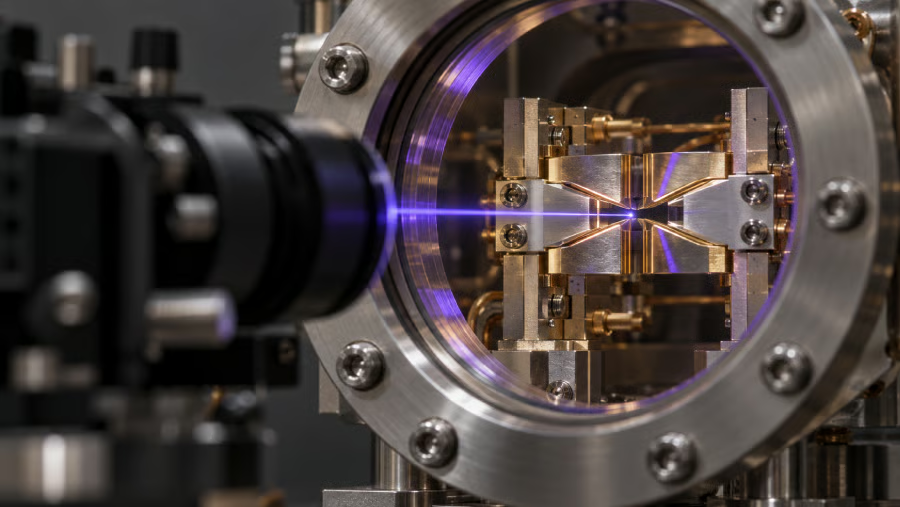
Three quantum hardware platforms have simulated versions of string breaking, a process in which energy stored between confined particles produces new particle pairs. Duke University researchers added the latest result in Nature Physics on Sept 23.
Duke's team used 13 trapped ions to watch the process unfold, according to the university. Google and QuEra Computing recreated it on superconducting and neutral-atom hardware. The studies investigate related physics using different models, rather than reproducing an identical experiment. Duke checked its result against classical calculations, so its study does not establish quantum advantage.
For enterprise teams evaluating quantum pilots, the distinction matters: demonstrating a physics model does not establish that a platform can outperform classical computing on their intended workload.
What Is String Breaking?
String breaking can occur when confined particles, such as a quark and an antiquark, are pulled apart. The field between them acts like a string. Stretch it far enough, and the stored energy becomes a new particle pair, which splits the string in two.
Duke's trapped-ion quantum computer ran the test on 13 ytterbium-171 ions in a line. Charge pairs formed near the string's edges before spreading inward, a pattern the paper calls "edge-facilitated" breaking.
Christopher Monroe, a Duke professor of electrical and computer engineering and physics, directed the study. Arinjoy De, the paper’s first-listed author and a former PhD student in Monroe’s lab, is now production machine lead at QuEra.
How the Three Experiments Compare
Metric / Dimension | Duke University / Maryland | Google Quantum AI | QuEra / Harvard / Innsbruck |
| Core Architecture | Trapped ions (ytterbium-171) | Superconducting circuits | Neutral atoms (Rydberg arrays) |
| Hardware Grid | 13-ion linear 1D chain | 45-qubit grid on 72-qubit Sycamore chip | Programmable 2D Rydberg atom array |
| Simulated Geometry | 1D lattice gauge theory | 2D lattice gauge theory | 2D lattice gauge theory with dynamical matter |
| Publication Date | Nature Physics (Sept. 23, 2026) | Nature (June 4, 2025) | Nature (June 4, 2025) |
The experiments differ in more than hardware. Platform tradeoffs are covered in the comparison of trapped-ion, superconducting, and photonic systems.
Why This Is Not Quantum Advantage Yet
Duke says classical computers can still handle quantum simulation at this scale. The experiment used a finite 13-spin system. The paper says conventional Schwinger pair creation was too strongly suppressed to observe within the experiment’s accessible timescales.
Scaling remains a challenge, but larger hardware announcements do not establish performance on this workload. IonQ’s announced Superion 256 platform has customer deliveries planned for 2027; Duke’s study does not test string breaking at that scale.
What eWeek Found: These Experiments Do Not Rank Quantum Platforms
The three studies investigate related string-breaking physics using different models and experimental protocols. They cannot establish which hardware architecture performs best.
Other research targets different barriers. The Chalmers-led proposal for faster bosonic-code operations addresses control overhead, but remains theoretical and has not been demonstrated in these string-breaking experiments.
For enterprise buyers, the takeaway is to ask for results on the intended workload: accuracy, runtime, resource requirements, and a comparison with strong classical methods. Qubit counts and physics demonstrations alone do not establish a business advantage.