








Samsung Research has developed a health AI model small enough to run entirely on smartwatch-class hardware, opening a path toward more biometric analysis directly on future wearables. Called HiMAE, the model achieves inference in less than a millisecond on smartwatch-class processors, according to the researchers.
Samsung has not announced HiMAE as a consumer Galaxy Watch feature or said its current Samsung Health tools use the model. Its ability to run locally nevertheless shows that advanced health-data analysis does not necessarily require every calculation to be sent to a phone or remote server.
Small models bring more AI to the wrist
HiMAE, short for Hierarchical Masked Autoencoder, analyzes wearable health signals at different time scales. In its published HiMAE research, Samsung Research reports that the model outperformed larger comparison models across multiple benchmarks while remaining compact enough for on-device inference. The work was accepted at ICLR 2026.
Samsung is also developing a model called xMAE, accepted at ICML 2026. During training, xMAE uses synchronized electrocardiogram, or ECG, and photoplethysmography, or PPG, signals to learn relationships between cardiac electrical activity and optical pulse data collected by wearables.
After training, the ECG branch can be removed and the PPG encoder used for health-related tasks. Researchers reported that xMAE outperformed comparison models on 15 of 19 evaluated tasks, including cardiovascular outcome prediction and sleep staging.
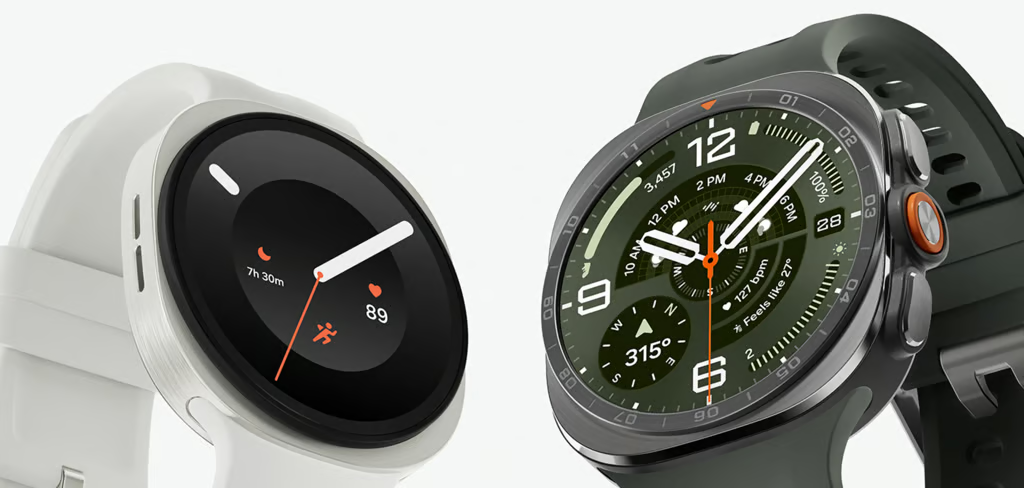
The work comes as Samsung expands health features across the Galaxy Watch9 and Galaxy Watch Ultra2, announced July 22. Some capabilities also run on older hardware, making which health features actually require a Watch9 relevant for owners weighing an upgrade. Samsung has not connected those commercial features to HiMAE or xMAE.
Existing sensors could do more
Local health AI could reduce network dependence and latency for future features while allowing more analysis to occur on the wearable itself. Samsung has not disclosed how a commercial HiMAE implementation would divide processing among the watch, phone and cloud, so privacy or battery-life benefits should not be assumed.
Samsung is already moving toward more software-based interpretation through its Health Assistant beta, which uses Samsung Health and wearable data to provide personalized wellness guidance. A similar shift is visible in AI-assisted smartwatch glucose tracking, where software can add context to readings collected by external continuous glucose monitors.
xMAE could likewise extract more information from optical signals watches already collect. Samsung Research notes that it uses ECG only during training; it does not turn PPG into continuous ECG measurement.
For organizations deploying wearables at scale, on-device inference could reduce dependence on continuous connectivity and change how architects evaluate latency and the movement of sensitive biometric data. Those benefits remain theoretical for HiMAE until Samsung documents a commercial implementation.
Samsung has not identified Galaxy Watch models that could receive HiMAE-based features, provided a rollout date or disclosed continuous-inference battery demands. Until it does, HiMAE remains a research demonstration rather than a Galaxy Watch buying feature.
Read more: Samsung is also testing other ways to extract earlier warnings from wearable signals: a separate Galaxy Watch AI study predicted fainting up to five minutes in advance, although that capability also remains experimental.